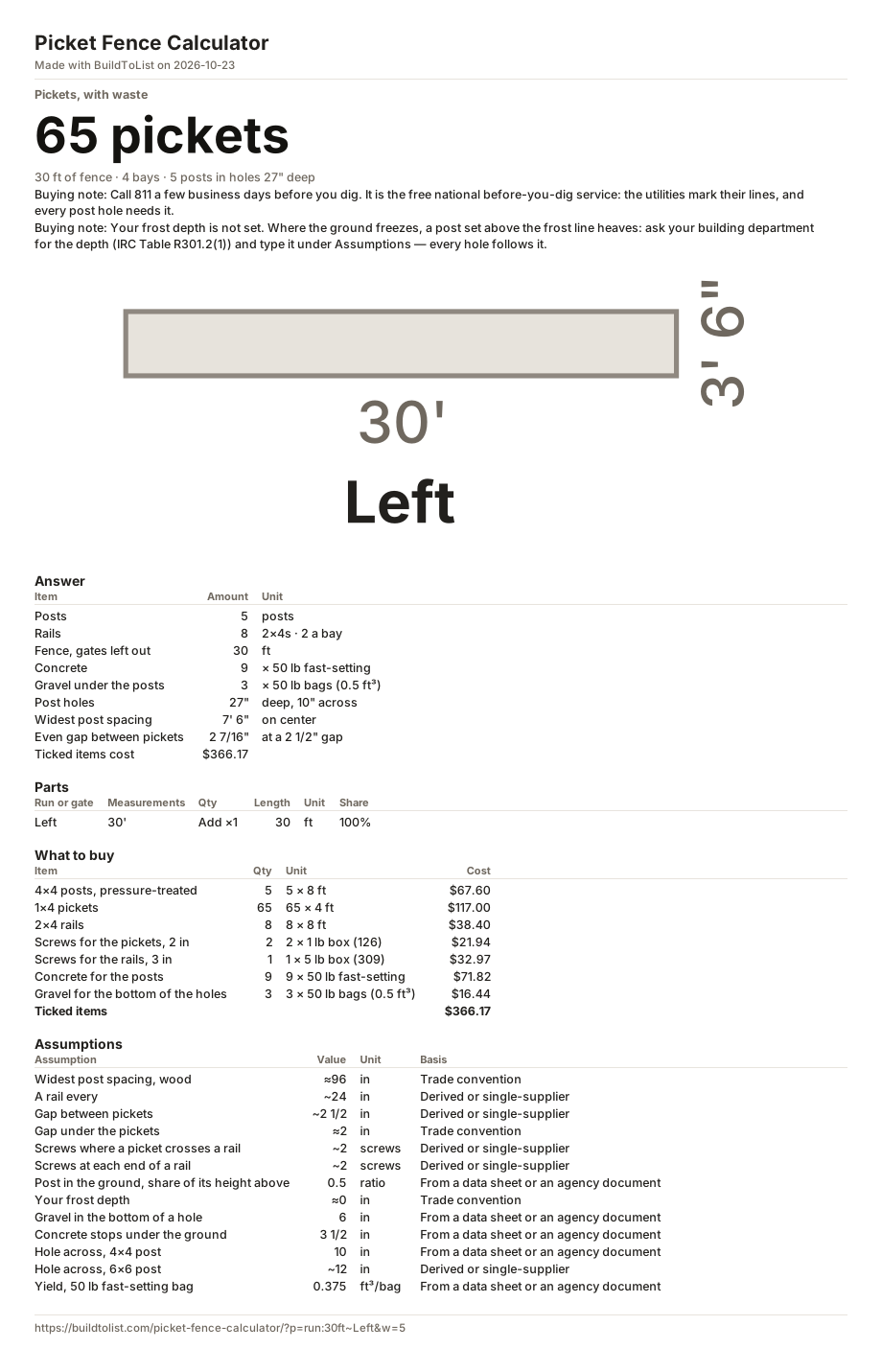
How many pickets a picket fence takes
Pickets with a gap between them are counted as pickets and gaps: n pickets and one gap fewer fill a run, so the count is (run + gap) ÷ (picket + gap), rounded up. A front-yard fence of two 30 foot runs either side of a 4 foot walk gate, in 1×4 pickets 3½ inches wide with 2½ inch gaps, takes (360 + 2.5) ÷ (3.5 + 2.5) = 60.4, so 61 pickets a run, and 9 on the gate: 131 pickets, 138 with 5% for culls. On a fence 3½ feet high each is a 4 foot picket set 2 inches off the ground.
Rounded up, the pickets will not land on exactly 2½ inches. Spread 61 of them evenly along 30 feet and the gaps come to (360 − 61 × 3.5) ÷ 60 = 2 7/16" — the width to cut a spacer block to, so the last picket meets the post as square as the first.
Rails, posts and the gate
A fence this low carries two rails a bay, top and bottom. Each 30 foot run is 4 bays of 7' 6", so 16 rails of 2×4, and 10 posts: 6 inside the runs, one at each end, and the two gate posts — 6×6, because a gate swings on them. The posts go 21 inches into the ground on 6 inches of gravel, half of what stands above it. The gate is framed from the same boards: two rails and a brace from the bottom of the hinge side to the top of the latch side, two hinges, and a latch.
Spacing
The gap is the Gap between pickets under Assumptions: 2½ inches is the figure Omni's fence FAQ uses, Inch Calculator uses 2. Narrow it and the count rises, widen it and it falls; the even gap on the page follows.
Round a pool the gap is not a matter of taste. Where the tops of the rails are less than 45 inches apart, as they are on any fence this height, the International Swimming Pool and Spa Code puts the rails on the pool side and holds the gaps to 1¾ inches (section 305.2.5); choose A pool under Assumptions and the page checks it. We are not connected with any maker, store or supplier named here.