How a patio is measured
A patio is measured as the ground it covers, in as many parts as it takes — the patio, the walk to it, a fire pit, a planter set to subtract — and each part says which of its sides sits against the house. That side needs no edging and no base past it, so the 12 by 20 foot patio the first page opens with, its 20 foot side against the wall, has 44 feet of free edge, not 64.
The paver is a product, not a size you type. A Holland paver is 100 by 200 mm, laid at a 4 by 8 inch module — the paver and its joint — which is 4.5 to the square foot. That patio is 240 square feet, 264 with 10% for the pavers cut at the edges, and 1,188 pavers. A store's calculator rounds a paver to 0.22 square feet and gets 1,200; another divides by 0.23 and gets 2,609 for 600 square feet, where the module gives 2,700.
Waste goes on the pavers only. The base, the bedding sand and the joint sand are geometry, and none of them moves with the waste box.
The base is set by what it carries and what it sits on
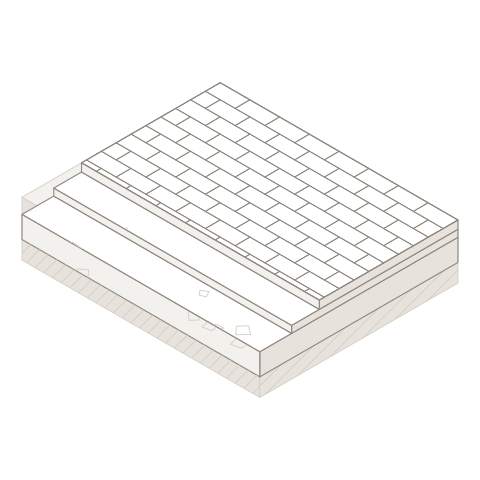
The pages ask what the pavement carries, feet or cars, and whether the ground drains well, is clay or silt, or was recently dug and filled. On well-drained ground the base is at least 4 inches after compaction under a patio and 6 under a drive; on clay or new fill, 8 and 12. The opening patio takes 5.14 short tons (2,000 lb) of base on good ground. On clay the same patio takes 10.57, its hole goes from 7.36 inches deep to 11.36, and the geotextile row is ticked.
The depth is after compaction, so the stone is weighed once, at the compacted 1.59 short tons a cubic yard, and ordered loose at that weight over 1.25. A popular base calculator adds 20% "for compaction" to a figure already compacted, and orders a fifth too much.
The base also reaches past every free edge, so the edging is spiked into stone: 6 inches for a base up to 6 inches deep, as far as the base is deep from 6 to 10, and 10 inches past that. On the opening patio the band is 44 feet by 6 inches, 22 more square feet of base; on clay it widens to 8 inches; under a 12 inch driveway base it stops at 10.
Joint sand comes out of the joint
Polymeric sand is worked from the joint, not from a coverage figure on a bag. The module less the paver's face is the joint — 3.12% of the surface for a 60 mm Holland — and it is as deep as the paver. For the 240 square foot patio that is 161 pounds, 4 bags of 50 lb, about 75 square feet a bag: inside the 65 to 85 the sand maker's own chart gives for pavers that thick with narrow joints.
Where the numbers come from
The base depths on good ground, the inch of bedding sand, the compaction lifts, the fabric overlap and the 60 mm paver for a drive are CMHA's PAV-TEC-002-22. That the base reaches past the edging is PAV-TEC-003-22; the band widths are the base extension table of ICPI's Construction Tolerances, now CMHA PAV-MAN-006-20. The deeper bases on clay and fill are Unilock's. Pallet counts and weights are each paver's data sheet, except the 45 mm pallet, read from a store's price break. The stone densities are MoDOT's, the gravel pages' own constants, labeled estimate because no figure for graded paver base was found.
CMHA's documents are an industry guide, not a code: their figures are constants and cited warnings, and there is no pass or fail panel.
Some numbers are softer, and say so. The 10% waste is a convention. The 20% for herringbone is an estimate whose only source is a store's calculator, so it is named beside the waste box and left to you. Polymeric sand at 109.3 pounds a cubic foot is an estimate from Alliance Gator's sand calculator, not a data sheet. Most prices are store listings; the 80 mm pallet, a loose 60 or 80 mm paver, a single spike, the fabric and delivered stone are our estimates.
What these pages do not do
They do not know where two parts meet. Mark the end of a walk that runs into the patio and the walk's edging comes off, but the patio edge it meets stays in: 3 feet too much for a 3 foot walk. And they measure the band from the paver, not from the outside of the edging as the tolerance table does, so it comes out narrow by the edging's own base, never wide.
They do not lay a soldier course, a border in a second paver or a pattern of mixed sizes, and there is no square paver: only three Holland sizes had data sheets to read. They do not work wide joints — tumbled pavers or natural stone with joints over about half an inch take a different sand.
They do not add swell to the soil you dig out, and they do not price labor: the cost is the materials on the list.