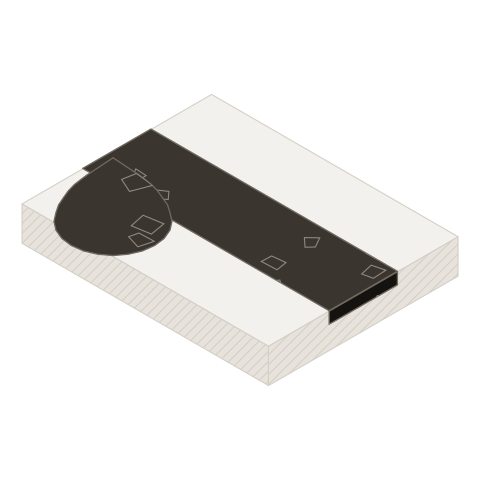
How a layer of stone is measured
Stone is sold by weight or by the loose yard, but it is measured as a finished layer, and the pages ask in that order: an area of any flat shape, its depth in inches, the stone, whether it will be compacted, and whether your yard sells by the short ton (2,000 lb) or the cubic yard. The depth is the finished layer, after the plate compactor: that is how a base is specified and checked.
A job is often several areas, and each area's card can pick its own stone. Each stone gets its own bag table, order and line on the shopping list, and every page carries a landscape fabric row, unticked.
Compacted once, never twice
Missouri DOT's tables put crushed granite and limestone at 2,410 to 2,590 lb a cubic yard loose and 3,060 to 3,300 lb compacted, a ratio of about 1.27. That ratio is used exactly once: the finished layer is weighed at the compacted density, and the ratio only turns finished yards into the loose yards a bucket measures.
Using it twice is the commonest mistake. One large site takes a bed 10 by 10 feet and a foot deep, starts from a density near the compacted figure, adds 10% for waste and 30% more for compaction, and arrives at 7.4 "tons". Those 3.70 cubic yards at 1.59 short tons a yard, with the same waste, are 6.48 short tons. Leave the ratio out and you err the other way: a crusher run pad of 2.37 packed cubic yards is 3.32 loose ones with waste.
Only crushed stone, crusher run and trap rock have two figures, so only they bring the compaction question; pea gravel, river rock, #57 and sand are laid loose. A compacted layer that starts as more than NRCS's 9 inch lift of loose stone says on its card how many lifts it takes.
Short tons, bags, and a floor under the truck
A US quarry pricing "per ton" means the short ton; a tonne is about 10% heavier. A popular calculator gets 0.875 short tons for a bed 10 by 10 feet and 2 inches deep, then writes it as "0.794 tons", the figure in tonnes, which orders you 9% short. Every weight here says which it is.
Bagged stone is sold by volume, half a cubic foot a bag, 54 bags to the loose yard. The 10 by 10 foot pad at 4 inches that the gravel calculator opens on is 2.16 short tons, 1.73 loose yards, or 94 bags. A delivered load is a price per short ton or per yard, rounded up to the step your yard sells in, plus a delivery fee per trip in a box of its own.
Where price alone would choose a truck, a floor overrules it: under 1 cubic yard of loose stone the page buys bags whatever the arithmetic says. Above it the prices decide, stone by stone. On a 10 by 12 foot patio, 4 inches of compacted crusher run comes to 2.75 short tons delivered, while the inch of sand over it, under the floor, stays at 22 bags.
Where the numbers come from
The crushed stone and trap rock densities are the middles of Missouri DOT's highway maintenance tables. The #57 figure, 1.38 short tons a yard, is the middle of FHWA lab measurements of 95.4 to 108.7 lb a cubic foot (FHWA-HRT-15-034), and sand's 1.4 is the Minnesota Pollution Control Agency's conversion. The driveway depths, 4.5, 5.5 and 6.5 inches on firm, average and soft ground, are Table 3 of FHWA's Gravel Roads Construction & Maintenance Guide. The lift is NRCS Conservation Practice Standard NY-560, and the fabric overlap, 18 inches and 24 on the driveway page, is NRCS Construction Specification 95.
The rest says convention or estimate on its row. A layer at least twice its largest stone is what the FHWA guide calls "a general rule", so it is a convention. Crusher run borrows Missouri DOT's crushed stone, because no figure for the graded product was found; pea gravel and river rock are supplier figures. The 10% waste is convention, the 1 cubic yard floor is our choice, and every price, from $5.48 a bag to $95.00 a trip, is a dated reference estimate: type your yard's.
What these pages do not do
They do not price each stone on its own. A project has one bag price, one loose price and one delivery fee, so sand costs what the crusher run under it costs, and typing over a box changes both.
They do not count edging, the length along a path's outline that keeps its stone off the lawn.
They do not take a density in lb/ft³ or kg/m³. The box is short tons a cubic yard, and a figure no stone weighs is asked about again, with the division: lb/ft³ ÷ 74.07.
They check the twice-the-stone rule only for #57 and pea gravel, whose largest size a grading table gives. River rock is sold by a size the yard names, and the base-course tables for crusher run disagree.
And they do not judge your ground. The driveway page asks whether it is firm, average or soft and checks the depth against FHWA's figure; whether wet clay needs drainage under the stone is a site decision, not a quantity.