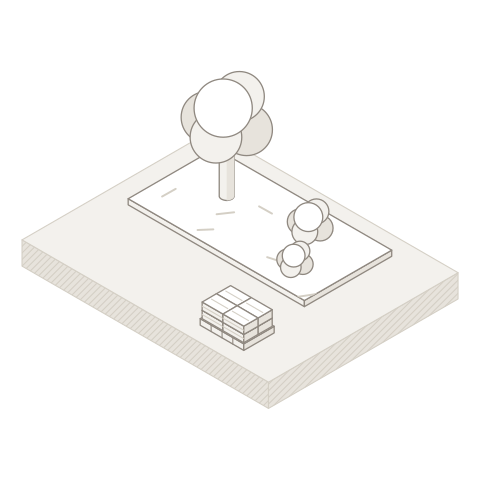
How a bed is measured
A bed is an area and a depth in inches, and the pages ask in that order: each bed as a part of any flat shape, its depth, then the material — wood mulch, topsoil, rubber, compost, or a raised bed's mix. A path inside a bed is a part set to subtract, and a tree is a ring with two diameters, the mulched circle and the bare one left at the trunk, because mulch piled against bark is the one place it should not go.
All of it is sold by volume: bags printed in cubic feet, and loads by the cubic yard. Weight is worked out only to say how many trips your truck makes, never to buy by.
Every bag size, and a floor under the truck
Every bag size a store sells is its own row, rounded up to whole bags. A bed 10 by 12 feet at 3 inches is 33 cubic feet with 10% for spill and settling: 17 bags of 2 cubic feet, 11 of 3 or 22 of 1.5. The two largest home stores' calculators both print 15 bags of 2 cubic feet for it, because they add nothing for spill or settling.
A delivered load is a price per cubic yard plus a fee per trip, and the trip is what decides. At $38 a yard plus $85 delivered, one yard of bark costs $123, where 14 bags cost $62.72. At 600 square feet and 3 inches the two cross: 55 bags of 3 cubic feet at $328.90 against a 6.25 cubic yard load at $322.50. So below a floor the page buys bags whatever the arithmetic says — 2 cubic yards for bark and compost, 5 for topsoil — and above it the prices decide, each product its own way. Rubber is sold here only in bags, so it has no load to compare.
The depth belongs to the material
Every material but topsoil carries its own range, and a depth outside it is flagged on that bed's card. Bark goes 2 to 4 inches: thinner does little against weeds, deeper keeps air from the roots. Compost worked into a garden has a ceiling of 3 inches and no floor. A raised bed with nothing under it wants at least 8 inches of soil. Rubber under play equipment has a floor and no ceiling, 6 inches, which protects a 10 foot fall: a 12 by 12 foot play area is 99 bags of 0.8 cubic feet, and the same area at 4 inches is warned.
On a lawn the limit is the grass's. The top-dressing page asks where the material goes, and on a lawn anything spread is held to ½ inch; 50 by 60 feet at ¼ inch is 2.75 cubic yards delivered rather than 69 bags. The raised-bed page splits one volume into two products, 2 parts topsoil to 1 of compost: a bed 4 by 8 feet and 12 inches deep is 16 bags of 1.5 cubic feet of topsoil and 6 bags of 2 cubic feet of compost.
Where the numbers come from
The bark range is University of Illinois Extension's Proper Mulching Techniques (March 2024), read in the info sheet itself. The compost ceiling is WSU Extension FS123E with Virginia Tech 426-704 beside it, and the lawn's ½ inch is WSU's. The raised bed's ratio and its 8 inch floor are University of Maryland Extension's Filling raised beds; the rubber floor is section 2.4.2.2 of the CPSC Public Playground Safety Handbook, Pub. 325.
The weights are estimates: bark's 473 lb a cubic yard is the green figure in EPA's volume-to-weight factors for wood chips, topsoil's 2,360 lb is the top of NRCS's ideal bulk density for loam measured dry in the ground, compost's 800 lb is a conversion California's organic-waste regulation sets, and rubber's 25 lb a cubic foot is one maker's flyer. The 2:1 mix is a convention, the leaner of Maryland's two ratios, and so is the 10% for spill and settling, because no Extension guide gives a settling figure. The bark and topsoil floors follow a home store's own calculator; compost's 2 yards is our choice. Every price is a dated reference estimate, and the rubber bulk bag has none, because nothing readable prices one.
What these pages do not do
They do not work out a top-up. A bed is one depth, the layer you add, not the difference between the depth you want and the one already there.
They do not mix materials part by part. The material is one choice for the whole project, so bark on the front beds and compost in the vegetable garden are two runs of a page. The raised bed's two products come from one volume and a ratio.
They do not give topsoil a depth. No Extension figure for spreading it was found to cite, so a topsoil bed is not warned at any depth.
They do not count a soilless growing mix. Maryland's advice for a raised bed on a patio is a soilless mix with compost; the raised-bed page counts topsoil and compost.
And they do not ask how far a child can fall. The rubber page's 6 inches is for a 10 foot fall; equipment higher than that needs more than the page gives.