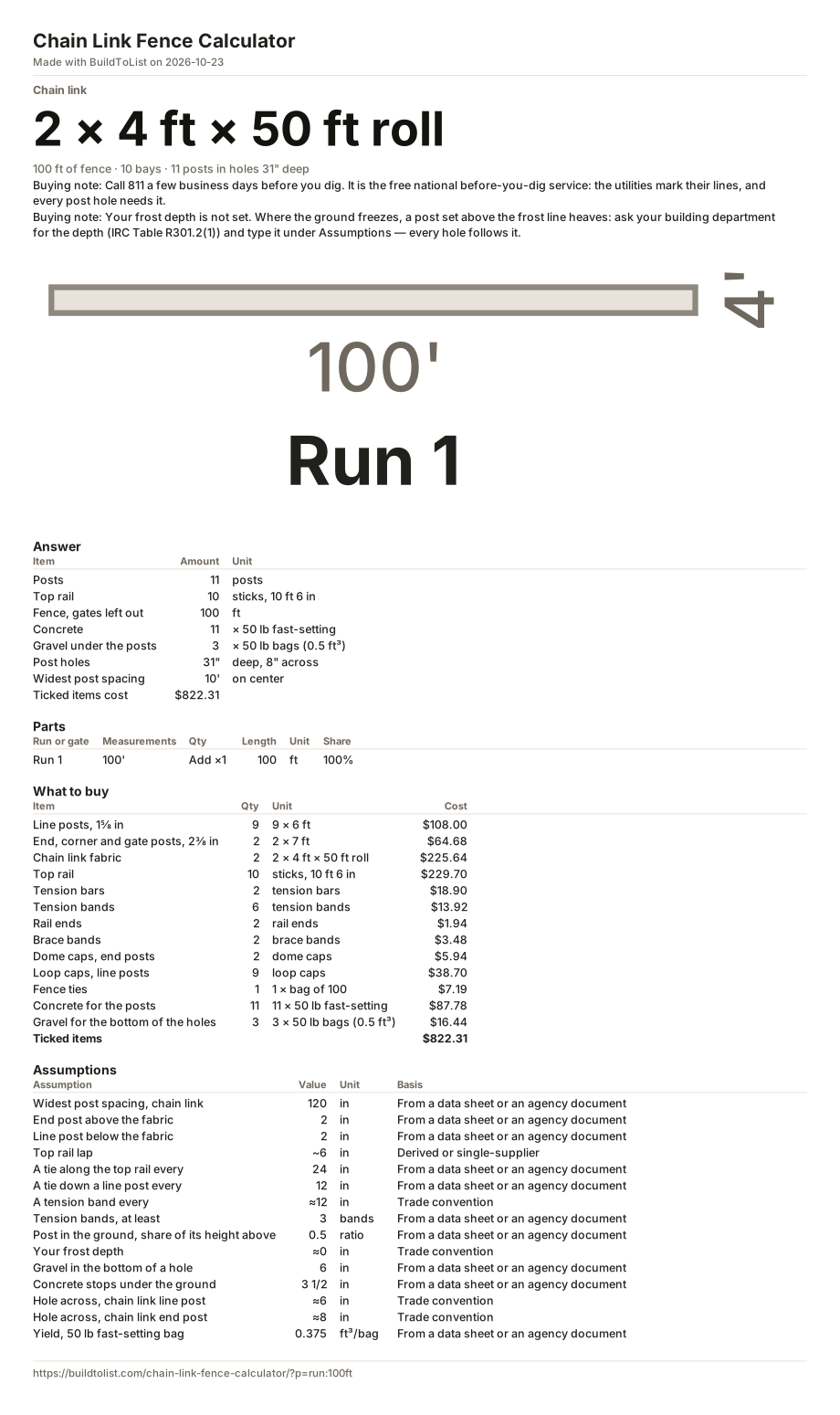
What 100 feet of chain link takes
Chain link fabric comes in 50 foot rolls, so 100 feet of 4 foot fence is 2 rolls. Its line posts may stand no more than 10 feet apart — Home Depot's installation guide gives that figure — so the run is 10 bays, with 9 line posts of 1⅝ inch pipe between 2 terminal posts of 2⅜ inch pipe at the ends. The top rail comes in 10 foot 6 inch sticks, each slipped into the swaged end of the next: 10 sticks.
The fittings are counted where the fabric ends. Each end of a run of fabric takes a tension bar woven through it, a rail end that cups the top rail, a brace band that holds the rail end to the post, and tension bands up the post that hold the bar: three on a 4 foot fence, four on 5 feet, five on 6. A corner post holds two ends of fabric, so it takes everything twice; a gate post, one. Ties hold the fabric every 24 inches along the top rail and every 12 inches down each line post: 86 ties, a bag of 100.
Posts and holes
A line post stands 2 inches under the top of the fabric, so the rail can run over its loop cap; a terminal post stands 2 inches over it under a dome cap. Each is set a third of its length in the ground, so a 4 foot fence takes 6 foot line posts and 7 foot terminals. The line posts go in 6 inch holes and the terminals in 8 inch ones, both on 6 inches of gravel: 11 bags of fast-setting concrete in all, counted from the shape of the holes.
Where other calculators come up short
Asked for 100 feet of 6 foot chain link with no ends chosen, Home Depot's calculator lists no end posts; given two ends, it still lists no rail ends or brace bands — the fittings that hold the fabric tight. A run of fence always has two ends. Its bags of concrete are one a line post and two a terminal, which is not the shape of either hole.
Round a pool, chain link may open no more than 1¾ inches (ISPSC section 305.2.7), and the usual residential fabric is woven at 2¼: buy the smaller mesh, or weave in slats. We are not connected with any maker, store or supplier named here.