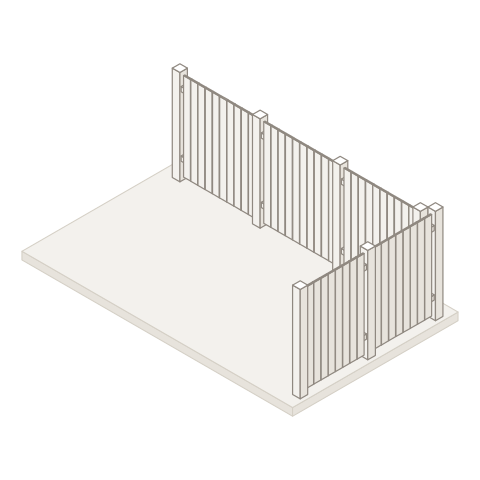
How a fence is measured
A fence is walked, not drawn. List it the way you walk it — a run, a gate, the next run — and the pages treat the list as one line: each part starts where the one before it ends. Say whether it has two free ends or closes on itself.
The height is a select, not a box: it offers only the heights the chosen style is sold at. The style decides what fills the bays — pickets edge to edge, panels by the panel, chain link by the 50 foot roll, split rails by the rail.
Posts stand at the joints
Each run is divided into equal bays no wider than the spacing allowed, and the posts stand at the joints between parts: a corner post where two runs meet, a gate post either side of a gate, an end post at each free end. So 100 feet with posts no more than 8 feet apart is 13 bays of 7' 8 5/16" and 14 posts, where a store's fencing calculator prints 15 for the same 100 feet. A back yard of 50, 100 and 50 feet is 28 posts — 24 inside the runs, two corners, two ends. Added up run by run it would come to 30.
The joint sizes the post too. A wood gate post is a 6×6 in a 12 inch hole where the line posts are 4×4s in 10 inch ones. Chain link fittings are counted where the fabric ends — a tension bar, a rail end, a brace band and three to five tension bands by height — and a corner post holds two ends, so it takes everything twice.
Pickets are counted with a signed gap, (run + gap) ÷ (picket + gap): 219 for 100 feet of privacy fence butted tight, and 267 for board-on-board, the same formula with the gap negative, each board lapping 1 inch. Waste goes on the pickets and nowhere else, so a chain link, panel or split rail page has no waste box: everything it buys is counted from the line.
Holes are counted from their shape
A post goes in half as deep as it stands — a third of its length — on 6 inches of gravel, with concrete around it to 3½ inches below the ground; only split rail is set to the rail maker's depth instead. A 6 foot fence's hole is 42 inches deep and 10 across, 1.247 cubic feet of concrete a post, and the 14 posts of the 100 foot fence take 47 bags of fast-setting mix. A popular calculator buries the same posts 2 feet, a foot shallower. Quikrete's own example of two bags for a 10 inch hole 2 feet deep fills about four fifths of it; the geometry says 2.46.
Where the ground freezes, type the frost depth your building department gives under Assumptions, and no hole stops above it.
Where the numbers come from, and the pool code
The hole depth, the 10 inch hole for a 4×4, the gravel and the gap left at the top are Quikrete's, from its fast-setting mix spec sheet and its post-setting instructions. Chain link spacing, ties and bands are from Home Depot's chain link installation guide; split rail from West Virginia Split Rail's instructions; vinyl and aluminum from the panel makers'. Wood posts 8 feet apart is a convention with no standard behind it. The 5% for culled pickets, the picket gap, the lap, the gate post hole, the screws and Hoover Fence's hinge counts are estimates. Prices are store listings read in October 2026, or our estimates where none was found.
Choose a pool under Assumptions and the page reads the fence against section 305 of the 2021 International Swimming Pool and Spa Code, the one edition held, read whole in the text a township publishes. It must stand at least 48 inches with no more than 2 inches under it. A closed face passes the openings check; split rail fails it. Chain link gets no verdict, because the code holds its mesh to 1¾ inches and the usual fabric is woven at 2¼, which the page cannot see; nor does a picket gap between 1¾ and 4 inches, which turns on how far apart the rails are. The gate check never passes: a gate that opens out, closes and latches itself, with a low latch on the pool side, is hardware, not a number.
What these pages do not do
They do not follow a slope: a fence stepped or racked down a hill is worked as if the ground were level. One height is asked for the whole line, so a 4 foot front and a 6 foot back are two pages.
They do not count chain link's bottom tension wire or its hog rings. They put every wood gate on 6×6 posts, even a walk gate that would hang on 4×4s. They buy each post at the shortest length sold that is long enough and leave the offcut; there is no cutting list for posts.
The cost is materials: labor, permits, stain and hauling the dirt away are not on the list. And the pages do not decide whether your fence needs a permit, how tall your town allows it, or whether a pool barrier passes inspection. That is the local authority's call.