Find a tool

Board Foot and Lumber Calculators

Board feet four ways, a log rule, and what a length of lumber costs by the foot or the thousand.

These pages count board feet the way a softwood invoice, a hardwood tally and three log rules count them. Your yard's or mill's rule decides the bill, and these pages do not grade lumber or say what a board can span.

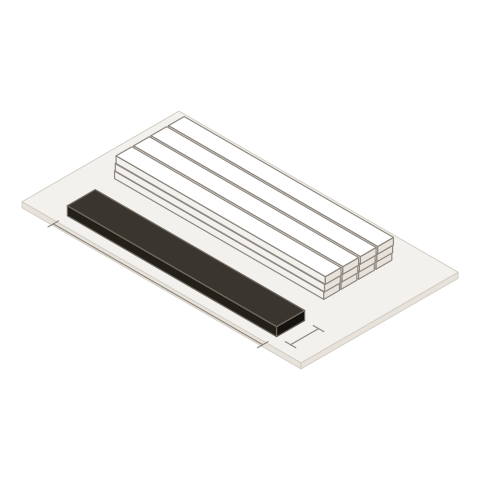
An isometric stack of sawn boards with one board shaded

Which of these 5 pages is yours

Not sure which one? Start with the Board Foot Calculator — it handles the general case, and the links under its answer carry your measurements to the next page.

Page The question it answers The number it prints largest
Board feet Boards in, as a yard names them; the board feet you pay for, and the ones you take home, out. Prints: Board feet at nominal size, as lumber is billed
Hardwood board feet Quarters in, as a hardwood yard writes them; the board feet, and the tally on the ticket, out. Prints: Board feet by the quarter
Linear feet to board feet A run of lumber in; the board feet in it, and in every foot, out. Prints: In a linear foot, at nominal size
Lumber price One price in; the same price per board foot, linear foot, board and MBF out. Prints: Price per board, 8' long
Log board feet The small end and the length in; the board feet by all three log rules out. Prints: Doyle

How lumber is measured

A board foot is a piece of wood 12 inches long, 12 inches wide and 1 inch thick: thickness × width × length in inches, divided by 144. The pages ask for the three the way a yard says them — thickness and width in inches, length in feet — then the number of boards. A bare 8 in the length box is 8 feet, 8' 6" reads as well, and the thickness box takes hardwood quarters as written: 4/4, 5/4, 8/4. Five boards 1¼ by 10 inches and 8 feet long are 41.67 board feet.

A log is measured across the small end inside the bark, and along its length, and scaled at the whole inch and whole foot below what you measure. Then a log rule turns it into lumber, and the rules disagree: a log 16 inches by 16 feet scales 144 board feet by Doyle, 160 by Scribner Decimal C and 180 by International ¼ inch. The page prints all three, the rule you pick largest.

Which size you pay for

Softwood is billed by the nominal size on the tag, and its board feet are counted on that name. A 2×4 dried and planed is 1½ by 3½ inches, so a 2×4 8 feet long is 5.33 board feet on the invoice and 3.5 board feet of wood, and the pages print both, each saying which size it is. The five 5/4×10 boards above are dressed to 1 by 9¼ inches: 30.83 board feet of wood in the 41.67 you pay for.

Hardwood is tallied instead. The length drops to the whole foot below, width times those feet over 12 is the surface measure, rounded to the nearest whole square foot, and the board feet are that times the thickness. A 4/4 board 7½ inches by 9 feet 6 inches is 5.94 board feet exactly and 6 on the ticket. A board on exactly half a square foot is counted up and the next one down, in turn; wood thinner than an inch is measured as an inch; and a board surfaced two sides is billed at its rough quarter — the 4/4 above planes to 13/16 inch, 4.82 board feet of wood billed as 6.

Rounding once, and a waste figure

Every decimal is kept until the money: 41.67 board feet at $4.15 is $172.92, where a calculator that rounds the board feet first gets $172.93. One price is said four ways: for a 5/4×10 board 8 feet long, $4.15 a board foot is $4.32 a linear foot, $34.58 a board and $4,150 a thousand board feet.

No calculator we checked adds any waste. These pages start at 10%, the low end of what suppliers add for knots, checks and saw cuts, and the five boards become six on the list. Softwood is listed by the board at the shortest length a yard sells that holds yours, and a longer run in the longest it sells: 100 feet of 2×6 is five 20 foot boards, six with the waste. Hardwood is listed by the whole board foot: 5.94 with 10% is 6.53, so 7.

Where the numbers come from

The softwood rules are NIST's PS 20-20, read in the published text: §2.2 counts board feet on the nominal size, and Table 3 gives the dressed sizes. One simplification: PS 20 dresses the ⅜, ½ and ⅝ inch boards 1/16 inch under, and these pages use ⅛ for every board under an inch. The hardwood rules are the National Hardwood Lumber Association's 2019 rule book, read in a copy held by a third party because the association's own PDF is gone, and checked against the American Hardwood Export Council's grading guide. Lengths sold are the Southern Forest Products Association's 8 to 20 feet for dimension lumber, and the even feet from 6 to 16 for 1× boards, within NeLMA's grading rules.

The log rules are Purdue's FNR-191. Doyle and International are worked from its formulas, because its printed tables disagree with them in a few cells. Scribner Decimal C was drawn rather than computed, so it is read from FNR-191's Table 2, and a log the table has no cell for is left out and named, never given the nearest cell. The one convention is the 10% waste. There are no reference prices, since species and grade move a board foot too far: the price box is empty until you type your yard's, except on the lumber price page, which opens on its worked example.

What these pages do not do

They do not plan the cuts. The list counts boards; where the joints fall in a 100 foot run is yours to lay out.

They do not have a measure for every way wood is sold. Hardwood surfaced four sides and molding have no mode of their own, and a live-edge slab has no box for its wavy edge: type its average width, at actual size.

They do not grade lumber or say what a board can span. No code check runs here.

And the log page does not price a log or say what it will saw out. It has no buying list and no price box, and the mill's overrun or underrun is its own. International ¼ inch scales a log longer than 20 feet as two, so type it as two.

What this cluster assumes

14 assumptions: 14 from a data sheet or an agency document

Every constant these pages show under Assumptions, on the project each one opens with and on every choice its form offers, with its tier and the document it was read from. Each one is editable on the page that uses it; the waste each page starts at is in its own box, beside the form.

Assumption Value Confidence
Hardwood is counted at leastNHLA Rules (2019), paragraphs 16 and 18: hardwood thinner than 1 in is measured as 1 in - its board feet are its surface measure. 1 in From a data sheet or an agency document · source
The thicker S2S allowance fromNHLA Rules (2019), paragraph 14: the S2S allowance goes from 3/16 in to ¼ in at 1¾ in. 1 3/4 in From a data sheet or an agency document · source
Surfaced two sides, from 1¾ inNHLA Rules (2019), paragraph 14: from 1¾ in to 4 in, S2S is ¼ in under - 8/4 to 1¾, 12/4 to 2¾, 16/4 to 3¾. 1/4 in From a data sheet or an agency document · source
Surfaced two sides, up to 1½ inNHLA Rules (2019), paragraph 14: hardwood surfaced two sides (S2S) is 3/16 in under its quarter up to 1½ in - 4/4 to 13/16, 5/4 to 1 1/16, 6/4 to 1 5/16. Its board feet are measured before surfacing. 3/16 in From a data sheet or an agency document · source
Dressed, boards 1 to 1½ inNIST PS 20-20, Table 3 (p. 16): a board from 1 in and under 2 in nominal is dressed dry ¼ in under it - 1 to ¾, 1¼ to 1, 1½ to 1¼. 1/4 in From a data sheet or an agency document · source
Boards' ¼ in fromNIST PS 20-20, Table 3: from 1 in nominal a board is dressed ¼ in under; thinner boards less. 1 in From a data sheet or an agency document · source
Dressed, 2 in up to 8 inNIST PS 20-20, Table 3: from 2 in nominal and under 8 in wide, lumber is dressed dry ½ in under it - 2 to 1½, 4 to 3½, 6 to 5½. 1/2 in From a data sheet or an agency document · source
Dimension lumber fromNIST PS 20-20: dimension lumber starts at 2 in nominal thickness; boards are thinner. 2 in From a data sheet or an agency document · source
Dressed, boards under 1 inNIST PS 20-20, Table 3 (p. 16): a board ¾ in nominal is dressed dry to ⅝ in. This is the ¾ in board's figure, used for every board under 1 in; PS 20 dresses the ⅜, ½ and ⅝ in boards 1/16 in under, which this does not model. 1/8 in From a data sheet or an agency document · source
Dressed green, timbersNIST PS 20-20, Table 3: timbers, 5 in nominal and thicker, are dressed green ½ in under nominal on both faces - 6×6 to 5½ × 5½, 8×8 to 7½ × 7½. Timbers are sold green; dried, 7 in and up loses more. 1/2 in From a data sheet or an agency document · source
Timbers fromNIST PS 20-20: timbers are lumber 5 in nominal and thicker in the least dimension. 5 in From a data sheet or an agency document · source
Dressed, 8 in and widerNIST PS 20-20, Table 3: 8 in nominal and wider is dressed dry ¾ in under it - 8 to 7¼, 10 to 9¼, 12 to 11¼. 3/4 in From a data sheet or an agency document · source
The wide allowance fromNIST PS 20-20, Table 3: the dressed allowance goes from ½ in to ¾ in at 8 in nominal width. 8 in From a data sheet or an agency document · source
Scribner Decimal C, by diameter and lengthPurdue FNR-191 (Cassens, Log and Tree Scaling Techniques), Table 2: board feet in tens, no taper, by the small-end diameter inside the bark and the length. A diagram rule - its numbers were drawn, not computed - so it is read here, not worked out; the 39 in row is blank in the source and stays blank. Purdue FNR-191, Table 2 From a data sheet or an agency document · source

Every Board feet and lumber calculator 5

Read at the source

Every constant on this site carries the tier it sits in and the document it came from. These are the documents, read in the text and not quoted from another calculator.

  • PS 20-20
  • NHLA
  • Purdue