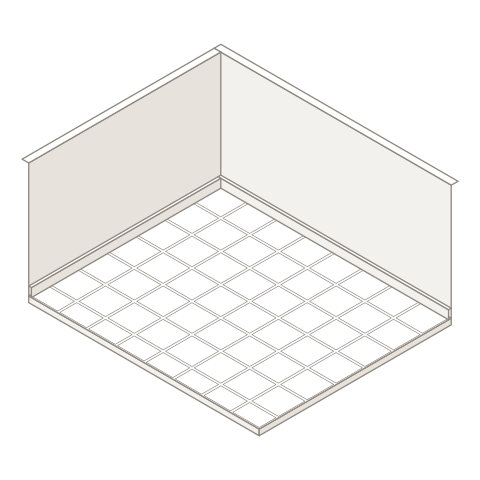
How a tiled surface is measured
A tiler measures faces, not rooms. A shower has three walls and each one is its own rectangle; a backsplash is a strip with the window and the hood cut out of it; a floor is the floor. That is why every page here takes a list of parts rather than one room: you add a face, give it its two measurements, and subtract the openings as negative parts. A single room-shaped box that asks for length, width and height would need a third copy of two door constants to describe a way of measuring that nobody uses.
Tile is counted in pieces, not in square feet, and the piece is what the store sells. A 12 by 24 inch tile covers 2 square feet of face, so 100 square feet is 50 pieces — but it ships in boxes, and a box holds a whole number of them. The pages here carry the division through to the boxes, which is where most calculators stop: 218.4 square feet of plank flooring is the number you cannot buy, and 11 boxes is the number you can.
Waste goes into the pieces and into the trim, and nowhere else. The amount of grout a floor takes is geometry — the joints are a fixed fraction of a laid surface — and the amount of thinset is coverage per unit. Adding a cut allowance to either of those would be adding a second allowance to a number that already has none, which is the mistake rule 9 exists to stop.
Grout comes out of the volume of the joints
Most grout calculators hand you a coverage figure per bag and leave you to trust it. These pages work the volume of the joint itself — tile face, joint width, joint depth, the number of joints per square foot — and turn it into pounds. The formula was worked backwards from thirty cells of the published Polyblend Plus coverage table and agrees with it to within 1% for tiles of 12 inches and up.
Where it does not agree is mosaic, and the page says which way: at mosaic sizes the volume method runs about 20% high, because a sanded grout bridging a sheet of 1 inch tile does not fill the joint the way the arithmetic assumes. Reading 20% high on grout costs a few dollars. Reading low leaves you mixing a second batch with a different water ratio, which shows in the color.
Thinset is by the trowel you pick, not by the tile
Coverage for thinset is per trowel notch, and the notch is the choice. The figures come from the low end of the manufacturer's published range, so the answer leans towards buying a bag more rather than a bag fewer.
The page does not pick the notch for you from the tile size. The usual pairing — a bigger tile means a bigger notch — is a rule of thumb rather than a published rule, and guessing on your behalf would turn an assumption into a number you cannot see.
Where the code numbers come from, and one debt
The tolerance checks on these pages come from ANSI A108.02. That document is sold rather than published, and four of its numbers here were read from an article by the Ceramic Tile Education Foundation rather than from the standard itself. Every citation on the page says so in words. We would rather carry a visible debt than imply we read a page we did not.
None of the tile checks ever returns a pass, and the reason is the same three times over: a large-format joint depends on whether the tile is rectified or calibrated, which is printed on the box and not in a measurement; mortar coverage is verified by pulling a set tile back up; and the minimum joint has a second condition — three times the facial variation of the tile — that you find by dry-laying a few pieces. A tick that ignored those would be a tick about something the page cannot see.
What these pages do not do
They do not lay out a pattern on your actual walls. They will tell you how many pieces a herringbone floor takes and how its cuts run, but not where the first tile goes or which wall the pattern should start square to.
They do not judge your substrate. Flatness, deflection, movement joints and whether that wall needs cement board or a membrane are not quantities, and a calculator that implied otherwise would be doing harm.
They do not size carpet. Carpet needs the roll width and the direction of the run, and across several rooms it is a two-dimensional nesting problem rather than a count — a different thing from the one-direction cut list the flooring pages use.
And they do not pick a tile for you. Sizes on these pages are real products with published dimensions; which of them belongs in your bathroom is not a number.