How a room is measured for paint
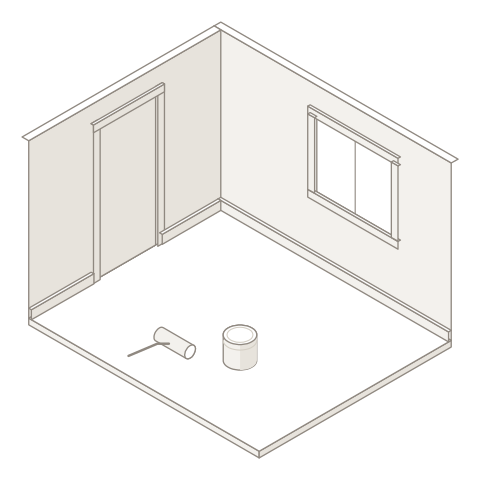
A painter measures a room as a box — its length, its width, the height of its walls — then counts the doors and windows. That is what the pages ask, in that order. The walls are the perimeter times the height: a 12 by 12 foot bedroom with 8 foot walls is 384 square feet, and one door at 20 square feet and one window at 15 leave 349. The ceiling is the length times the width, 144 square feet. The baseboard runs around the floor, 48 feet, painted half a foot wide.
Anything that is not a whole room is a part of its own: a single wall or a run of casing as a rectangle, a gable end as a triangle, a garage door or a picture window of its own size as a rectangle set to subtract. What the page paints — walls, ceiling, trim, or the outside of the house — is one select; the coats and the primer are two more.
Every coat counts
Two coats is the default, and the gallons on every page are every coat. The bedroom's 349 square feet twice over is 698, and at 350 square feet a gallon that is 1.99 gallons: two 1-gallon cans. A popular calculator answers the same room, ceiling included, with "most likely 2 gallons" because it counts one coat; two coats, with its own door and window taken out, is 2.83 gallons, three cans. Another prints gallons per coat with no box for the coats, and a store's works one coat only.
Beside the answer the page shows what the same walls take at 400 square feet a gallon, the top of the published range. A coverage below 200 or above 500 is almost always square meters a liter typed as square feet a gallon, and the page says so: multiply it by 40.7.
Cans, not gallons
Paint is sold in quarts, gallons and 5-gallon pails, and the page works out every mix and buys the cheapest, unless one with fewer sizes is within 2% of it. Make the bedroom's window 12 square feet and it needs 2.01 gallons. Rounded up to whole gallons that is three cans at $116.94; the page buys two gallons and a quart at $95.94 instead. From a little over 4 gallons a pail costs less than gallons and quarts together, which is why a job is bought at once: two 12 by 12 rooms with their ceilings are 986 square feet, 5.63 gallons for two coats, a pail and a gallon rather than six gallon cans. Room by room, the pail never comes into it.
Trim paint and primer are their own rows on the list. Primer is one coat over everything the page paints, at 250 square feet a gallon: 1.40 gallons for the bedroom's walls, two cans. Outside, the trim and gutters take a gallon for every 8 on the body of the house. The waste box is extra for touch-ups and starts at 0, because most paint calculators add nothing; the hint under it names the 5% one maker keeps back.
Where the numbers come from
None of the paint constants is labeled measured. Coverage is the low end of the 350 to 400 square feet a gallon Sherwin-Williams publishes, a convention, and 400 is its high end. Exterior coverage, 350, is an estimate inferred from Sherwin-Williams' own calculator; primer, 250, is the middle of the 200 to 300 it gives, also an estimate. A door at 20 square feet and a window at 15 are conventions, because the calculators disagree: some take a 3 by 7 foot door, 21, and a 12 square foot window. The trim width of half a foot and the gallon of trim to 8 on the body are Behr's, read from its own pages while its calculator would not run, so they are estimates too.
The can prices are our own estimates; no shelf price was read for any of them. They keep the shape of a real shelf — a quart costs more by the gallon than a gallon can, a pail less — because the cheapest mix turns on that shape. Type your store's beside each can and the mix follows. No code governs how much paint a wall takes, so there is no code panel here.
What these pages do not do
They do not know your product. Coverage is a box, not a list of paints: a can whose data sheet gives another figure is a number to type.
They do not add a factor for a porous or textured surface, or extra paint for a first coat on new drywall. The only figures found for those had no source, and they would overlap the primer and the coats, which already carry that paint.
They have no shape for a vaulted ceiling, and they do not draw the four walls unfolded: the drawing is the floor plan, enough to catch a number typed in the wrong box.
They do not list tape, rollers, trays or drop cloths, because no quantity for any of them had a source, and the cost is the paint alone, not the labor. And they do not do cabinets, which have no sourced coverage or coat count, or stain for a deck or a fence.