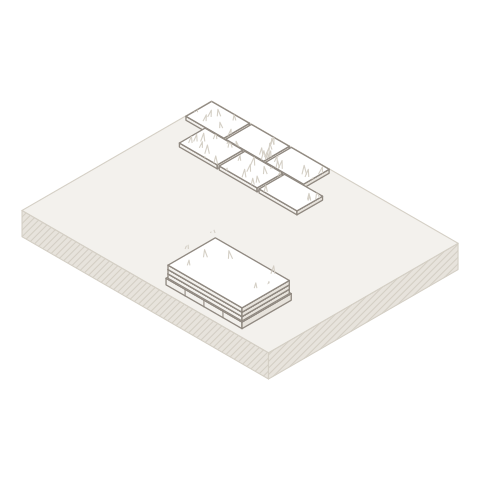
How a lawn is measured
A lawn is an area measured once, and the pages ask for it the way it is measured: parts of any flat shape, or an area typed straight in, with the patio, the beds and the path set to subtract. Each part's card also asks whether it is a steep bank, because a bank is pinned. Then comes the cut your farm sells, one of two slabs or three rolls, with the 16 by 24 inch Southern slab first.
Waste goes on the sod and nowhere else. The 10% is for pieces cut at corners and edges: the yard the sod calculator opens on, two lawns less a patio, is 2,758 square feet, 3,033.8 to buy, and at 2.667 square feet a slab, 1,138 slabs. The soil under the lawn is the size of the ground however the sod is cut: at 2 inches it is 17.02 cubic yards, ordered as 17.25. Staples go only on a bank, two to a piece, with nothing added for cuts: a 200 square foot bank takes 150, two boxes of 100.
A pallet is a count of pieces
A sod farm stacks a pallet by count, and the square feet on the ticket are that count times the piece. So the constant on these pages is pieces a pallet — 170 slabs of 16 by 24 inches, which is 453 square feet — and a pallet's area is worked out from it, never the other way around. Dividing an area by the wrong piece is how pallet counts go wrong: one seller writes that a 450 square foot pallet holds about 165 slabs, from a slab it counts as 2.75 square feet, when 16 × 24 ÷ 144 is 2.667 and 450 square feet is 169 slabs.
A popular calculator adds nothing for cuts. Its own example, 0.13 acre in 10 square foot rolls, comes to 567 rolls, which is the lawn with no cut piece anywhere; the same lawn here is 623.
The last pallet, bought two ways
The 1,138 slabs are 6.69 pallets, and the last 0.69 can be bought whole or loose. The page prices all three: 7 whole pallets at $1,610.00, with 52 slabs over; 6 pallets and 118 loose slabs at $1,731.64; or 1,138 loose slabs at $3,391.24. A loose slab costs more than one off a pallet, so the seventh pallet is $121.64 cheaper than the slabs it replaces.
The page picks the cheapest row, or whole pallets when they cost within 2% of the mix, because one item at the counter is worth that. On a 1,000 square foot lawn three pallets at $690.00 are picked over two pallets and 73 loose slabs at $677.54. On a 100 square foot patch the answer turns over: 42 loose slabs at $125.16 against $230.00 for a pallet you would mostly throw away.
The weight follows the row you buy, not the lawn: seven pallets are 1,190 slabs on the truck, about 20,309 lb. One pallet of 170 slabs is 2,901 lb, nearly twice what a full-size pickup is built to carry, so sod is a delivery.
Where the numbers come from
Purdue Extension's sod guide, AY-28-W, gives the 10% to order over, three of the five cuts, a pallet of about 50 square yards, pegs or staples at both ends of a piece on a slope, and sod laid within 24 hours of being cut. Penn State Extension's Lawn Establishment gives the layer under it, 1 to 2 inches of compost or peat worked 4 to 6 inches in, and the pages take its top as a convention. The 16 by 24 inch slab, the 18 by 40 inch hand roll and the 2,800 to 3,000 lb pallet come from The Grass Outlet, a Southern sod seller, and the $230.00 pallet price is our pick inside its range for St. Augustine.
The rest is estimate, and its row says so. Every pieces-a-pallet count is our division of a pallet's area by its piece. The 6.4 lb a square foot comes from the seller's range rather than Purdue's lighter 3.9 to 4.4 for thin-cut sod, because the heavier figure decides the truck. Two staples a piece is our reading of Purdue. A loose piece's price is ours, about twice a pallet's price a square foot, and the soil's $35.00 a cubic yard and $85.00 delivery are the mulch pages' estimates for bulk topsoil.
What these pages do not do
They do not price the labor. No figure for laying sod could be cited, so the pages give the material in a quote, which is the half you can check.
They do not price by grass. St. Augustine, Bermuda and Zoysia change one number here, the pallet price, and only one seller listed prices by grass; type your farm's into the pallet box.
They do not offer the big rolls a sod-laying machine puts down, a contractor's product sold by the roll.
They do not compare sod with seed, which is a different count, and they do not price the farm's delivery: the list holds the sod, the soil and the staples, and the truck is the farm's to quote.
And they do not decide whether your ground needs soil at all. The soil row starts unticked everywhere but the topsoil-for-sod page, because a soil test says that, not a tape measure.