How to find the area of an L-shaped room
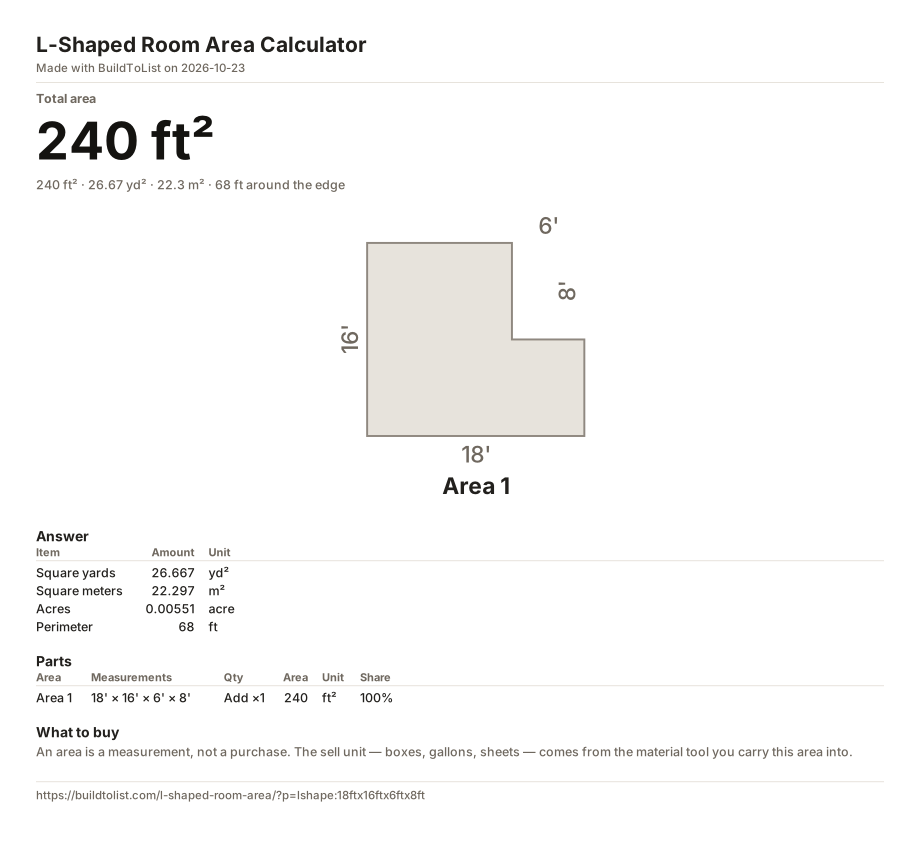
Treat the L as a rectangle with one corner missing. Measure the room's overall width and overall length — the two longest walls, each running the whole way across — and multiply them. Then measure the missing corner and take it away. The room this page opens with is 18 by 16 feet overall with a corner 6 by 8 feet cut out: 18 × 16 = 288, 6 × 8 = 48, and 288 − 48 = 240 square feet. The working under the answer writes the same sum with your own numbers in it.
The two sides of the missing corner are the two short walls that meet at the room's inside corner, the one that points into the room. Measure those, not the gap across the open side. An L has six walls, so you need four measurements: the two long outside walls and the two inside ones. The other two walls follow from them, which is a free check — here 18 − 6 = 12 and 16 − 8 = 8, and if your tape says something else, one of the four is wrong.
Splitting the L into two rectangles gives the same answer: 12 × 16 = 192 plus 6 × 8 = 48 is 240. Split it only once. The common mistake is to take the full length of both legs, 12 × 16 and 18 × 8, which counts the 12 by 8 corner where they meet twice and comes to 336, 96 square feet too many. Multiplying the two longest walls and stopping there, 288, is the other one.
Feet and inches
Type each side the way the tape reads, in one box. On a page in feet and
inches, 14' 6", 14 6 and 14-6 are all 14.5
feet; on a metric page a bare 14 6 is refused rather than guessed.
The line under the box says what it read. 14 feet 6 inches is not 14.6 feet,
and on an L the error lands in four places instead of two.
Two rectangles instead of one L
The shape select on the card also offers a plain rectangle. Use it if the room is easier to measure as two pieces: change the first area to a rectangle, add a second, and the breakdown gives each piece its own row and its share of the total. To take the corner away instead, add the overall rectangle and a second one set to subtract. All three ways come to the same 240.
What else the page gives you
The perimeter, 68 feet here, is what baseboard and trim are bought by. On a plain L it equals the perimeter of the overall rectangle, 2 × (18 + 16), because the two walls that step in add back exactly what the missing corner takes away. Subtract the door openings before you buy. Carpet is often priced by the square yard: 240 square feet is 26.67. In square meters it is 22.30.
Waste starts at zero, because the area is what you measured. Add it once, when you buy the material — tile, plank or carpet — not here and again there.
Common questions
How do I calculate the square footage of an L-shaped room?
Overall length times overall width, minus the missing corner. Or split it into two rectangles that do not overlap and add them. Both give 240 square feet for an 18 by 16 room missing a 6 by 8 corner.
Which walls are the cut-out width and length?
The two walls that meet at the inside corner. Together with the two longest walls, they fix the whole room.
What if the room is a U or a T?
The square footage calculator has U and T shapes, circles, triangles and more, and adds as many areas as the house has.
Is the area of an L the same as its floor for flooring?
It is the floor you measured. Flooring needs waste on top, more for a diagonal pattern or a room with many corners — and an L has more corners than a rectangle, so lean toward the high end of what the flooring maker suggests.