Find a tool

How Many Bags of Concrete Do I Need?

Type the pour, get the bag count in every size on the shelf.

Bag counts only — it does not design a slab or a footing.

Slab 1

12' · 144 in · 12 ft · 3.6576 m

14' · 168 in · 14 ft · 4.2672 m

4" · 4 in · 0.3333 ft · 0.1016 m

56 ft³

10% covers spill, a soft base and forms that bow. It is added once, to the concrete and the base gravel.

This page recalculates as you type. There is no Calculate button.

Answer

Save imageExcel

Bags

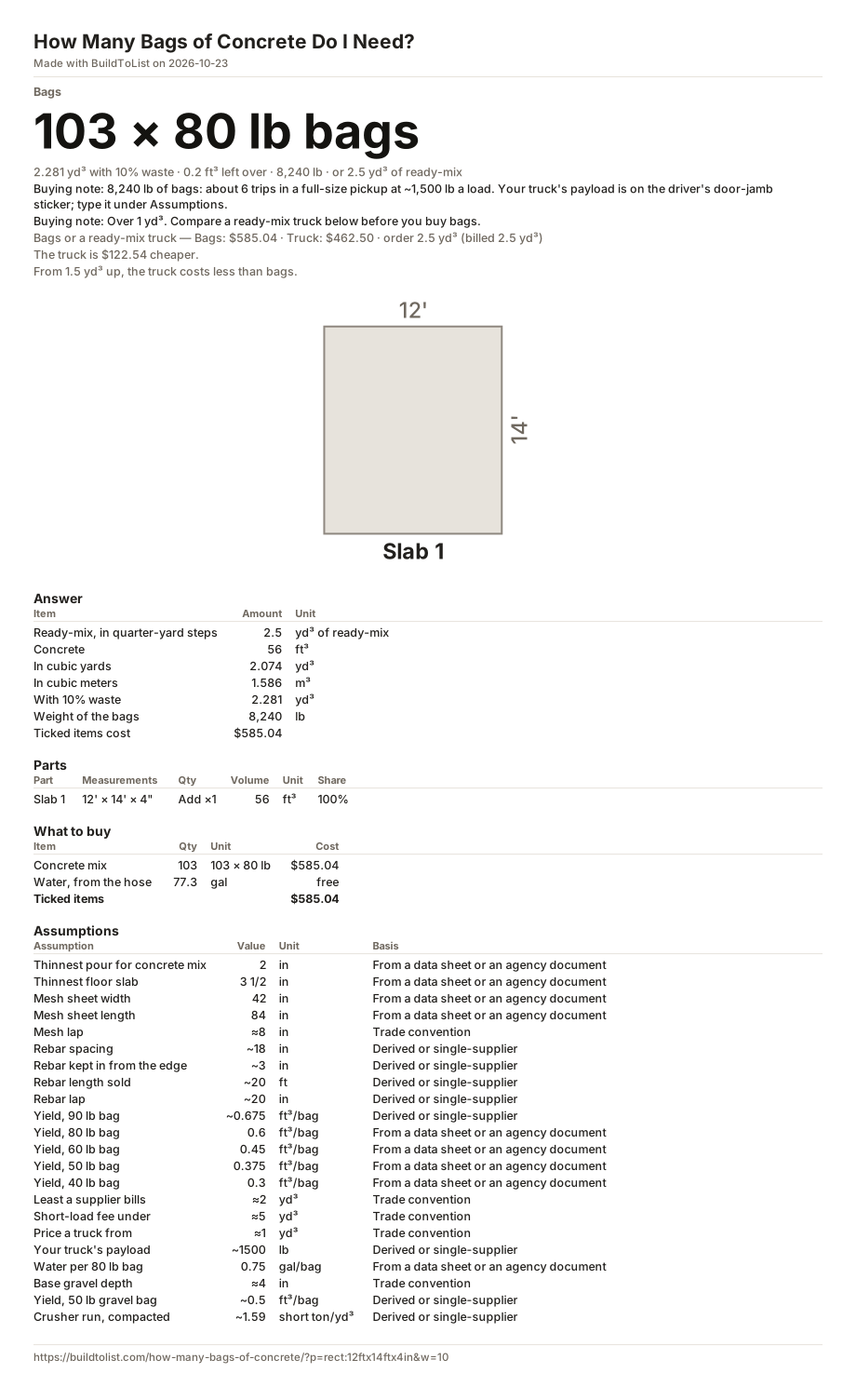
103 × 80 lb bags

2.281 yd³ with 10% waste · 0.2 ft³ left over · 8,240 lb · or 2.5 yd³ of ready-mix

Ready-mix, in quarter-yard steps 2.5 yd³ of ready-mix
Concrete 56 ft³
In cubic yards 2.074 yd³
In cubic meters 1.586 m³
With 10% waste 2.281 yd³
Weight of the bags 8,240 lb
Ticked items cost $585.04
DrawingThe project drawn to scale. Slab 1: 12' × 14'.12'14'Slab 1

Breakdown

Part Measurements Qty Volume Share
Slab 1 12' × 14' × 4" Add ×1 56 ft³

What to buy

Buying note8,240 lb of bags: about 6 trips in a full-size pickup at ~1,500 lb a load. Your truck's payload is on the driver's door-jamb sticker; type it under Assumptions.
Buying noteOver 1 yd³. Compare a ready-mix truck below before you buy bags.

Ways to buy the bags

Every way is worked out; pick the one you will buy. The 50 and 90 lb bags are offered on their own only: we have not seen them on a shelf.

102 × 80 lb + 1 × 60 lb Bags 103 Left over 0.05 ft³ Weight 8,220 lb Cost $584.34
92 × 90 lb Bags 92 Left over 0.5 ft³ Weight 8,280 lb Cost $596.16 Reference price $6.48. Type your store's.
103 × 80 lb Bags 103 Left over 0.2 ft³ Weight 8,240 lb Cost $585.04 Reference price $5.68. Type your store's.
137 × 60 lb Bags 137 Left over 0.05 ft³ Weight 8,220 lb Cost $682.26 Reference price $4.98. Type your store's.
165 × 50 lb Bags 165 Left over 0.27 ft³ Weight 8,250 lb Cost $739.20 Reference price $4.48. Type your store's.
206 × 40 lb Bags 206 Left over 0.2 ft³ Weight 8,240 lb Cost $819.88 Reference price $3.98. Type your store's.

Shopping list

103 103 × 80 lb $585.04
77.3 gal free
124 50 lb bags (0.5 ft³) $679.52 Reference price $5.48. Type your store's.
3.75 short tons (2,000 lb) $263.75 Reference price $45.00. Type your store's. Reference price $95.00. Type your store's.
10 sheets, lapped 8 in $108.70 Reference price $10.87. Type your store's.
12 #4 bars, 20 ft $179.76 Reference price $14.98. Type your store's.
Ticked items $585.04

Untick what you already have.

Save imageExcel

Bags or a ready-mix truck

Bags $585.04
Truck $462.50 order 2.5 yd³

The truck is $122.54 cheaper.

From 1.5 yd³ up, the truck costs less than bags.

Includes the short-load fee small orders pay.

Reference price $150.00. Type your store's. Reference price $35.00. Type your store's. No reference price. Type what your store charges.

Every supplier rounds, sets a minimum and charges for small loads its own way. Ask before you order.

How this was worked out

Every number below is yours. Each constant links to the row where you can change it.

Slab 1 12' × 14' × 4" 56 ft³
All parts 56 ft³ ÷ 27 2.074 yd³ · 1.586 m³
Plus waste 56 ft³ × (1 + 10%) 61.6 ft³ = 2.281 yd³
Bags 61.6 ft³ ÷ 80 lb at 0.6 ft³ 103 × 80 lb · 0.2 ft³ left over

Change:Yield, 80 lb bag

Ready-mix 2.281 yd³ → quarter-yard 2.5 yd³

Change:Least a supplier bills

Water 8,240 lb of bags ÷ 80 lb × 0.75 gal 77.3 gal

Change:Water per 80 lb bag

Base gravel (168 ft² × 4" + 0 ft³ in holes) × (1 + 10%) ÷ 0.5 ft³ a bag 124

Change:Base gravel depthYield, 50 lb gravel bag

Base gravel, delivered loose 2.281 yd³ × 1.59 short tons a yard, compacted, to 0.25 short ton steps 3.75 short tons (2,000 lb)

Change:Crusher run, compacted

Wire mesh 3' 6" × 7' sheets lapped 8", laid over each slab 10

Change:Mesh sheet widthMesh sheet lengthMesh lap

Rebar #4 every 1' 6" both ways, 3" in from the edge, 20' bars lapped 1' 8" 12

Change:Rebar spacingRebar kept in from the edgeRebar length soldRebar lap

Cost 103 × $5.68 $585.04

Assumptions

Every one of these is editable. Change one and the answer changes with it.

Assumption Value Confidence
Thinnest pour for concrete mixSakrete High-Strength Concrete Mix (Oldcastle APG): pour at least 2 in thick. Thinner is a job for a resurfacer. in From a data sheet or an agency document
Thinnest floor slabIRC 2021 R506.1: a concrete floor slab on the ground is at least 3½ in thick. ACI 332-20 §13.5 says the same, as the Tennessee Concrete Association summarises it. in From a data sheet or an agency document
Mesh sheet widthThe sheet Home Depot sells as a 42 in. x 84 in. remesh sheet. in From a data sheet or an agency document
Mesh sheet lengthThe sheet Home Depot sells as a 42 in. x 84 in. remesh sheet. in From a data sheet or an agency document
Mesh lapOne mesh square plus 2 in at every joint: 8 in for 6×6 mesh of W1.4-W2.1 wire under ACI 318-19 §25.5.4.1 (Wire Reinforcement Institute, WWR.7 schedule). WRI's ACI 301 detail for a slab on ground that carries no design load laps 2 in (WWR.2); the longer lap is kept. ≈ in Trade convention
Rebar spacingA common grid for #4 bar in a house slab. No standard sets one for a patio. ~ in Derived or single-supplier
Rebar kept in from the edgeACI 318-19 Table 20.5.1.3.1: 3 in of cover where concrete is cast against and stays in contact with the ground, kept here at the slab's edges. ~ in Derived or single-supplier
Rebar length sold#4 bar is sold in 10 ft and 20 ft lengths; the longer one wastes less. ~ ft Derived or single-supplier
Rebar lap40 bar diameters for #4 (½ in): a rule of thumb for a lap, not a code figure. ~ in Derived or single-supplier
Yield, 90 lb bagExtrapolated at 0.0075 ft³ per lb from the 80 lb bag of the 1101 data sheet, which lists no 90 lb bag. ~ ft³/bag Derived or single-supplier
Yield, 80 lb bagQuikrete Concrete Mix 1101 data sheet. ft³/bag From a data sheet or an agency document
Yield, 60 lb bagQuikrete Concrete Mix 1101 data sheet. ft³/bag From a data sheet or an agency document
Yield, 50 lb bagQuikrete Concrete Mix 1101 data sheet. ft³/bag From a data sheet or an agency document
Yield, 40 lb bagQuikrete Concrete Mix 1101 data sheet. ft³/bag From a data sheet or an agency document
Least a supplier billsJefferson County, MO ready-mix bid tabulation (2020): an order is billed at least 2 yd³. Every supplier sets its own minimum. ≈ yd³ Trade convention
Short-load fee underSame tabulation: a short-load fee on orders under 5 yd³. Ask your supplier for theirs. ≈ yd³ Trade convention
Price a truck fromCommon advice: past about a cubic yard, mixing bags by hand is a long day and a truck is worth pricing. ≈ yd³ Trade convention
Your truck's payloadFull-size (1500-series) pickups advertise 2,260-2,440 lb of payload (2026), and ordinary trims carry 600-700 lb less; this is the low end. Your truck's figure is on the driver's door-jamb placard. ~ lb Derived or single-supplier
Water per 80 lb bagQuikrete 1101 data sheet: start with about 6 pints per 80 lb bag, 6 to 9 pints in the end. Smaller bags take their share by weight. gal/bag From a data sheet or an agency document
Base gravel depthIRC R506.2.2 (R506.3.2 in IRC 2024) asks for 4 in of base under a floor slab below grade. Outdoors it is common practice. ≈ in Trade convention
Yield, 50 lb gravel bag0.5 ft³ per 50 lb bag. Sand, which the sand page buys in the same bag: Sakrete Play Sand (data sheet REV 3-10) and Sakrete's commercial sands (Rev. 06/16) yield 0.5 ft³, Quikrete Premium Play Sand is labeled 'approx 1/2 cu. ft.'; mason sand runs larger, 0.6 ft³ (Sakrete, Rev. 04/16). Gravel: Quikrete All-Purpose Gravel as retailers list it. ~ ft³/bag Derived or single-supplier
Crusher run, compactedMoDOT's compacted crushed granite or limestone, used for crusher run and paver base: assumed to pack about this tight, as no figure for the graded product was found. ~ short ton/yd³ Derived or single-supplier

How many bags you need

A bag count is the volume of the pour divided by what one bag makes, rounded up. A slab 10 feet by 10 feet and 4 inches thick is 10 × 10 × 4/12 = 33.3 cubic feet; 10% for waste makes 36.7; an 80 lb bag of concrete mix makes 0.60 cubic feet, so 36.7 ÷ 0.60 = 61.1, and you buy 62. The same slab is 82 bags of 60 lb, or 123 bags of 40 lb. Count up, never to the nearest bag: 62.5 bags is 63, and the half bag you round away is the corner that does not get filled.

A cubic yard is 27 cubic feet, which is 45 bags of 80 lb. And because every size on the data sheet yields the same 0.0075 cubic feet per pound, a cubic yard is 3,600 lb of bags whatever size you buy — 45 × 80 lb, 60 × 60 lb or 90 × 40 lb all weigh the same on the trolley. Choosing a bag size changes how many times you lift, not how much you carry.

Bags per cubic yard, and for this slab

Bag Makes Per cubic yard 10×10 slab, 4 in, +10% That order weighs
90 lb0.675 ft³ ~40554,950 lb
80 lb0.60 ft³45624,960 lb
60 lb0.45 ft³60824,920 lb
50 lb0.375 ft³72984,900 lb
40 lb0.30 ft³901234,920 lb

The yields are the ones on the Quikrete Concrete Mix 1101 data sheet, and every one of them is a box you can type over under Assumptions if your bag says something else. We are not connected with Quikrete or any other maker. Two rows come with a warning: the sheet lists no 90 lb concrete mix, so that yield is worked out from the others, and the 50 lb bag is on the sheet but we have not found one on a shelf. Those two sizes are offered on their own and never put inside a mixed order, because an order that needs a bag nobody stocks is not an order. A 50 lb bag is 72 to the cubic yard, not the 75 a large calculator still prints.

Which size to buy

Since the weight is the same either way, the size is a question about your back and your boot. Sixty-two 80 lb bags is 4,960 lb, about four trips in a full-size pickup at the 1,500 lb we assume for a payload — your truck's real figure is on the door-jamb sticker and there is a box for it. The same slab in 40 lb bags is 123 lifts instead of 62, and 123 bags to cut open and empty.

Money usually runs the other way: the bigger the bag, the less it costs per cubic foot, so the same slab usually costs more in 40 lb bags than in 80 lb ones — the cost column on the rows above says by how much. Every row is priced, including the cheapest mixture of sizes, which here saves a couple of dollars by sending you to three shelves rather than one. Those starting figures are dated reference prices and only the 80 lb one came from a store listing, so type what your store charges into the row you are reading and every total redoes itself.

Water, and mixing it

Concrete mix takes about 6 pints of water per 80 lb bag — three quarters of a gallon — and the smaller bags take their share of that by weight. For 62 bags that is about 46 gallons, which is on the shopping list so you can see it before you are standing in a dry yard. Start at the low end: the data sheet allows 6 to 9 pints, more water makes the mix easier to place and weaker when it sets, and you cannot take it back out. Mix only what you can place and finish before it stiffens, and keep the last bags dry under cover until you need them.

Fence posts take a different bag

A post is set with fast-setting mix, which comes in 50 lb bags of 0.375 cubic feet, goes into the hole dry, and takes about a gallon of water poured over it. A 4×4 post — 3½ inches across, really — in a 10 inch hole 24 inches deep, filled to 3½ inches below the ground, takes 0.79 cubic feet: 3 bags. Pick Fast-setting mix in the form above and the whole page switches to that bag. Holes deeper than 2 feet 6 inches are filled in layers rather than in one go.

When bags stop being the cheap way

Past about a cubic yard, price a truck before you load a trolley. This slab sits right at that line, and bags still come out slightly ahead of ready-mix on it, because a supplier bills a minimum order — often 2 cubic yards — and adds a short-load fee below five. The comparison under the shopping list puts both on one line with the prices in boxes, says which is cheaper and by how much, and works out from how many yards the truck takes over. Past that point you are buying a day of mixing as well as the concrete. The concrete calculator is the version of this page that adds up a whole job — slab, post holes and steps together — and prints whichever way of buying is cheaper.

Common questions

How many 80 lb bags of concrete are in a cubic yard?

Forty-five. A cubic yard is 27 cubic feet and an 80 lb bag makes 0.60, so 27 ÷ 0.60 = 45 exactly, weighing 3,600 lb.

How many bags of concrete for a 10x10 slab?

At 4 inches thick, 56 bags of 80 lb for the concrete itself and 62 once 10% is added for waste. At 6 inches, 92 bags. In 60 lb bags, 82 and 123 respectively.

How many bags do I need for a fence post?

Three bags of 50 lb fast-setting mix for a 4×4 in a 10 inch hole 24 inches deep. A wider hole climbs quickly: the concrete goes around the post, so the hole's diameter counts twice over.

Can I mix bag sizes in one pour?

Yes — it is the same mix in different sacks, and the cheapest row above often uses two or three sizes. The reason to buy one size is the shelf: stores run out of the popular bag, and a plan that needs exactly one 40 lb bag is a plan that can fail at the till.

What if I have bags left over?

Keep them dry and off the floor; a bag that has taken damp sets in the sack and is no use. The page shows what is left over on every row — about half a cubic foot on the 80 lb row here — so you can pick the order that wastes least rather than the one that rounds most.