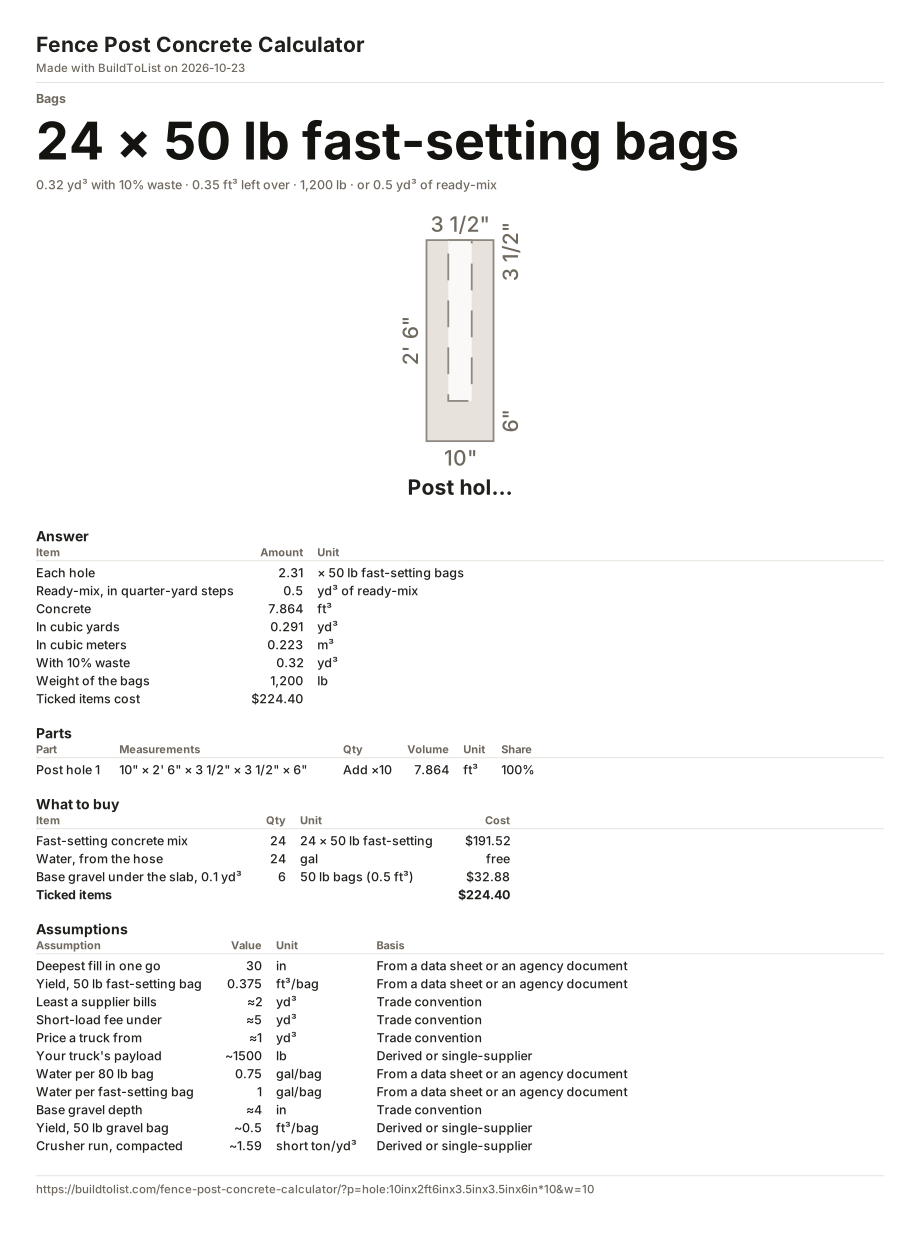
How many bags of concrete per fence post
A 4×4 post in a 10 in hole takes about 2.1 bags of 50 lb fast-setting concrete, set the way the bag's maker describes — 6 in of gravel at the bottom and the concrete stopped 3½ in short of the top — in a hole 30 in deep, which puts 2 ft of post in the ground, the usual minimum for a 6 ft fence. That leaves 20½ in of concrete around the post, and the hole less the post is (π/4 × 10² − 3.5²) × 20.5 = 1,359 cubic inches, or 0.786 cubic feet. At 0.375 ft³ a bag it is 2.10 bags, and 2.31 with the 10% waste in the box.
Buy for the fence, not for each post. The ten posts this page opens with take 7.86 ft³, 8.65 with waste, which is 23.07 bags — so 24 bags, rounded up once for the whole job. Rounding each post up to 3 bags would buy 30, six more than the holes can hold. The line under the answer gives the per-hole figure, and the total is what goes in the cart: 1,200 lb of bags, about 24 gallons of water, and 6 bags of gravel for the bottoms of the holes.
Type your own post, hole and depth over the numbers, and change the quantity to the number of posts. A 4×4 is 3½ in across, not 4 — type the actual size, and the page says so if you type the name.
Why the post comes out of the hole
A hole with a post in it holds less concrete than an empty one. A 4×4 fills 15.6% of a 10 in hole, so a count that treats the hole as a solid cylinder buys about 18% more concrete than the hole can take: 0.932 ft³ a hole instead of 0.786. Here the post's own section comes out first — its side squared for a square post, π/4 times its diameter squared for a round one — and the working under Method shows that subtraction with your numbers in it. Switch the shape between square and round post and every measurement stays where you typed it.
Gravel at the bottom, soil at the top
Quikrete's own post setting instructions put 6 in of gravel in the bottom of the hole, for drainage, and pour the fast-setting mix to 3 to 4 in from the top, so the last few inches can be soil or a sloped cap that sheds water away from the post. The two boxes for those are Gravel at the bottom and Stop short of the top by. Both take 0: set them to 0 and the concrete fills the hole from bottom to brim. The gravel is counted into the shopping list in 0.5 ft³ bags; untick its row if you have gravel already. We are not connected with Quikrete or any other maker.
Bags per hole for common posts
Each row has 6 in of gravel and the concrete stopped 3½ in from the top, and none has waste added yet:
| Post | Hole | Per hole | 50 lb fast-setting | 80 lb mix |
|---|---|---|---|---|
| 4×4 (3½") | 10" × 30" deep | 0.786 ft³ | 2.10 | 1.31 |
| 4×4 (3½") | 12" × 36" deep | 1.547 ft³ | 4.12 | 2.58 |
| 6×6 (5½") | 12" × 36" deep | 1.271 ft³ | 3.39 | 2.12 |
| 6×6 (5½") | 16" × 42" deep | 3.213 ft³ | 8.57 | 5.35 |
| Round 4" | 10" × 30" deep | 0.783 ft³ | 2.09 | 1.30 |
| Round 2⅜" (chain link end) | 8" × 30" deep | 0.544 ft³ | 1.45 | 0.91 |
Multiply by the number of posts, add the waste, and round up once at the end. The bag counts are fractions on purpose: a bag opened for one hole finishes the next.
Fast-setting or ordinary concrete mix
Fast-setting mix is poured dry into the hole around the post and soaked with about a gallon of water a bag; it sets in 20 to 40 minutes, so a post can stand on its own before the next hole is dug. Ordinary concrete mix is mixed first and needs bracing while it cures, but an 80 lb bag yields 0.60 ft³ against 0.375, and at the reference prices in the boxes it costs less than half as much per cubic foot. The Mix select switches the whole project between the two, and the bag line, the per-hole line and the water follow it.
How deep, how wide, and what this page cannot tell you
The same instructions size the hole at three times the post's width and its depth at a third of the post's length plus the 6 in of gravel. For the 8 ft post of a 6 ft fence that is 32 in of post in the ground and a hole 38 in deep — deeper than the 2 ft this page opens on, which is the minimum most guides give. At 38 in the ten holes take 33 bags instead of 24; type your own depth over the 2' 6" and the count follows. Quikrete's own worked example uses a 10 in hole for a 4 in post, and so does this page; it warns about neither.
Depth is the number that matters more, and it is local. Where the ground freezes, a post set above the frost line is lifted a little every winter, and the frost depth is a figure your building department holds, not one in a national code. The panel under the answer says that, and checks nothing it cannot see. Many towns also limit fence height or ask for a permit, and a homeowners' association may have its own rules. Before you dig, call 811: the utility lines are marked for free, and a post hole is exactly deep enough to find one.
Common questions
How many bags of concrete do I need for a 4×4 post?
About 2.1 bags of 50 lb fast-setting mix in a 10 in hole with 20½ in of concrete, or 1.31 bags of 80 lb concrete mix. A round 4 in post in a 10 in hole 2 ft deep, with no gravel and concrete to the brim, takes 2.44. Count the posts first, then buy the total.
How many 80 lb bags of concrete per fence post?
For the 4×4 above, 1.31 before waste. Choose Concrete mix in the Mix select and the per-hole line changes to 80 lb bags; pick a row in the bag table to count in another size.
Do I need gravel under a fence post?
It is there for drainage, so the foot of the post does not sit in water. Quikrete's instructions use 6 in; set the box to 0 if you skip it, and the concrete fills the hole down to the bottom.
Can I count line posts and gate posts together?
Yes. Add a part for the gate posts — usually 6×6 in a wider, deeper hole — and the breakdown gives each kind its own line while the bag count covers both. With two sizes of hole there is no single "per hole" figure, so that line steps aside and the breakdown carries it.
Should the concrete come up to the top of the hole?
Not usually. Stopping 3 to 4 in short leaves room for soil or a sloped cap that sheds water away from the post, which is what the box for it is for. Set it to 0 if you want concrete to grade.
Is the waste added twice?
No. Waste is multiplied in exactly one place in this site, and the result shows the volume before and after it. The per-hole line carries the same waste as the total, so ten holes at 2.31 come to the 23.07 the bags are rounded up from.