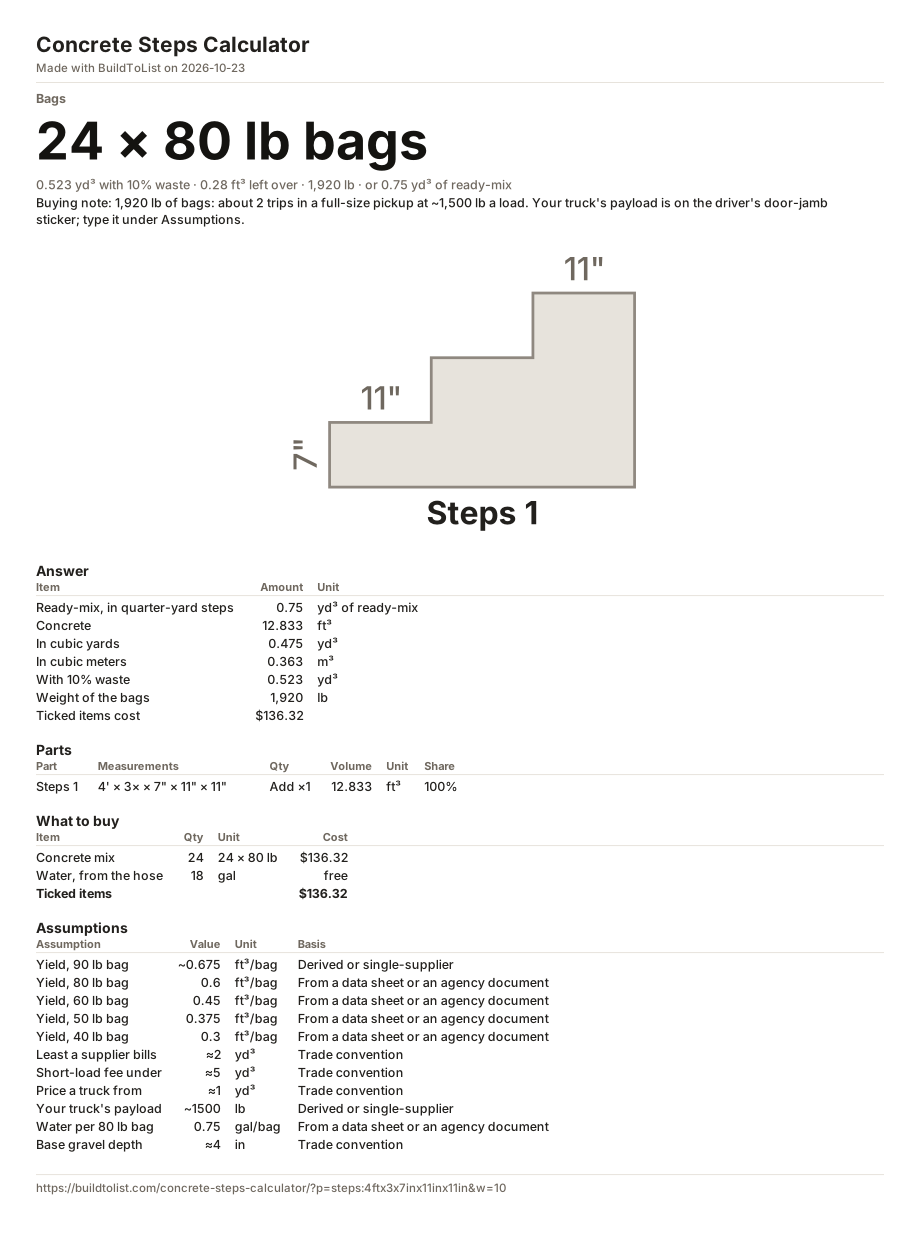
How much concrete for steps
Solid steps are a staircase of blocks: each step is a block as wide as the flight, as deep as everything in front of it, and one rise high. The three steps this page opens with — 4 ft wide, 7 in rise, 11 in treads, with an 11 in top step — add up to 4 ft × 11 in × 7 in × (1 + 2 + 3) = 22,176 cubic inches, or 12.83 cubic feet = 0.475 cubic yards. With the 10% waste in the box it is 14.12 ft³, which is 24 bags of 80 lb — 1,920 lb, more than the 1,500 lb the page assumes a half-ton pickup carries, so it says beside the shopping list that this is two trips.
Type the number of steps as a count, the rise and the treads in inches and the width in feet, the way a set of steps is measured. The top landing has its own box because it is usually deeper than a tread: a landing outside a door is the step people stand on while the door swings.
The formula, with your numbers
For n steps of rise r, tread t and width w, with a top landing L deep:
V = w × t × r × (n − 1) × n ÷ 2 + w × L × n × r
The first term is the steps below the landing, the second is the landing
block, which stands the full height. When the landing is as deep as a tread the
formula folds into w × t × r × n(n + 1) ÷ 2. The working under
Method restates the flight with your own numbers and the cubic feet it comes
to, and the drawing is the steps in section, rise and tread marked where you
typed them.
Bags per set of steps
Solid steps 4 ft wide with a 7 in rise and 11 in treads, top step the same depth as the others, before waste:
| Steps | Concrete | 80 lb bags | 60 lb bags |
|---|---|---|---|
| 2 | 6.42 ft³ | 11 | 15 |
| 3 | 12.83 ft³ | 22 | 29 |
| 4 | 21.39 ft³ | 36 | 48 |
| 5 | 32.08 ft³ | 54 | 72 |
Each step added costs more than the one before, because it is the full depth of every step in front of it. Past four or five steps, a solid set is a cubic yard or more, and a truck is worth pricing — the comparison under the shopping list does it.
Solid or filled
This page counts solid steps. Larger sets are often poured as a shell over a core of compacted gravel or rubble, which saves concrete. To count one, use the concrete calculator: a steps part, plus a second part set to subtract for the block of fill inside it, and the breakdown shows both lines. Keep enough concrete over the fill on every face for the steps to carry their load — your supplier or a mason can say how much for your set.
What the code asks of steps
Where the IRC is in force, the steps to a house have limits worth knowing before the forms go up: a riser no more than 7¾ in and a tread at least 10 in (R311.7.5), with the tallest and shortest riser in a flight within ⅜ in of each other, and a landing outside an exterior door at least 36 in deep in the direction of travel (R311.3). This page counts concrete and does not check those — your building department has the edition in force and any local changes.
Common questions
How many bags of concrete for 3 steps?
For 4 ft wide steps with a 7 in rise and 11 in treads, 22 bags of 80 lb before waste, 24 with 10%. Wider steps scale with the width: the same three steps 5 ft wide are 16.04 ft³: 27 bags before waste, 30 with it.
How many yards of concrete for steps?
Divide the cubic feet by 27. The opening three steps are 0.475 yd³, 0.52 with waste — well under the 2 yard minimum most trucks bill, which is why the page starts from bags.
Does the bottom step sit on a footing?
Steps against a house usually stand on their own footing or a compacted base, and in cold climates below the frost line so they do not lift away from the house. That is a question for whoever designs the steps; add a footing part on the concrete calculator to count its concrete in the same order.
Is the waste added twice?
No. Waste is multiplied in exactly one place in this site, and the result shows the volume before and after it. Set the box to 0 and the two lines agree.