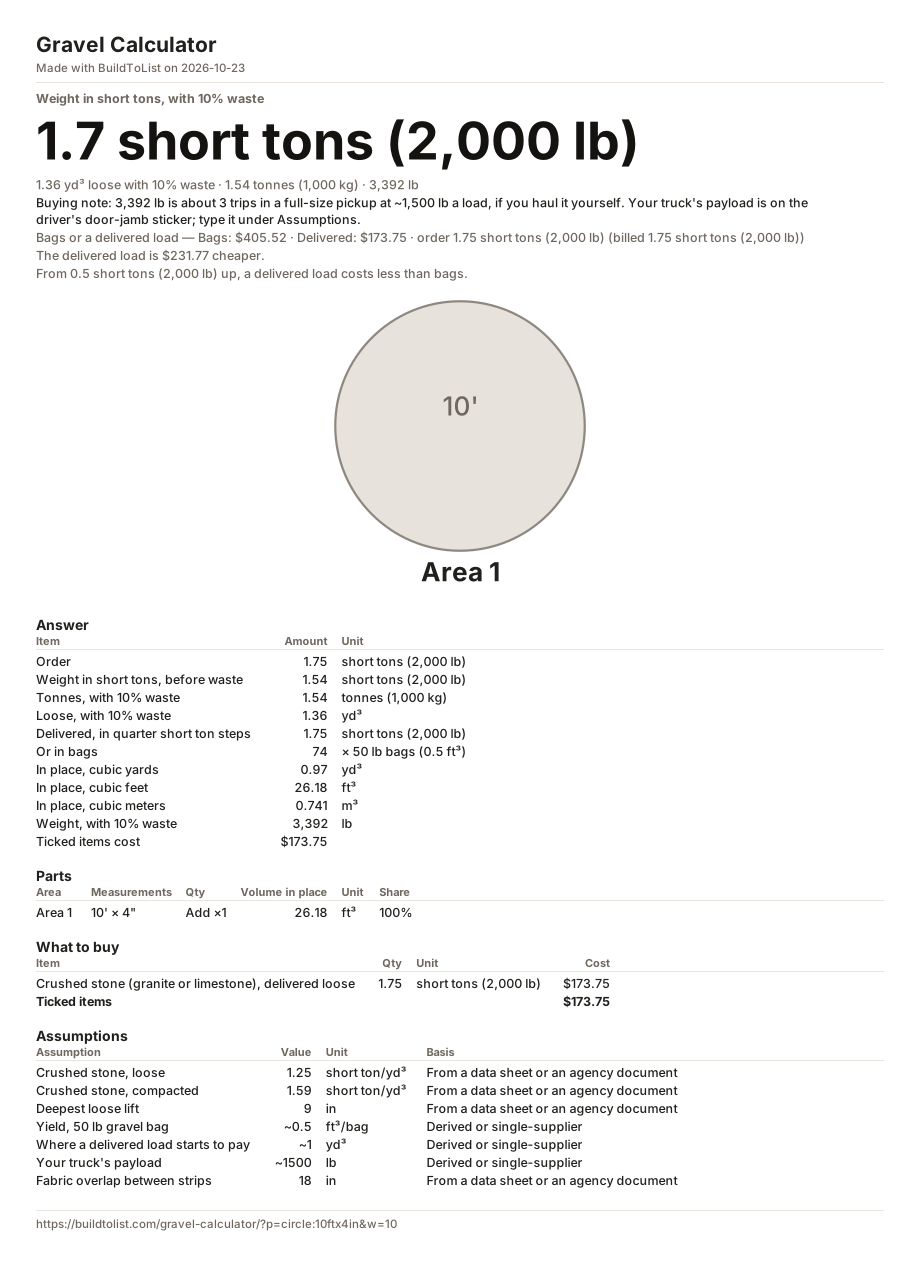
How much gravel you need
Gravel is ordered by weight or by the loose yard, but you measure it as a finished layer. So the sum runs from the layer to the order: area × depth gives the volume in place, the stone's density turns that into short tons, and 10% for waste goes on once at the end. A pad 10 feet by 10 feet and 4 inches deep is 10 × 10 × 4/12 = 33.3 cubic feet, or 1.235 cubic yards. Crushed stone packed down weighs about 1.59 short tons a cubic yard, so the pad holds 1.96 short tons; with waste you order 2.16 short tons, which is 1.96 tonnes or 4,319 lb.
If your yard sells by the cubic yard instead, it measures the stone loose, in the bucket. Loose crushed stone weighs about 1.25 short tons a yard, so the 1.96 short tons that end up in the pad are 1.96 ÷ 1.25 = 1.57 loose yards before waste and 1.73 yards after it. The page prints both, because the two numbers answer two different ways of selling the same stone.
Compacted or loose: the step most calculators get wrong
Stone dumped from a truck has air in it. Run a plate compactor over it and the same stone takes about a fifth less room: the Missouri DOT tables put crushed granite and limestone at 2,410–2,590 lb a yard loose and 3,060–3,300 lb compacted, a ratio of about 1.27. That ratio is real, and it is exactly why it must be used once. Weigh the finished layer at the compacted density, or the loose stone at the loose density — never the compacted density and then another 30% on top.
That second way is what one large calculator does with its own example, a bed 10 × 10 feet and a foot deep. It takes a density already near the compacted figure, adds 10% for waste and then 30% for compaction, and arrives at 7.4 "tons". The 3.70 cubic yards in that bed, at 1.59 short tons a yard compacted, are 5.89 short tons; with 10% waste, 6.48. The difference is about a short ton of stone you would pay for, haul and have nowhere to put.
So the switch on this page asks one question: will you compact it? Answer yes and the depth you typed is the depth after compacting, the weight uses the compacted density, and the loose yards are scaled up by the ratio. Answer no and both use the loose density. Pea gravel, river rock, #57 stone and sand have one figure only, because they are spread and raked rather than packed, and the switch does not appear for them.
What each stone weighs
| Stone | Short tons a yard, loose · compacted | From |
|---|---|---|
| Crushed stone | 1.25 · 1.59 | Missouri DOT |
| Crusher run, paver base | 1.25 · 1.59 ~ | Missouri DOT's crushed stone |
| Trap rock | 1.34 · 1.71 | Missouri DOT |
| #57 stone | 1.38 | FHWA lab tests |
| Pea gravel | 1.4 ~ (1.25 to 1.6) | Suppliers |
| River rock | 1.4 ~ (1.25 to 1.75) | Suppliers |
| Sand | 1.4 | Minnesota PCA |
A ~ marks an estimate. Crusher run and paver base are the same
rock as crushed stone with its fines left in, and no figure of their own was
found, so they borrow its numbers. Stone from two quarries can differ by 10%
or more, so every figure is a box under Assumptions: type your supplier's number
and every line on the page follows it. A supplier who quotes in pounds per cubic
foot can be converted by dividing by 74.07 — 105 lb/ft³ is 1.42 short tons a
yard. We are not connected with any quarry, producer or store named here.
Short tons, tonnes, and the 9% between them
In the United States a quarry that prices gravel "per ton" means the short ton of 2,000 lb. A tonne is 1,000 kg, or 2,205 lb — about 10% heavier. A popular calculator's own answer for a 10 × 10 foot bed 2 inches deep is right at 0.875 short tons, but its help text writes the same stone as "0.794 tons", which is the figure in tonnes. Order 0.794 short tons from that sentence and you are 9% short. Every weight on this page says which one it is, and both are printed side by side.
How deep to spread it
- Gravel driveway: the Federal Highway Administration's gravel roads guide asks for at least 4.5 inches of surface gravel on firm ground, 5.5 on average soil and 6.5 on soft ground, for the lightest traffic it lists. Six inches — four of base and two of surface stone — is the usual answer.
- Path or patio bed: 2 to 3 inches is what suppliers recommend; no agency publishes a figure. The one firm rule is that a layer should be at least twice as deep as its largest stone, so ⅜ inch pea gravel wants ¾ inch or more.
- Base under a shed or pavers: 4 to 6 inches compacted is common.
Spread a deep base in layers. The NRCS access-road standard limits each loose lift to 9 inches before it is compacted, and a Penn State bulletin on gravel roads gives the feel of it: 8 inches spread packs to about 6. When a layer you type needs more than 9 inches of loose stone, the page says how many lifts.
Bags or a delivered load
Bagged gravel, sand and paver base are sold by volume, 0.5 cubic feet a bag, which is 54 bags to the loose yard. The 10 × 10 pad above is 94 bags, and at about 50 lb each that is some 4,700 lb to lift twice — about three trips in a full-size pickup at the 1,500 lb payload we assume. A yard delivers the same stone in one dump. Type the price per bag, the yard's price per short ton or per yard, and its delivery fee, and the block under the shopping list says which costs less and from what quantity the load wins. The delivered prices start at a dated reference estimate, and they vary several times over from one region to the next: type your yard's before you trust the comparison. Under 1 cubic yard the page buys bags whatever the arithmetic says, because a trip charged whole rarely pays for a few bags' worth.