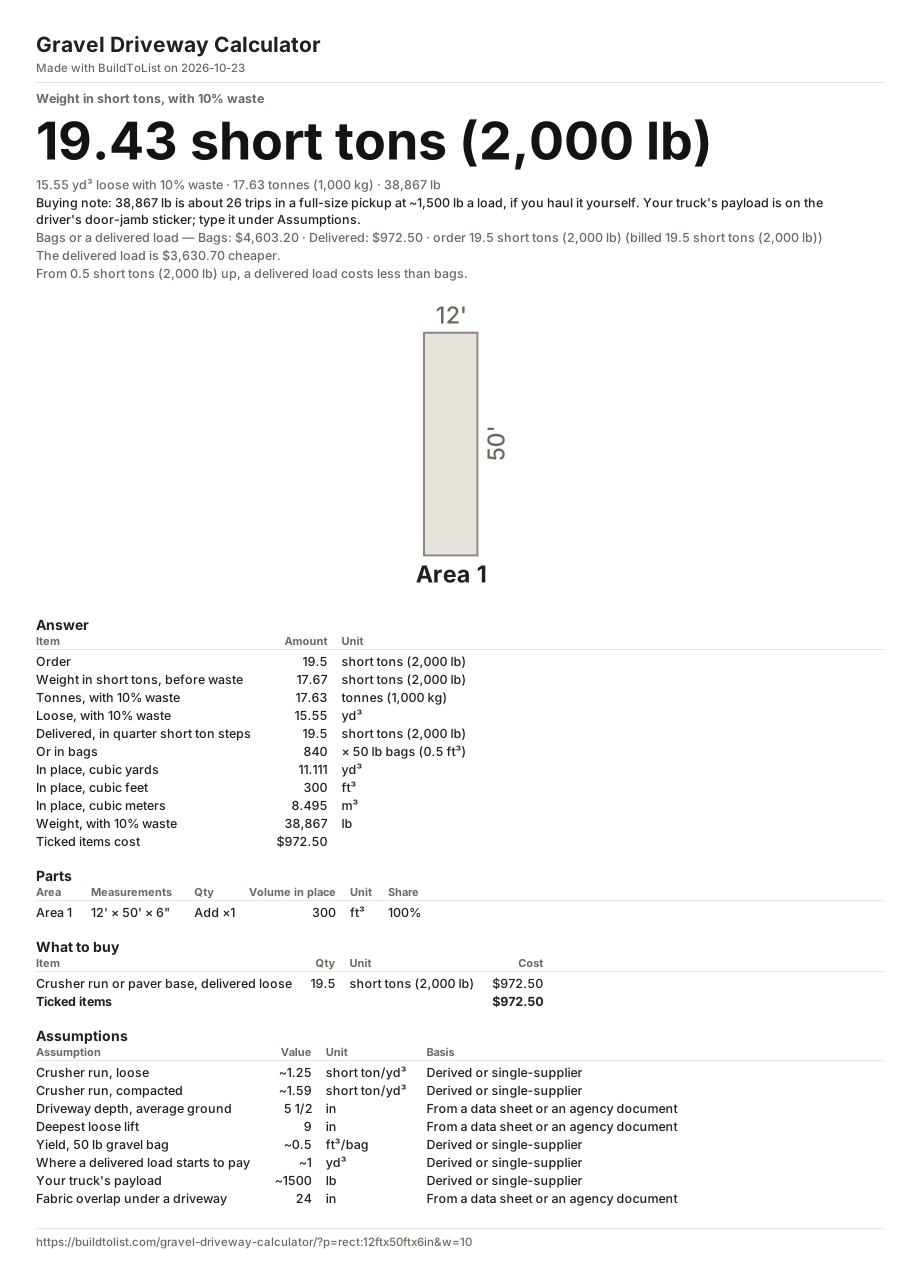
How much gravel a driveway takes
Length × width × depth gives the volume of the finished drive, and the stone's compacted weight turns it into short tons. A single-car drive 12 feet wide and 50 feet long, 6 inches deep once rolled, is 12 × 50 × 6/12 = 300 cubic feet, or 11.1 cubic yards. Crusher run packed down weighs about 1.59 short tons a yard, so the drive holds 17.7 short tons; with 10% for waste you order 19.4 short tons. A yard that sells by volume loads it loose, which is more: 15.5 cubic yards, because compacting squeezes about a fifth of the air out of the stone.
The depth you type is the depth after compacting, which is how a drive is specified and how you check it with a ruler afterwards. The page weighs it once, at the compacted figure. It never adds a compaction allowance on top of a compacted density — that double count is how one well-known calculator orders 20 to 30% more stone than the drive holds.
How thick: the FHWA figures
The Federal Highway Administration's Gravel Roads Construction & Maintenance Guide gives the least depth of gravel a road needs — the whole course, base and surface together — by how many heavy trucks use it and how firm the ground under it is. For the lightest traffic it lists — up to five heavy trucks a day, which covers a house drive with the odd delivery — the figures are:
| Ground under the drive | Gravel, at least | 12 × 50 ft drive, with waste |
|---|---|---|
| Firm | 4.5 in | 14.6 short tons |
| Average | 5.5 in | 17.8 short tons |
| Soft | 6.5 in | 21.1 short tons |
Choose the ground under the drive in the form, and every area typed thinner than its figure says so beside its depth box. The usual answer of 6 inches — 4 of base and 2 of surface stone — clears firm and average ground and falls short on soft ground, where the guide asks for 6½. Clay that stays wet, or ground that ruts under a car, is the soft column; and if it pumps mud through the stone it needs drainage under it, which this page does not design, and a fabric: the landscape fabric row on the list, unticked until you tick it, lays it under the stone at a 24 inch overlap.
Spread it in lifts
Stone compacts only so deep. The NRCS standard for farm access roads limits each loose lift to 9 inches before it is rolled, and a Penn State bulletin on gravel roads puts the shrink plainly: 8 inches spread packs to about 6. Six inches of compacted crusher run starts as about 7.6 loose, one lift; 8 inches compacted is about 10.2 loose, and the page tells you to lay it in two. The FHWA guide adds that each layer should be at least twice as deep as its largest stone.
Base and surface are two stones
A drive is often a base of crusher run with a surface of #57 or another clean stone on top. Work the base here at its own depth, then open the same outline on the gravel calculator — the link below carries it — choose the surface stone and type its depth. The two orders are two lines on the yard's ticket anyway.
Buying it
Nineteen short tons is 38,867 lb, which is no job for a pickup: at the 1,500 lb payload we assume, that is 26 trips. Quarries and yards deliver in dump trucks and sell by the short ton of 2,000 lb, sometimes by the cubic yard. Type the yard's price per short ton and its delivery fee in the comparison under the shopping list for the total; the order is rounded up to the step you choose, a quarter short ton unless you say otherwise. The delivered prices start at a dated reference estimate and vary several times over from one region to the next, so type your yard's. We are not connected with any quarry or supplier.