Find a tool

Pea Gravel Calculator

A patio, a path, a play area — the loose yards or the bags to buy.

Material only — pea gravel weights vary by pit; ask your supplier for theirs.

Area 1

10' · 120 in · 10 ft · 3.048 m

12' · 144 in · 12 ft · 3.6576 m

3" · 3 in · 0.25 ft · 0.0762 m

30 ft³

10% covers what is pressed into soft ground, spread past the edges and left in the truck bed or the bags. It is added once, to the weight and to the loose yards.

This page recalculates as you type. There is no Calculate button.

Answer

Save imageExcel

Loose, with 10% waste

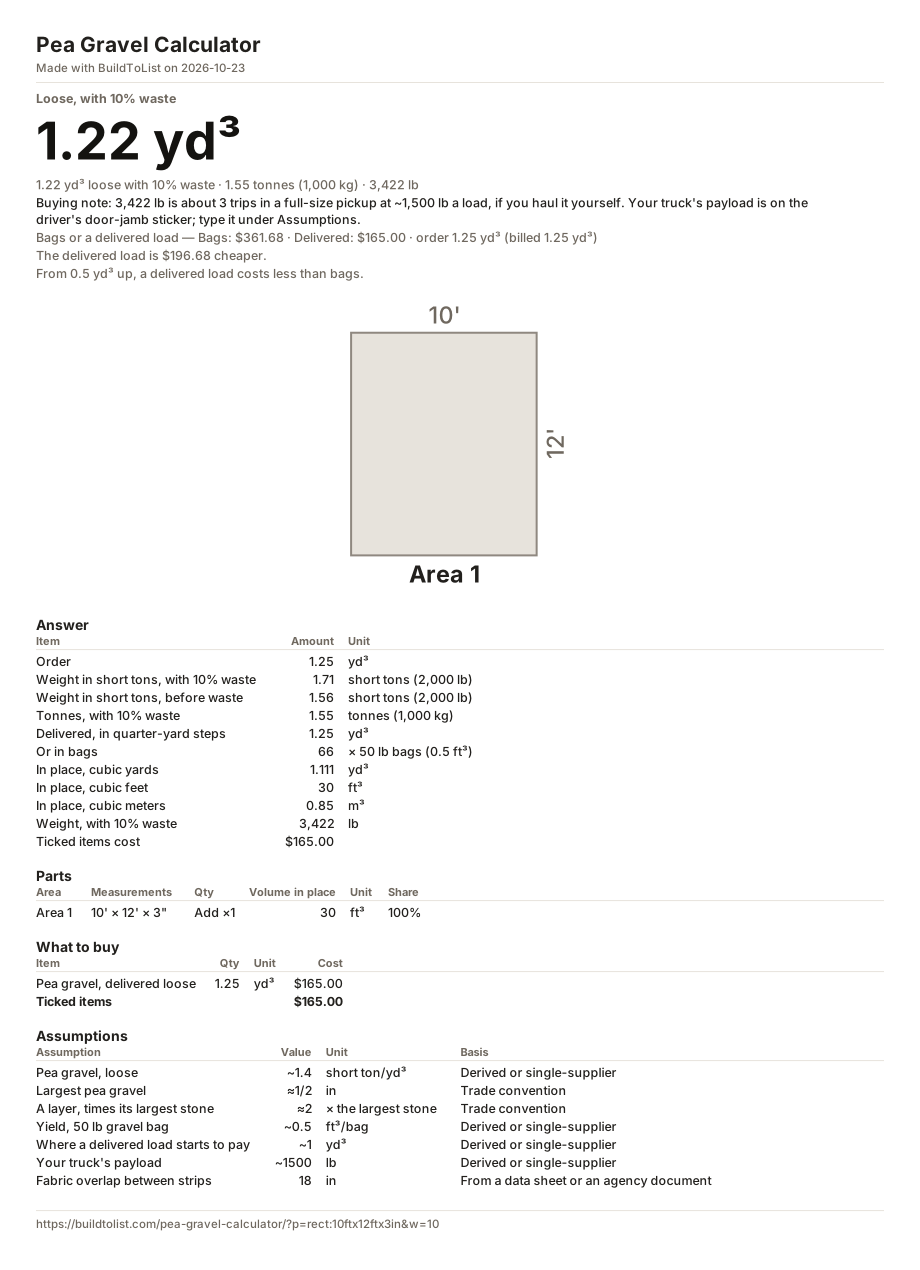
1.22 yd³

1.22 yd³ loose with 10% waste · 1.55 tonnes (1,000 kg) · 3,422 lb

Order 1.25 yd³
Weight in short tons, with 10% waste 1.71 short tons (2,000 lb)
Weight in short tons, before waste 1.56 short tons (2,000 lb)
Tonnes, with 10% waste 1.55 tonnes (1,000 kg)
Delivered, in quarter-yard steps 1.25 yd³
Or in bags 66 × 50 lb bags (0.5 ft³)
In place, cubic yards 1.111 yd³
In place, cubic feet 30 ft³
In place, cubic meters 0.85 m³
Weight, with 10% waste 3,422 lb
Ticked items cost $165.00
DrawingThe project drawn to scale. Area 1: 10' × 12'.10'12'Area 1

Breakdown

Area Measurements Qty Volume in place Share
Area 1 10' × 12' × 3" Add ×1 30 ft³

What to buy

Buying note3,422 lb is about 3 trips in a full-size pickup at ~1,500 lb a load, if you haul it yourself. Your truck's payload is on the driver's door-jamb sticker; type it under Assumptions.

Ways to buy the bags

Bags of gravel, sand and paver base are sold by volume, 0.5 ft³ a bag; the count is the loose volume over that.

66 × 50 lb bags (0.5 ft³) Bags 66 Left over 0 ft³ Weight 3,300 lb Cost $361.68 Reference price $5.48. Type your store's.

Shopping list

1.25 yd³ $165.00
1 rolls $24.00 Reference price $0.12. Type your store's.
Ticked items $165.00

Untick what you already have. A delivered load's price includes the delivery fee you type below.

Save imageExcel

Bags or a delivered load

Bags $361.68
Delivered $165.00 order 1.25 yd³

The delivered load is $196.68 cheaper.

From 0.5 yd³ up, a delivered load costs less than bags.

Reference price $56.00. Type your store's. Reference price $95.00. Type your store's.

Every supplier rounds, sets a minimum and charges for small loads its own way. Ask before you order.

How this was worked out

Every number below is yours. Each constant links to the row where you can change it.

Area 1 10' × 12' × 3" 30 ft³
All areas 30 ft³ ÷ 27 1.111 yd³ · 0.85 m³
Weight 1.111 yd³ × 1.4 short tons a yard, loose 1.556 short tons (2,000 lb)

Change:Pea gravel, loose

Plus waste 1.556 short tons (2,000 lb) × (1 + 10%) 1.711 short tons (2,000 lb) · 1.552 tonnes (1,000 kg)
Loose, to order 1.111 yd³ × (1 + 10%) 1.222 yd³
Bags 33 ft³ ÷ 0.5 ft³ a bag 66 × 50 lb bags (0.5 ft³) · 0 ft³ left over

Change:Yield, 50 lb gravel bag

Delivered 1.222 yd³ → quarter-yard 1.25 yd³
Cost 1.25 yd³ × $56.00 + $95.00 $165.00

Assumptions

Every one of these is editable. Change one and the answer changes with it.

Assumption Value Confidence
Pea gravel, looseStone Center (Ohio) gives 1.4-1.6 short tons per yd³, Inch Calculator 1.25-1.5. Supplier figures only; ask yours. ~ short ton/yd³ Derived or single-supplier
Largest pea gravelPea gravel is most often sold as AASHTO No. 8, all of which passes ½ in (FHWA-HRT-15-034 Table 4); a bag sold as all-purpose gravel can be ⅜ in top size (Quikrete 1151). ≈ in Trade convention
A layer, times its largest stoneFHWA Gravel Roads Construction & Maintenance Guide (FHWA-OTS-15-0002, 2015), §3.21: a general rule is that each layer is at least twice as thick as its top-sized stone - a 1 in stone, a 2 in layer. ≈ × the largest stone Trade convention
Yield, 50 lb gravel bag0.5 ft³ per 50 lb bag. Sand, which the sand page buys in the same bag: Sakrete Play Sand (data sheet REV 3-10) and Sakrete's commercial sands (Rev. 06/16) yield 0.5 ft³, Quikrete Premium Play Sand is labeled 'approx 1/2 cu. ft.'; mason sand runs larger, 0.6 ft³ (Sakrete, Rev. 04/16). Gravel: Quikrete All-Purpose Gravel as retailers list it. ~ ft³/bag Derived or single-supplier
Where a delivered load starts to payAbout where bags stop making sense: 54 bags of 0.5 ft³, some 2,700 lb. Chosen, not sourced. ~ yd³ Derived or single-supplier
Your truck's payloadFull-size (1500-series) pickups advertise 2,260-2,440 lb of payload (2026), and ordinary trims carry 600-700 lb less; this is the low end. Your truck's figure is on the driver's door-jamb placard. ~ lb Derived or single-supplier
Fabric overlap between stripsNRCS Construction Specification 95, Geotextile (national 210-VI-NIH, May 2001): panels joined without sewing overlap at least 18 in unless otherwise specified. in From a data sheet or an agency document

How much pea gravel you need

Multiply the area by the depth, add 10% for waste, and you have the loose volume to buy. A patio 10 feet by 12 feet, 3 inches deep, is 10 × 12 × 3/12 = 30 cubic feet, or 1.11 cubic yards. With waste that is 1.22 cubic yards, which a landscape yard rounds up to 1¼, or 33 cubic feet, which is 66 bags of 0.5 cubic feet. It weighs about 1.71 short tons (3,422 lb), at 1.4 short tons a yard.

Pea gravel is not compacted. The stones are round, so they roll past each other instead of locking, and a plate compactor only moves them around. That is why this page has no compaction question: the depth you type is the depth you rake out, and the yards you buy are the yards that go down. The waste is for what works into the soil, spills past the edge and stays in the truck bed.

How deep to spread it

  • Paths and walks: 2 inches is the usual depth. Deeper than about 3 and it is like walking on a beach.
  • Patios and seating areas: 3 inches, on a compacted base of crushed stone so the pea gravel does not sink into the soil.
  • Never thinner than twice the stone: the gravel roads guide of the Federal Highway Administration asks for a layer at least twice as deep as its largest stone. Pea gravel is about ⅜ inch, so ¾ inch is the floor, and that only for a top-up.
  • Play areas have surfacing rules of their own. Check the U.S. Consumer Product Safety Commission's Public Playground Safety Handbook before you choose a depth under swings or a climber.

The 2 and 3 inch figures are what suppliers recommend; no agency publishes a depth for a garden path. Edging matters more than an extra inch: without a border the stones walk out onto the lawn, and the path gets thinner every month.

One cubic yard covers

Depth One yard covers Bags per 100 ft²
2 in162 ft²34
3 in108 ft²50
4 in81 ft²67

Those are before waste, and the bags are rounded up: 100 square feet at 2 inches is 16.7 cubic feet, which is 33.3 bags, so you buy 34. The page adds the waste once, on the loose volume, and counts the bags from that.

Bags or a yard delivered

A bag holds 0.5 cubic feet, so a cubic yard is 54 bags. Bags make sense for a top-up or a small bed; past about a yard they are a lot of lifting. The patio above is 66 bags — at about 50 lb each, 3,300 lb, which is three trips in a full-size pickup at the 1,500 lb payload we assume — or one dump from a truck. At the reference $5.48 a bag that is $361.68. Type the yard's price per cubic yard and its delivery fee into the comparison under the shopping list, and the page says which costs less and from what amount the delivery wins. The delivered prices start at a dated reference estimate; they vary by region, so type your yard's.

A path 3 feet wide and 40 feet long at 2 inches, ending at a round seating area 8 feet across, is two areas on this page: 20 cubic feet for the path and 8.4 for the circle. That is 1.16 yards loose with waste, or 63 bags. Add an area for each piece of the layout, and subtract one for a tree or a bed you leave out.

What a yard of pea gravel weighs

About 1.4 short tons, or 2,800 lb, though suppliers quote anywhere from 1.25 to 1.6 depending on how wet it is and how evenly it is screened. Only supplier figures were found; no quarry data sheet. The number is a box under Assumptions: if your yard sells by the short ton, type its own figure and the weight follows. We are not connected with any supplier.