Find a tool

Fence Calculator

Your fence line, run by run — every post, what hangs between them, and what each hole takes.

An estimate of material — your yard's lumber, local rules and the ground decide the build.

Run 1

200' · 2400 in · 200 ft · 60.96 m

200 ft

This page recalculates as you type. There is no Calculate button.

Answer

Save imageExcel

Posts

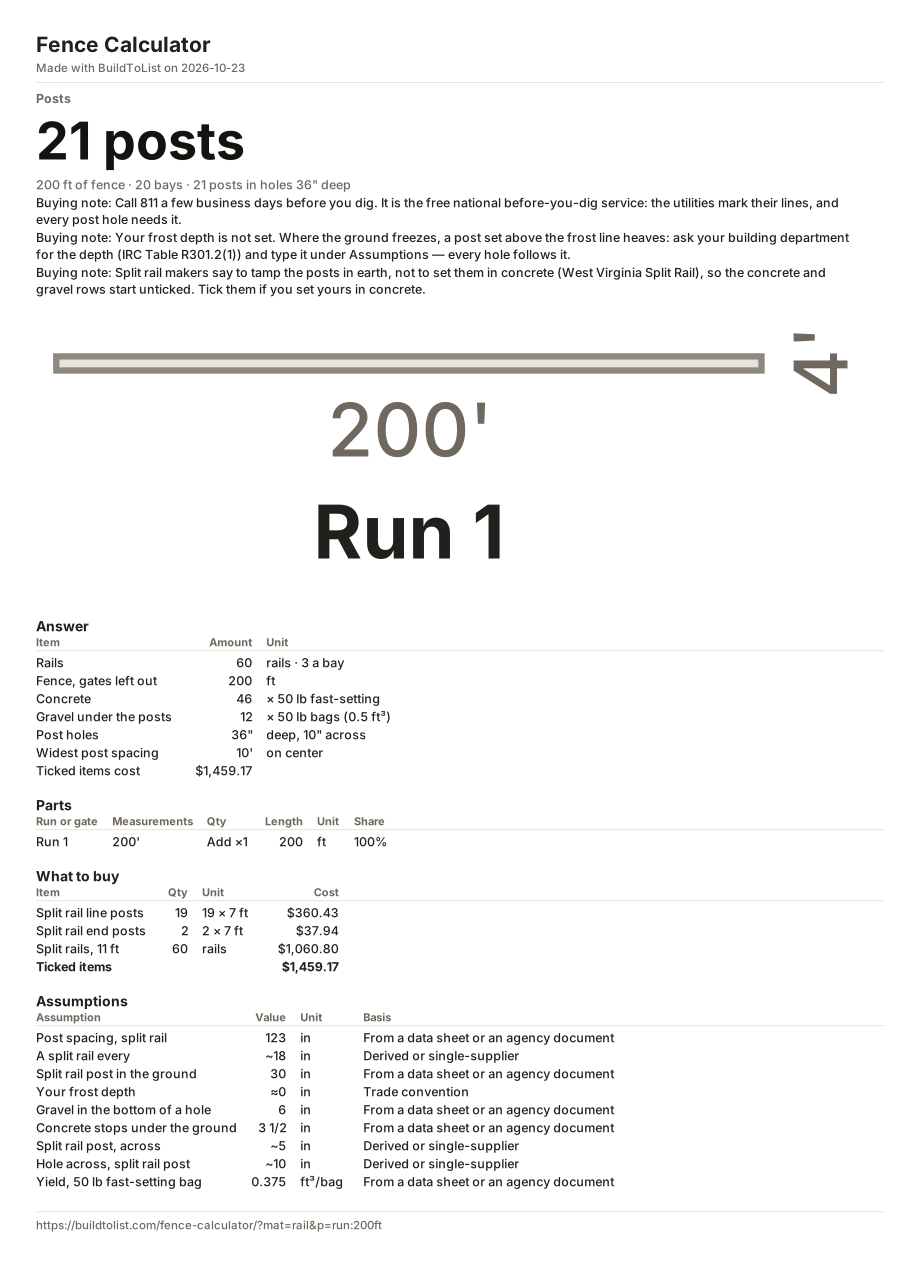
21 posts

200 ft of fence · 20 bays · 21 posts in holes 36" deep

Rails 60 rails · 3 a bay
Fence, gates left out 200 ft
Concrete 46 × 50 lb fast-setting
Gravel under the posts 12 × 50 lb bags (0.5 ft³)
Ticked items cost $1,459.17
More numbers
Post holes 36" deep, 10" across
Widest post spacing 10' on center
DrawingThe project drawn to scale. Run 1: 200' × 4'.200'4'Run 1

Breakdown

Run or gate Measurements Qty Length Share
Run 1 200' Add ×1 200 ft

What to buy

Buying noteCall 811 a few business days before you dig. It is the free national before-you-dig service: the utilities mark their lines, and every post hole needs it.
Buying noteYour frost depth is not set. Where the ground freezes, a post set above the frost line heaves: ask your building department for the depth (IRC Table R301.2(1)) and type it under Assumptions — every hole follows it.
Buying noteSplit rail makers say to tamp the posts in earth, not to set them in concrete (West Virginia Split Rail), so the concrete and gravel rows start unticked. Tick them if you set yours in concrete.

Ways to buy the concrete

The bags for every post hole together, by the shape of the holes. Every way is worked out; pick the one you will buy.

46 × 50 lb fast-setting Bags 46 Left over 0.01 ft³ Weight 2,300 lb Cost $367.08 Reference price $7.98. Type your store's.

Shopping list

19 19 × 7 ft $360.43 Reference price $2.71. Type your store's.
2 2 × 7 ft $37.94 Reference price $2.71. Type your store's.
60 rails $1,060.80 Reference price $17.68. Type your store's.
46 46 × 50 lb fast-setting $367.08
12 12 × 50 lb bags (0.5 ft³) $65.76 Reference price $5.48. Type your store's.
Ticked items $1,459.17

Untick what you already have. Lumber is priced by the foot, beside its row; the concrete's bags are priced in the table above.

Save imageExcel
How this was worked out

Every number below is yours. Each constant links to the row where you can change it.

Run 1 200' 200 ft
Posts 20 bays in 1 runs: 19 line + 2 end + 0 corner + 0 gate 21 posts

Change:Post spacing, split rail

How deep a post goes 30" in the ground, or the frost depth 0" where deeper 30" + 6" = 36"

Change:Split rail post in the groundYour frost depthGravel in the bottom of a hole

Line posts, length 48" + 30" = 78" 19 × 7 ft
End posts, length 48" + 30" = 78" 2 × 7 ft
Concrete, each line post (π ÷ 4 × 10" × 10" − 5" × 5") × 26 1/2" 0.821 ft³ × 19 = 15.6 ft³

Change:Split rail post, acrossHole across, split rail postConcrete stops under the ground

Concrete, each end post (π ÷ 4 × 10" × 10" − 5" × 5") × 26 1/2" 0.821 ft³ × 2 = 1.642 ft³

Change:Split rail post, acrossHole across, split rail postConcrete stops under the ground

Bags of concrete 17.242 ft³ ÷ 0.375 ft³ 45.98 → 46 × 50 lb fast-setting

Change:Yield, 50 lb fast-setting bag

Gravel under the posts π ÷ 4 × 10" × 10" × 6" × 19 + π ÷ 4 × 10" × 10" × 6" × 2 5.727 ft³ → 12 × 50 lb bags (0.5 ft³)

Change:Gravel in the bottom of a hole

Split rails 20 × 3 60

Change:A split rail every

What it comes to 19 × 7 ft × $2.71/ft + 2 × 7 ft × $2.71/ft + 60 × $17.68 $1,459.17

Assumptions

Every one of these is editable. Change one and the answer changes with it.

Assumption Value Confidence
Post spacing, split railWest Virginia Split Rail installation instructions: 11 ft rails lapped 6 in into each post, so posts stand about 10 ft 3 in on center. in From a data sheet or an agency document
A split rail everySplit rail is sold two rails for a fence about 3 ft high and three for about 4 ft; one rail for every 18 in of height gives the same. ~ in Derived or single-supplier
Split rail post in the groundWest Virginia Split Rail: post holes 24-30 in deep, backfilled with tamped earth. The deep end, which puts a 3-rail fence on a 7 ft post. in From a data sheet or an agency document
Your frost depthYour frost depth, from your building department (IRC Table R301.2(1) is filled in locally). 0 means not given: every hole is then as deep as the post's own rule. Typed in, no hole stops above it. ≈ in Trade convention
Gravel in the bottom of a holeQuikrete Setting Posts, step 2: 6 in of gravel or crushed stone in the bottom of the hole, for drainage. in From a data sheet or an agency document
Concrete stops under the groundQuikrete Setting Posts, steps 4 and 6: fill the hole to 3-4 in below the top, then finish with soil. The middle of the range. in From a data sheet or an agency document
Split rail post, acrossA split rail post is a split log about 5 in across; taken as square for the hole it fills. ~ in Derived or single-supplier
Hole across, split rail postA split rail post's hole; the rail maker gives a depth and no width. ~ in Derived or single-supplier
Yield, 50 lb fast-setting bagQuikrete Fast-Setting Concrete Mix spec sheet. ft³/bag From a data sheet or an agency document

What a 100 foot fence takes

A straight run of 100 feet with posts no more than 8 feet apart is 12½ bays, so it is 13 bays of 7' 8 5/16" each, and 14 posts — always one more post than bays on a run with two free ends. A 6 foot privacy fence carries three 2×4 rails a bay, one for every 24 inches of height: 39 rails, each an 8 foot board. Its 1×6 pickets are 5½ inches wide, so 1,200 inches of fence takes 1,200 ÷ 5.5 = 218.2, rounded up to 219 pickets — 230 with 5% for the ones that split or warp.

Each post goes 36 inches into the ground, half the 72 inches that stand above it, on a 6 inch bed of gravel: a hole 42 inches deep and 10 inches across. The concrete fills it from the gravel to 3½ inches under the ground, around the post: (π ÷ 4 × 10" × 10" − 3½" × 3½") × 32½" is 1.247 cubic feet a post, 17.455 for fourteen, and at 0.375 cubic feet a 50 pound bag of fast-setting mix that is 47 bags. A post 72 + 36 = 108 inches long is bought as a 10 foot 4×4 and cut.

Runs, corners and gates

List your fence the way you walk it. Each run starts where the one before it ends, so the posts stand at the joints: where two runs meet is a corner post, either side of a gate is a gate post, and an open line has an end post at each end. Close the line — a garden or a pool all the way round — and the last run meets the first at a corner, with no ends at all. A back yard of 50, 100 and 50 feet is 27 bays and 28 posts: 24 inside the runs, two corners and two ends. Added up run by run it would come to 30.

A gate takes its own two posts, its hinges, a latch, and on a double gate a drop rod to hold the fixed leaf down. A wood gate is framed on site from the same 2×4s and pickets; chain link, vinyl and aluminum gates are bought made.

Why the holes are deeper than some calculators say

Quikrete's rule is a hole half as deep as the post stands — a third of the post's length — with 6 inches of gravel under it. Inch Calculator buries a 6 foot fence's posts 2 feet, a third of its height, which is a foot shallower. Where the ground freezes, a post set above the frost line heaves: your building department knows the depth, and typed into Your frost depth under Assumptions it sets every hole.

Bags are counted from the shape of the holes, not from a rule of so many a post. Quikrete's own example — two 50 pound bags for a 4 inch post in a 10 inch hole 2 feet deep — fills about four fifths of the hole: the geometry says 2.46 bags.

What this does not do yet

A fence down a slope, stepped or racked, is worked out as if the ground were level, and one height is asked for the whole line. Before you dig, call 811, and ask your town and any homeowners' association how tall a fence may be and where it may stand. We are not connected with any maker, store or supplier named here.