Deck footings: how wide, how thick, how many bags
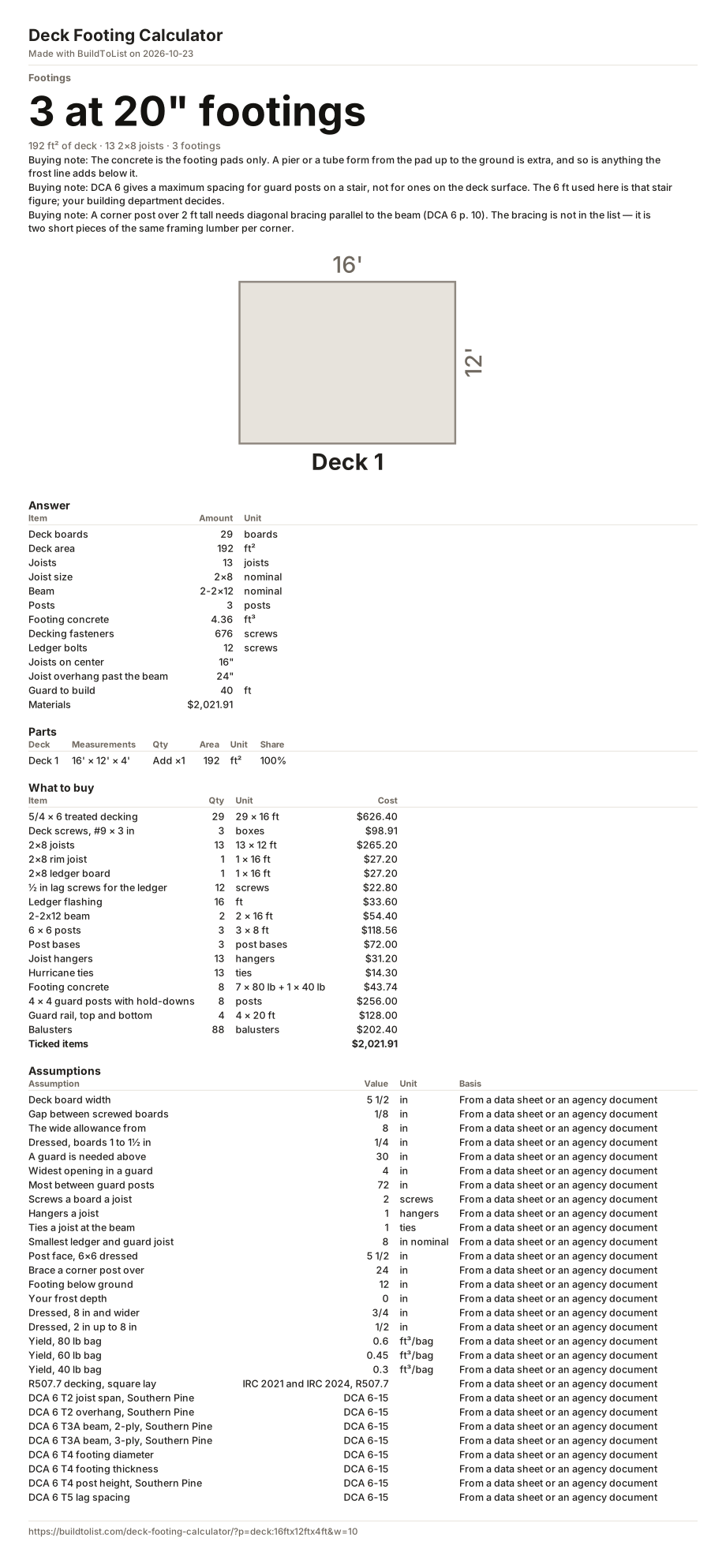
A 16 by 12 foot deck on three posts, its beam spanning 8 feet and its joists 10, takes a 20 inch round footing 8 inches thick under each post. π × 10² × 8 is 2,513 cubic inches, 1.45 cubic feet, and three of them are 4.36 cubic feet — eight bags, seven of 80 pounds and one of 40.
Footing size is DCA 6-15 Table 4, read against the beam span and the joist span, and both axes are "less than or equal to", so a span between two columns is read in the wider one. The table assumes soil that bears 1,500 psf and concrete at 150 pcf. Widen the post spacing and the footings grow fast: the same deck on two posts would want a far bigger pad than on three.
How deep the hole goes
The guide puts every footing on undisturbed soil at least 12 inches below the undisturbed ground surface, or below the frost line, whichever is deeper. Only your building department knows the local frost depth; type it into Your frost depth under Assumptions and the hole follows it. A footing closer than 5 feet to an exterior house foundation wall has to bear at the same elevation as the house footing.
Do not dig over a septic field, a leach field, a utility line or an enclosed meter, and call 811 first.
The concrete here is the pads only
What this counts is the footing pad the table sizes. A pier or a tube form carrying the post from the pad up to the ground is extra concrete, and it is not in the bag count — the volume depends on a form diameter nothing on this page asks for yet. The same goes for whatever the frost line adds below the pad. Deeper holes mean more concrete than the eight bags above.
Post anchors have to be galvanised or stainless, and the pad thickness has to suit the anchor you buy. Posts are 6×6 nominal at the smallest, centered on the footing, with cut ends and notches field-treated. These are estimates from a prescriptive guide: a licensed contractor or engineer, and your local authority, decide what is built.