Ledger bolts: how many, and how far apart
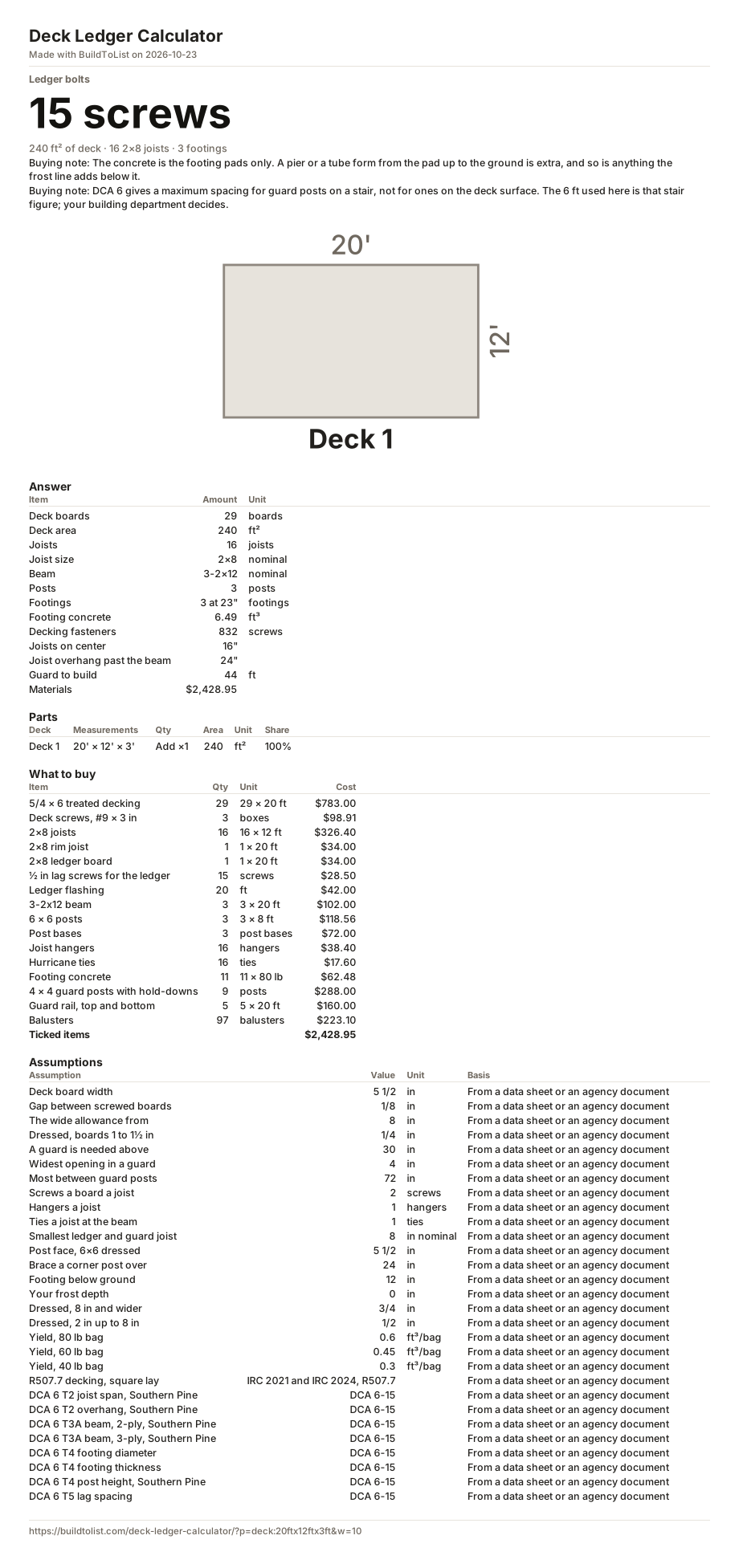
A 20 foot ledger carrying joists that span 10 feet takes ½ inch lag screws at 18 inches on center, which is 15 of them over the run. DCA 6-15 Table 5 reads the spacing off two things: what the house's band joist is, and how far the joists span. A 1½ inch solid-sawn band takes 30 inches at a 6 foot span, 18 at 10 feet, and 10 inches by the time the joists reach 18 feet.
Switch to ½ inch through bolts and the same band allows 34 inches at a 10 foot span — bolts carry nearly twice what lags do in solid lumber. The difference is smaller against an LVL rim: 1 inch LVL takes 14 inches either way. Fasteners are staggered, not in a line.
What may not be bolted into
Attaching a ledger to brick, stone or any masonry veneer is prohibited, and so is attaching to hollow masonry, to a cantilevered floor overhang or to a bay window. If that is your wall, the deck has to stand free of the house: two beams instead of one, joists over both, diagonal bracing, and no ledger at all. Switch Attachment under Assumptions and the page rebuilds the frame that way.
Lead anchors are prohibited outright. The lag's tip has to extend fully past the inside face of the band or rim joist, and there may be no more than 15/32 inch of sheathing between the ledger and the band. Flash or caulk the ledger so water cannot reach the house band — the row for flashing is in the list, by the foot.
The ledger is a 2×8 at the smallest
Table 2's sixth footnote sets it, and it holds whatever the span works out to: a shallow deck that would otherwise take 2×6 joists still gets a 2×8 ledger, and so does any joist or rim joist a guard post is bolted to. The ledger is pressure-preservative-treated No. 2 at the smallest.
Ledger failures are the commonest way a deck comes off a house, and this table is the reason the guide exists. It is still an estimate from a prescriptive document: a licensed contractor or engineer, and your local building department, decide what is built.