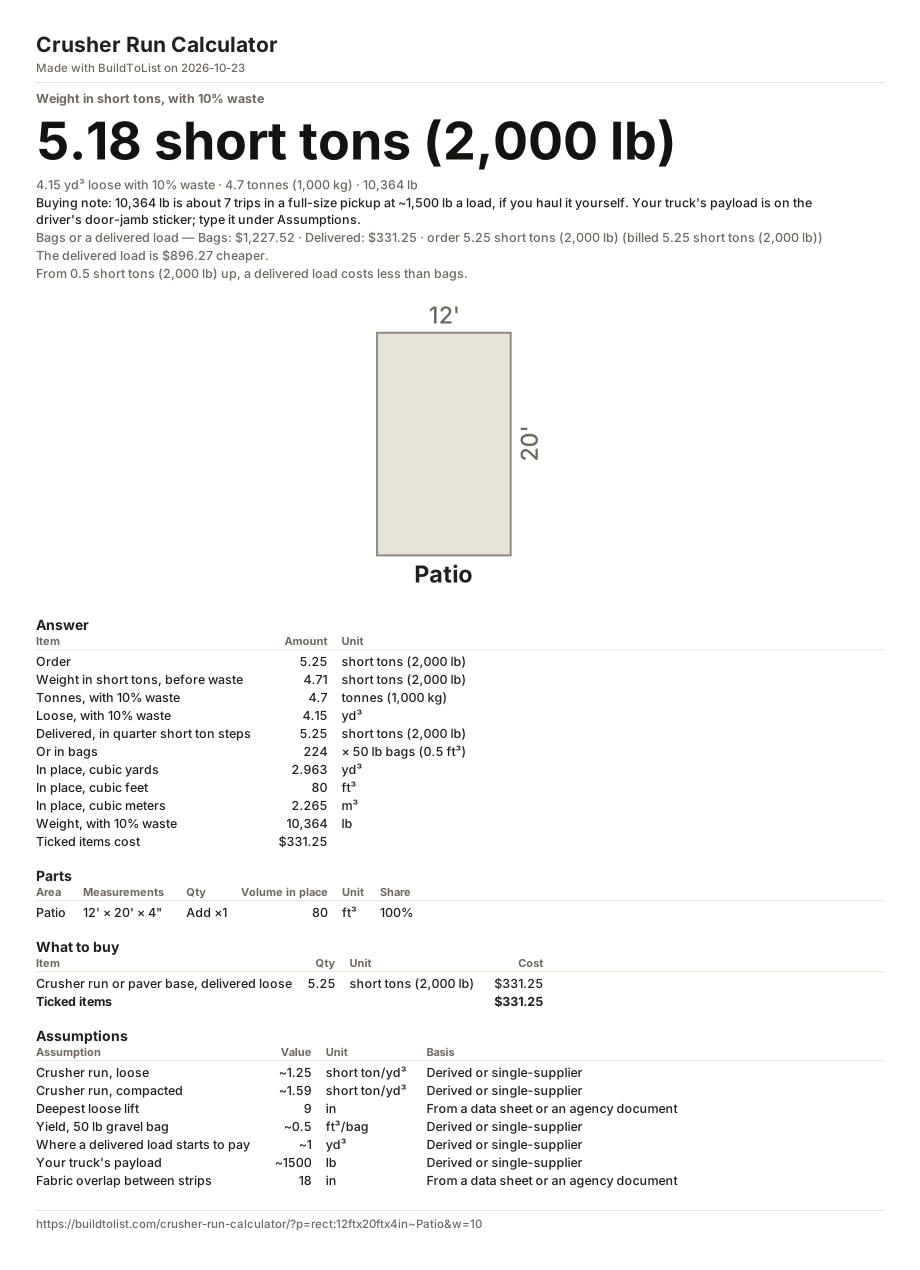
How much crusher run you need
Crusher run is weighed at its compacted density, because the depth you measure is the depth after the plate compactor. A shed pad 12 by 16 feet, 4 inches deep once packed, is 12 × 16 × 4/12 = 64 cubic feet, or 2.37 cubic yards. Compacted crusher run weighs about 1.59 short tons a yard, so the pad holds 3.77 short tons; with 10% for waste you order 4.15 short tons, which a quarry rounds up to 4¼.
If the yard sells it by the cubic yard, it is measuring loose stone in a bucket, and loose crusher run takes more room: about 1.25 short tons a yard. The same pad is 3.32 loose yards with waste, rounded up to 3½. Ordering the 2.37 yards the finished pad occupies would leave you about 30% short of the 3.32 you need.
What crusher run is
Crushed stone with its fines left in — the stone dust from the crusher, not screened out. The fines fill the gaps between the larger stones, which is why it packs hard and why it is the usual base under sheds, patios, pavers and driveways. It is also why it drains slowly; for a drainage bed, #57 stone, with the fines washed out, is the stone to use. Yards sell it under several names: crusher run, crush and run, dense-graded aggregate, road base.
No density for crusher run itself was found in a DOT table or a producer's sheet, so the page uses the Missouri DOT figures for crushed granite and limestone — loose 2,410 to 2,590 lb a yard, compacted 3,060 to 3,300 — and marks them as estimates. Ask your yard for its own figure and type it under Assumptions; both the short tons and the loose yards follow it.
Compacted once, never twice
For the shed pad above, the 1.59 already is the packed stone: the page never adds a compaction allowance on top of it, and the ratio of the two densities, about 1.27, only turns the finished 2.37 yards into the 3.01 loose yards that make them, 3.32 with waste.
Spread it in lifts
The NRCS standard for access roads limits each loose lift to 9 inches before it is compacted. Four inches compacted starts as about 5.1 loose, one lift. Six inches is about 7.6 loose, still one. Eight inches is about 10.2 loose, and the page tells you to spread and compact it in two.
Depth by job
- Shed pad or patio base: 4 inches compacted is common.
- Driveway: the FHWA gravel roads guide asks for at least 4.5 inches of gravel on firm ground, 5.5 on average ground and 6.5 on soft ground. The gravel driveway calculator asks about the ground and checks the depth.
- Never thinner than twice the largest stone, the same guide's rule for every layer.
A pad for a concrete slab goes under the slab; the link below carries the same outline to the concrete slab calculator. The 4.15 short tons above are 8,292 lb, about six trips in a full-size pickup at the 1,500 lb payload we assume, so this is a delivered load. Type the yard's price per short ton or per cubic yard and its delivery fee in the comparison under the shopping list for the total. We are not connected with any quarry or supplier.