Find a tool

Concrete Wall Calculator

A poured wall — how many yards, with its footing in the same order.

Material only — it does not design a wall. A retaining wall holding back over 4 ft of soil is an engineer's job.

Slab 1

10' · 120 in · 10 ft · 3.048 m

20' · 240 in · 20 ft · 6.096 m

6" · 6 in · 0.5 ft · 0.1524 m

100 ft³

10% covers spill, a soft base and forms that bow. It is added once, to the concrete and the base gravel.

This page recalculates as you type. There is no Calculate button.

Answer

Save imageExcel

With 10% waste

4.074 yd³

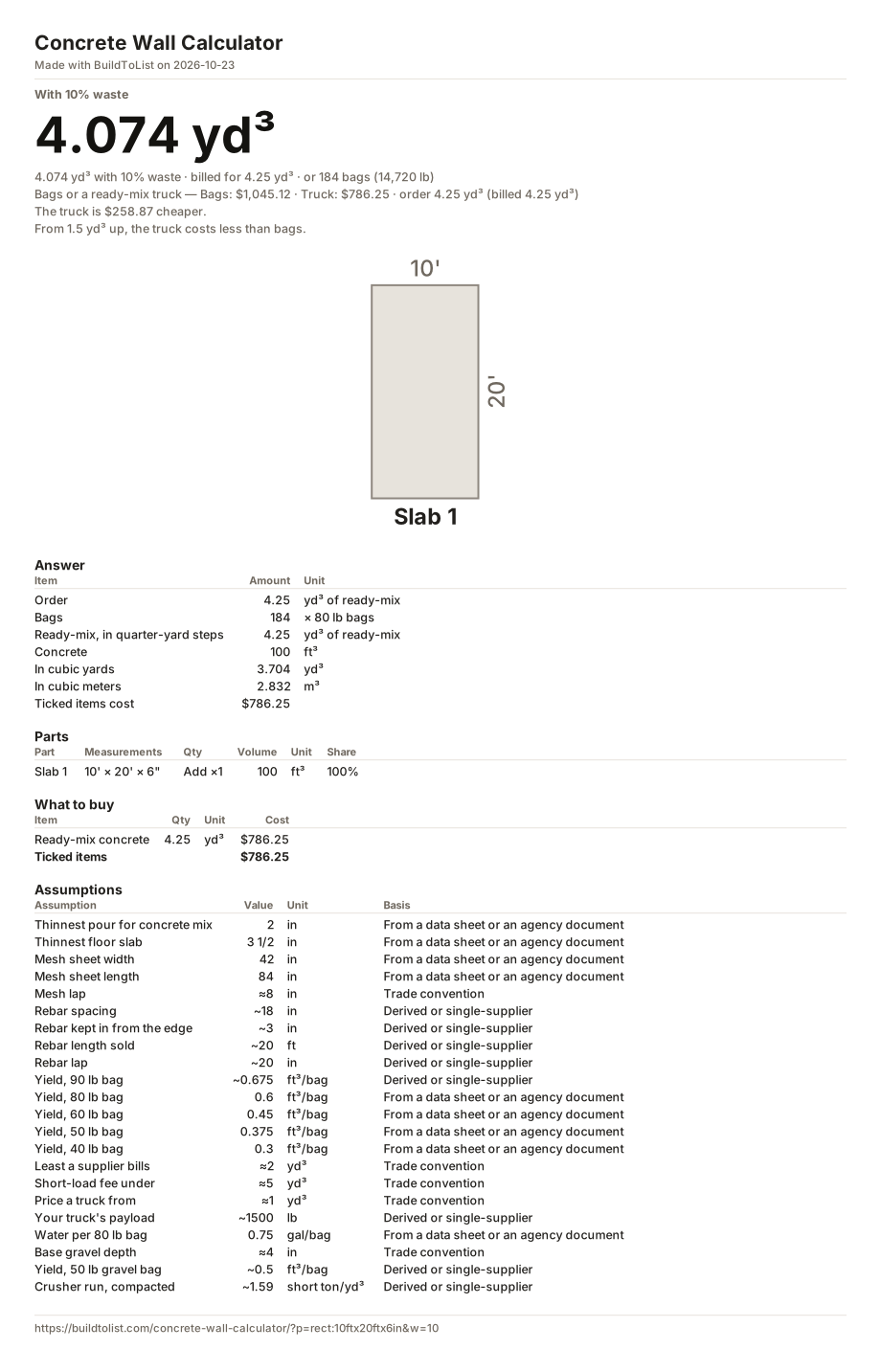
4.074 yd³ with 10% waste · billed for 4.25 yd³ · or 184 bags (14,720 lb)

Order 4.25 yd³ of ready-mix
Bags 184 × 80 lb bags
Ready-mix, in quarter-yard steps 4.25 yd³ of ready-mix
Concrete 100 ft³
In cubic yards 3.704 yd³
In cubic meters 2.832 m³
Ticked items cost $786.25
DrawingThe project drawn to scale. Slab 1: 10' × 20'.10'20'Slab 1

Breakdown

Part Measurements Qty Volume Share
Slab 1 10' × 20' × 6" Add ×1 100 ft³

What to buy

Ways to buy the bags

Every way is worked out; pick the one you will buy. The 50 and 90 lb bags are offered on their own only: we have not seen them on a shelf.

183 × 80 lb + 1 × 40 lb Bags 184 Left over 0.1 ft³ Weight 14,680 lb Cost $1,043.42
163 × 90 lb Bags 163 Left over 0.02 ft³ Weight 14,670 lb Cost $1,056.24 Reference price $6.48. Type your store's.
184 × 80 lb Bags 184 Left over 0.4 ft³ Weight 14,720 lb Cost $1,045.12 Reference price $5.68. Type your store's.
245 × 60 lb Bags 245 Left over 0.25 ft³ Weight 14,700 lb Cost $1,220.10 Reference price $4.98. Type your store's.
294 × 50 lb Bags 294 Left over 0.25 ft³ Weight 14,700 lb Cost $1,317.12 Reference price $4.48. Type your store's.
367 × 40 lb Bags 367 Left over 0.1 ft³ Weight 14,680 lb Cost $1,460.66 Reference price $3.98. Type your store's.

Shopping list

4.25 yd³ $786.25
147 50 lb bags (0.5 ft³) $805.56 Reference price $5.48. Type your store's.
4.5 short tons (2,000 lb) $297.50 Reference price $45.00. Type your store's. Reference price $95.00. Type your store's.
14 sheets, lapped 8 in $152.18 Reference price $10.87. Type your store's.
14 #4 bars, 20 ft $209.72 Reference price $14.98. Type your store's.
Ticked items $786.25

Untick what you already have.

Save imageExcel

Bags or a ready-mix truck

Bags $1,045.12
Truck $786.25 order 4.25 yd³

The truck is $258.87 cheaper.

From 1.5 yd³ up, the truck costs less than bags.

Includes the short-load fee small orders pay.

Reference price $150.00. Type your store's. Reference price $35.00. Type your store's. No reference price. Type what your store charges.

Every supplier rounds, sets a minimum and charges for small loads its own way. Ask before you order.

How this was worked out

Every number below is yours. Each constant links to the row where you can change it.

Slab 1 10' × 20' × 6" 100 ft³
All parts 100 ft³ ÷ 27 3.704 yd³ · 2.832 m³
Plus waste 100 ft³ × (1 + 10%) 110 ft³ = 4.074 yd³
Bags 110 ft³ ÷ 80 lb at 0.6 ft³ 184 × 80 lb · 0.4 ft³ left over

Change:Yield, 80 lb bag

Ready-mix 4.074 yd³ → quarter-yard 4.25 yd³

Change:Least a supplier bills

Base gravel (200 ft² × 4" + 0 ft³ in holes) × (1 + 10%) ÷ 0.5 ft³ a bag 147

Change:Base gravel depthYield, 50 lb gravel bag

Base gravel, delivered loose 2.716 yd³ × 1.59 short tons a yard, compacted, to 0.25 short ton steps 4.5 short tons (2,000 lb)

Change:Crusher run, compacted

Wire mesh 3' 6" × 7' sheets lapped 8", laid over each slab 14

Change:Mesh sheet widthMesh sheet lengthMesh lap

Rebar #4 every 1' 6" both ways, 3" in from the edge, 20' bars lapped 1' 8" 14

Change:Rebar spacingRebar kept in from the edgeRebar length soldRebar lap

Cost 4.25 yd³ × $150.00 + 4.25 yd³ × $35.00 $786.25

Assumptions

Every one of these is editable. Change one and the answer changes with it.

Assumption Value Confidence
Thinnest pour for concrete mixSakrete High-Strength Concrete Mix (Oldcastle APG): pour at least 2 in thick. Thinner is a job for a resurfacer. in From a data sheet or an agency document
Thinnest floor slabIRC 2021 R506.1: a concrete floor slab on the ground is at least 3½ in thick. ACI 332-20 §13.5 says the same, as the Tennessee Concrete Association summarises it. in From a data sheet or an agency document
Mesh sheet widthThe sheet Home Depot sells as a 42 in. x 84 in. remesh sheet. in From a data sheet or an agency document
Mesh sheet lengthThe sheet Home Depot sells as a 42 in. x 84 in. remesh sheet. in From a data sheet or an agency document
Mesh lapOne mesh square plus 2 in at every joint: 8 in for 6×6 mesh of W1.4-W2.1 wire under ACI 318-19 §25.5.4.1 (Wire Reinforcement Institute, WWR.7 schedule). WRI's ACI 301 detail for a slab on ground that carries no design load laps 2 in (WWR.2); the longer lap is kept. ≈ in Trade convention
Rebar spacingA common grid for #4 bar in a house slab. No standard sets one for a patio. ~ in Derived or single-supplier
Rebar kept in from the edgeACI 318-19 Table 20.5.1.3.1: 3 in of cover where concrete is cast against and stays in contact with the ground, kept here at the slab's edges. ~ in Derived or single-supplier
Rebar length sold#4 bar is sold in 10 ft and 20 ft lengths; the longer one wastes less. ~ ft Derived or single-supplier
Rebar lap40 bar diameters for #4 (½ in): a rule of thumb for a lap, not a code figure. ~ in Derived or single-supplier
Yield, 90 lb bagExtrapolated at 0.0075 ft³ per lb from the 80 lb bag of the 1101 data sheet, which lists no 90 lb bag. ~ ft³/bag Derived or single-supplier
Yield, 80 lb bagQuikrete Concrete Mix 1101 data sheet. ft³/bag From a data sheet or an agency document
Yield, 60 lb bagQuikrete Concrete Mix 1101 data sheet. ft³/bag From a data sheet or an agency document
Yield, 50 lb bagQuikrete Concrete Mix 1101 data sheet. ft³/bag From a data sheet or an agency document
Yield, 40 lb bagQuikrete Concrete Mix 1101 data sheet. ft³/bag From a data sheet or an agency document
Least a supplier billsJefferson County, MO ready-mix bid tabulation (2020): an order is billed at least 2 yd³. Every supplier sets its own minimum. ≈ yd³ Trade convention
Short-load fee underSame tabulation: a short-load fee on orders under 5 yd³. Ask your supplier for theirs. ≈ yd³ Trade convention
Price a truck fromCommon advice: past about a cubic yard, mixing bags by hand is a long day and a truck is worth pricing. ≈ yd³ Trade convention
Your truck's payloadFull-size (1500-series) pickups advertise 2,260-2,440 lb of payload (2026), and ordinary trims carry 600-700 lb less; this is the low end. Your truck's figure is on the driver's door-jamb placard. ~ lb Derived or single-supplier
Water per 80 lb bagQuikrete 1101 data sheet: start with about 6 pints per 80 lb bag, 6 to 9 pints in the end. Smaller bags take their share by weight. gal/bag From a data sheet or an agency document
Base gravel depthIRC R506.2.2 (R506.3.2 in IRC 2024) asks for 4 in of base under a floor slab below grade. Outdoors it is common practice. ≈ in Trade convention
Yield, 50 lb gravel bag0.5 ft³ per 50 lb bag. Sand, which the sand page buys in the same bag: Sakrete Play Sand (data sheet REV 3-10) and Sakrete's commercial sands (Rev. 06/16) yield 0.5 ft³, Quikrete Premium Play Sand is labeled 'approx 1/2 cu. ft.'; mason sand runs larger, 0.6 ft³ (Sakrete, Rev. 04/16). Gravel: Quikrete All-Purpose Gravel as retailers list it. ~ ft³/bag Derived or single-supplier
Crusher run, compactedMoDOT's compacted crushed granite or limestone, used for crusher run and paver base: assumed to pack about this tight, as no figure for the graded product was found. ~ short ton/yd³ Derived or single-supplier

How much concrete a wall takes

A poured wall is its length times its height times its thickness. The wall this page opens with — 20 ft long, 4 ft high, 8 in thick — is 20 × 4 × 8/12 = 53.33 cubic feet, which is 53.33 ÷ 27 = 1.98 cubic yards. Add the 10% waste in the box and it is 2.17, ordered as 2.25 in quarter-yard steps. In 80 lb bags the same wall is 98 bags and 7,840 lb, which is why the page prices a truck beside them and, at the reference prices in the boxes, picks the truck.

Length and height are typed in feet, the thickness in inches — an 8 in wall, the way the trade says it. Type 8, 8 in or 0'8" in the thickness box and all three are the same wall. A thickness past 24 in is flagged under the box, because a wall that thick is more often a height typed into the wrong box than a wall anyone pours.

A wall on its footing

Most walls stand on a footing, and the two are usually ordered as one load. Add a part, pick Footing, and the breakdown gives each its own line and its share of the order. A 16 by 8 in footing under the same 20 ft adds 17.78 cubic feet, 0.66 yd³, and the order covers both. The footing's own questions — how wide it has to be for the load, how deep for the frost — are on the concrete footing calculator.

Cubic yards per 10 ft of wall

Before waste:

Thickness 2 ft high 3 ft high 4 ft high 8 ft high
6"0.370.560.741.48
8"0.490.740.991.98
10"0.620.931.232.47
12"0.741.111.482.96

Scale by your length in tens of feet, add the waste, and round the order up once — to the step your supplier sells in, not to a whole yard unless that is their step. An 8 ft basement wall 8 in thick is about 2 yards every 10 ft, so a basement's walls are a truck, and usually more than one.

What this page counts, and what it does not

It counts the concrete: the yards, the bags if you mix, the water for those bags, and the truck's minimum order and short-load fee, both rows under Assumptions you can type over. It does not count the forms or the ties that hold them, which are rented by the panel or built from lumber, and it does not count the steel. The bars in a wall are sized with the wall, by whoever designed it, and they come from a drawing, not from the wall's volume.

What the code asks of a wall

Where the IRC 2021 is in force, two things are worth knowing before the forms go up. A retaining wall that is not braced at the top and holds back more than 48 in of soil has to be designed by accepted engineering practice (R404.4); so does one over 24 in that carries anything besides the soil. And a foundation wall is at least as thick as the wall it carries (R404.1.5.2). The panel under the answer adds the third: a wall sits on a footing below the frost line, a depth only your building department can give, so the page says not checked rather than guess. It sizes nothing — the thickness and the steel are the designer's, and the yards are this page's.

Common questions

How many yards of concrete for a 4 ft wall?

At 8 in thick, 0.99 yd³ for every 10 ft, before waste: 1.98 for 20 ft, 2.17 with 10% waste. At 6 in thick the same 20 ft is 1.48, and at 12 in it is 2.96. Change the thickness box and the three lines under the answer move with it.

How many bags of concrete for a wall?

Divide the cubic feet by the bag's yield — 0.60 ft³ for an 80 lb bag — and round up once for the job. The opening wall is 58.67 ft³ with waste, so 98 bags of 80 lb. Past about a yard most people order a truck instead; the comparison under the shopping list prices both.

Can I pour a wall from bags?

A short garden wall, yes. A wall wants to be poured in one go so it sets as one piece, and 98 bags is a long day of mixing for two people. That is the practical reason a wall of any length is a truck, before the price is.

Does the thickness include the form?

No. Type the thickness of the concrete — the gap between the form faces — not the outside of the forms.

Is the waste added twice?

No. Waste is multiplied in exactly one place in this site, and the result shows the volume before and after it. Set the box to 0 and the two lines agree.