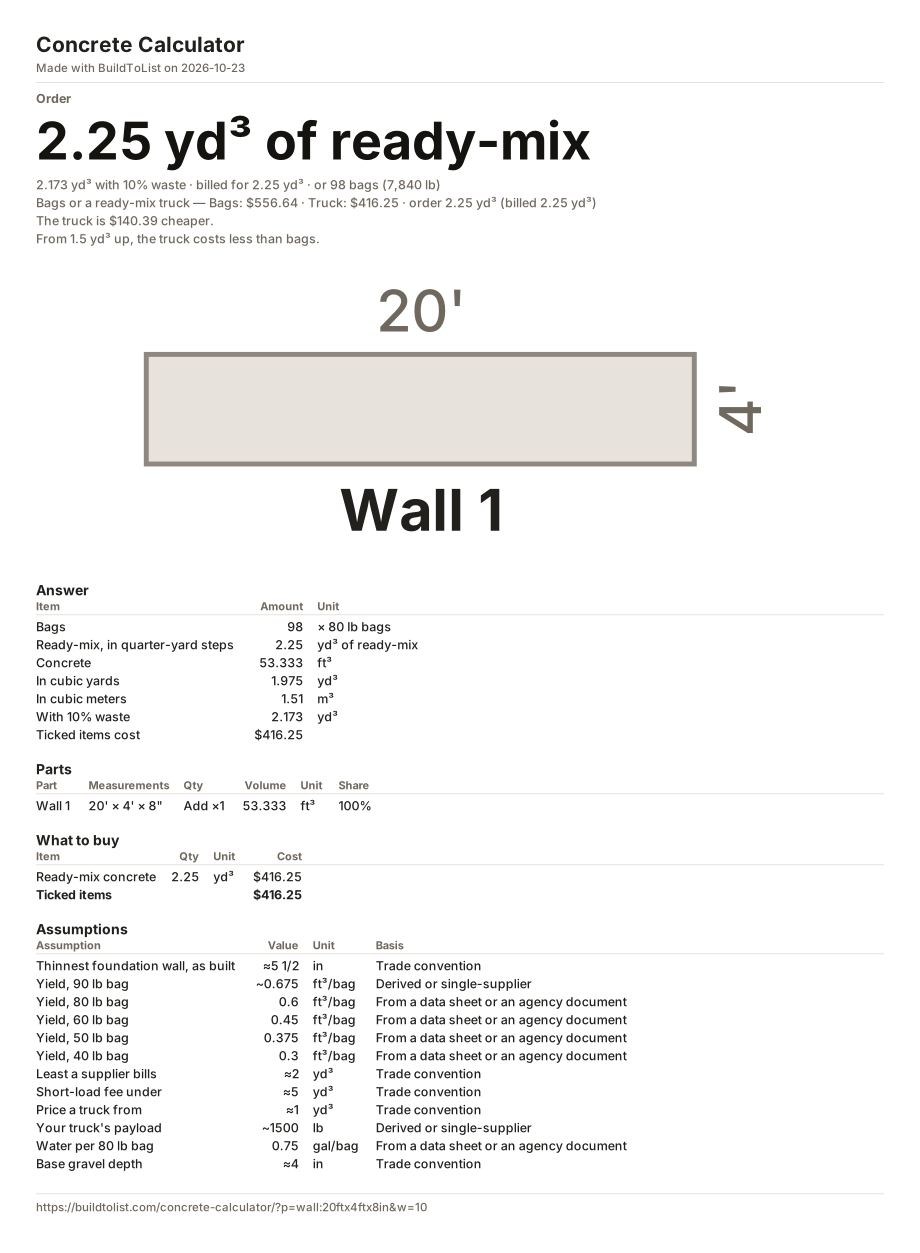
How much concrete you need
Concrete is bought by volume: length times width times thickness, all in feet. A slab 10 feet by 10 feet poured 4 inches thick is 10 × 10 × 4/12 = 33.3 cubic feet, and 33.3 ÷ 27 = 1.23 cubic yards. In 80 lb bags of concrete mix, each making 0.60 cubic feet, that is 56 bags before waste and 62 once 10% is added for spill, a soft base and forms that bow. A ready-mix truck would bring 1.5 cubic yards, because suppliers sell in quarter-yard steps and the order is rounded up to the next one, not to a whole yard.
Most jobs are more than one shape. Add every part of the pour to the same project — the slab, six post holes for the fence along it, three steps up to the door — and the page adds them up, shows each part's share of the total, and turns the whole into one shopping list. A part can also be subtracted: a block of compacted fill under the steps, a box-out for a drain.
What a bag of mix makes
| Bag | Makes | Bags per cubic yard |
|---|---|---|
| 40 lb | 0.30 ft³ | 90 |
| 50 lb | 0.375 ft³ | 72 |
| 60 lb | 0.45 ft³ | 60 |
| 80 lb | 0.60 ft³ | 45 |
These are the yields on the Quikrete Concrete Mix 1101 data sheet; other brands are within a few per cent and every yield is a box you can type over under Assumptions. We are not connected with Quikrete or any other maker. A 50 lb bag is 72 to the yard, not 75 as one large calculator still prints, and a count of bags is always rounded up: 62.5 bags is 63, never 62.
Bags or a truck
Past about a cubic yard, price a truck before you buy bags. Sixty-two 80 lb bags weigh 4,960 lb, which is three or four trips in a full-size pickup, and every bag has to be mixed by hand or in a rented mixer. A truck has its own costs: most suppliers bill a minimum order, often 2 cubic yards, and add a short-load fee to small orders. The comparison under the shopping list puts both on one line with the prices in the boxes, and says from how many yards the truck comes out cheaper. The prices start at dated reference figures; type your own store's and your supplier's quote and the answer follows.
Post holes
Concrete around a post fills the hole minus the post itself. A 4×4 post in a 10 inch hole 24 inches deep takes 0.92 cubic feet, not the 1.09 a calculator gets by filling the post's own space as well. Type the post's actual size: a 4×4 is 3½ inches across and a 6×6 is 5½. Concrete is usually stopped an inch or three below the ground so soil or gravel can cover it and water runs away from the post, and many installers put a few inches of gravel in the bottom first; both are boxes on the post hole card. Fast-setting mix comes in 50 lb bags of 0.375 cubic feet and is poured dry with about a gallon of water per bag; holes deeper than 2 feet 6 inches are filled in layers.
Steps
Steps are worked out as a solid block: every riser times the width and the depth of the tread above it, plus the top landing. Three steps of 7 inches rise and 11 inches tread, 4 feet wide, come to 12.8 cubic feet, or 22 bags of 80 lb before waste. Steps poured over compacted fill use less: add the fill as a part set to subtract.
Footings, walls and the frost line
A footing or a wall is a box: length, width and depth. The page checks a footing against the floor the International Residential Code sets — at least 6 inches thick and 12 inches wide — but it will not tell you a footing is big enough, because that depends on what it carries and the soil under it. How deep a footing or a post has to go is set by your building department, which writes its local frost depth into the code it enforces. Ask before you dig.
How thick to pour
A floor slab inside a house is at least 3½ inches thick under the IRC. A patio or a walk is usually poured at 4 inches, a driveway for cars at 4 inches, and one that takes heavier vehicles at 5 inches or more. Under 2 inches, ordinary concrete mix does not hold together; that is a job for a resurfacer.
Common questions
How many bags is that, and which size?
Sixty-two 80 lb bags for a 10x10 slab 4 inches thick with 10% waste, and 45 80 lb bags to the cubic yard. How many bags of concrete is the page for that question: it counts your pour in every bag size at once and says what each order weighs and how many trips it is.
Should I add waste?
Yes, once. Ten per cent is the usual figure for bags, five to ten for ready-mix. It is a box at the top of the page; the result shows the volume before and after it, so you can see it was added a single time.
Can I send someone this calculation?
Copy link puts the whole project in the address — every part, the waste, your prices — and the link opens with exactly these numbers. Nothing is stored on our side, and nothing is asked of you: no email, no postcode, no account.