4 × 8 or 4 × 12 — the same room, both ways
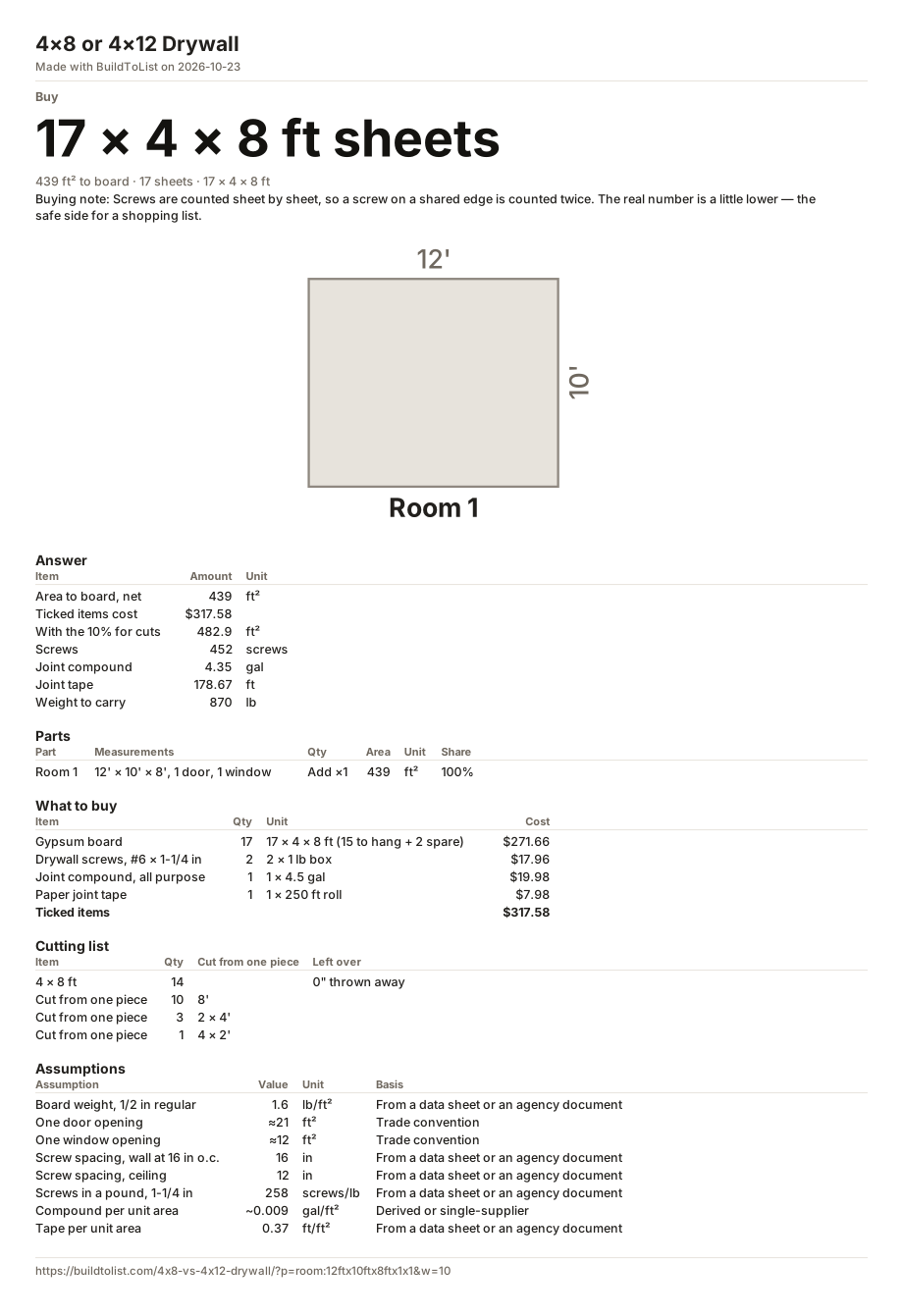
The 12 by 10 foot room this page opens with, 8 foot walls and the ceiling, hung in rows: 15 sheets of 4 × 8 or 11 sheets of 4 × 12, each laid out on the room with the offcut of one row starting the next. With 10% for breakage the list buys 17 or 13. Every size the stores carry is laid out the same way under the answer, with what it leaves over and what it costs, and the one you pick carries through to the screws, the weight and the cost.
| Sheet | Sheets hung | Left over | Each weighs |
|---|---|---|---|
| 4 × 8 ft | 15 | none | 51 lb |
| 4 × 9 ft | 14 | 5 ft | 58 lb |
| 4 × 10 ft | 13 | 8 ft | 64 lb |
| 4 × 12 ft | 11 | 8 ft | 77 lb |
| 54 in × 12 ft | 10 | 4 ft | 86 lb |
Half-inch regular board at the 1.6 pounds a square foot the mills publish; "left over" is the offcut no row could use, in feet of sheet. At the prices this page starts with the five come to $239.70, $244.72, $246.74, $241.78 and $244.80 before the 10% — a spread of $7 across the lot, which is close enough that the handling matters more than the money. The 4 × 8 is cheapest here by $2.08, and $2.08 is well inside the error of a price we estimated: the prices are our own, so type your store's beside the sheets and the layouts are priced again before you treat the winner as settled.
What you actually trade
Joints. This is the real reason to buy the long sheet. A 4 by 12 run horizontally across a 12 foot wall covers it in one piece with no butt joint at all. Butt joints — where two sheet ends meet away from a corner — are the hard ones to hide, because there is no tapered edge to bed the tape into. Half as many sheets is roughly half as many joints.
Weight and handling. A 4 by 12 of half-inch board is 77 pounds and 12 feet long. One person can walk a 4 by 8 up a stairwell; a 4 by 12 usually cannot be turned at the top of one. Measure the route before you buy the length, not just the wall.
Total material. Fewer sheets is not less board. Eleven 4 by 12s is 528 square feet where fifteen 4 by 8s is 480 — the long sheet brings home 10% more board for this room, because each 10 foot wall row cut from a 12 foot sheet leaves two feet nothing else can use, four times over, while the 8 foot sheet's offcut finishes the next row and nothing is dropped at all. The price per square foot falls with the size, which is what brings the two within $2 of each other.
The 54 inch width, which almost nobody mentions
USG makes gypsum board 54 inches wide as well as 48, and it exists for one reason: a wall framed 9 feet. Two courses of 54 inch board laid horizontally come to 108 inches — exactly 9 feet — with one joint in the middle of the wall and nothing to rip. In 48 inch board the same wall takes two full courses and a 12 inch strip, which is a third row of joints to tape along its whole length — and this page rips that strip the way a hanger does, four strips to a sheet, rather than buying a whole sheet for every strip row.
It is a pro-yard item rather than something stacked by the door at a big box, so this page never picks it for you even though it is the cheapest per square foot here: it is laid out and priced beside the others, and you choose it knowingly. On an 8 foot wall it buys nothing — two rows either way, so it comes to 10 sheets with a strip row to rip, and costs more than the 11 of the 4 by 12. Type a 9 foot wall height in and it hangs the room in two rows where every 4 foot sheet needs three.
What usually wins
For an 8 foot ceiling and rooms up to about 12 feet across, 4 by 8 upright is the common choice and the easiest to handle alone: every edge lands on a stud and every joint is a tapered one. Set "Hang the board" to upright and the page lays the walls out that way — a column as tall as the wall, stacked across its length — and a 4 by 9 sheet on a 9 foot wall then goes on with no horizontal joint anywhere. For long walls, for a garage, or wherever two people are hanging, 4 by 12 horizontal is fewer joints and a flatter finish. For 9 foot walls, the 54 inch width is the answer the others are approximating.
The page hangs the cheapest layout and shows the others beside it; it does not know whether you are hanging alone. Its cutting list says which pieces come off which sheet, in the direction you set, but it does not stagger the butt joints for you.
We are not connected with any brand or store named here.