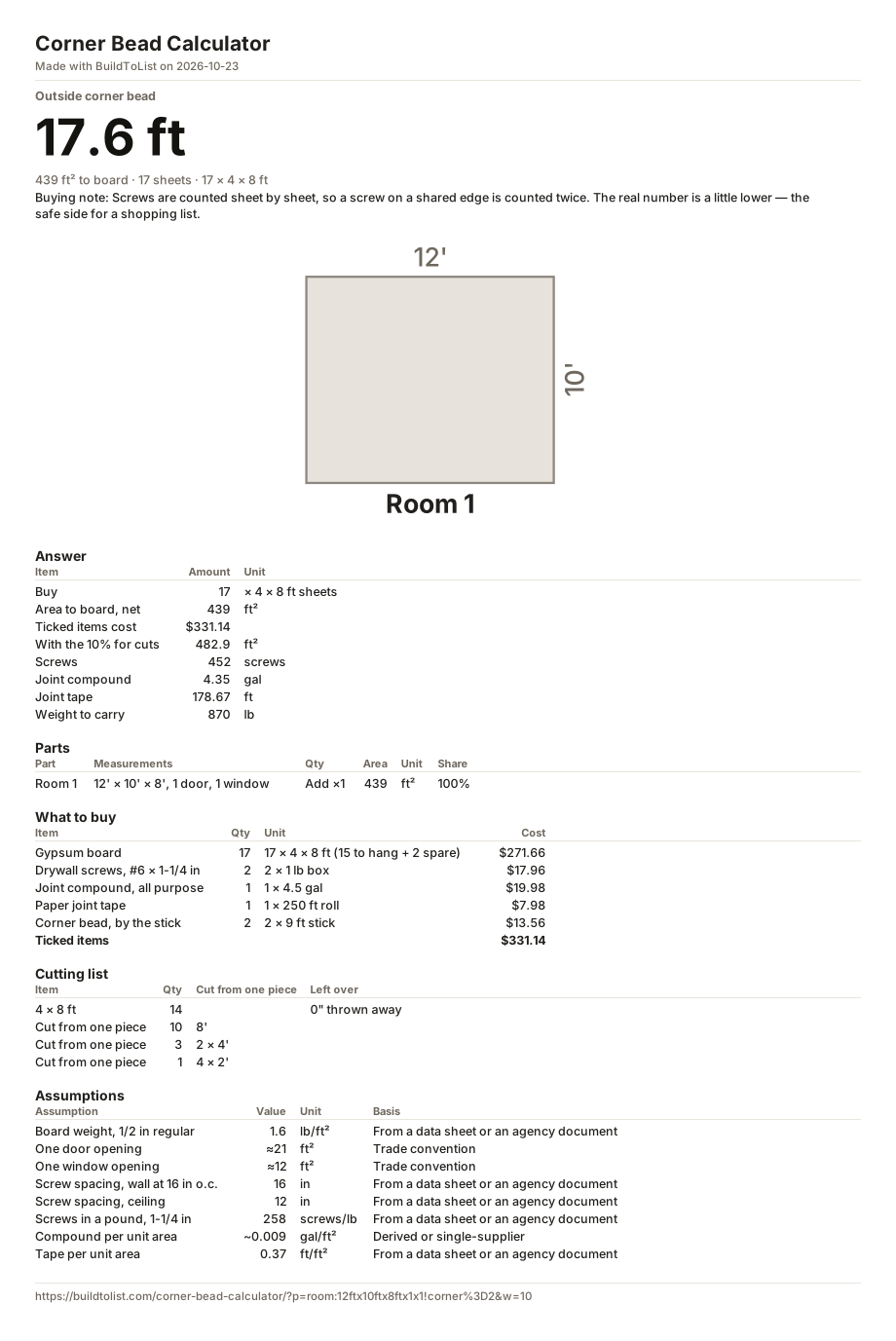
How much corner bead a room takes
An upright outside corner runs the full height of the wall it is on, so the arithmetic is a count times a height. This page opens on a 12 by 10 foot room with 8 foot walls and two outside corners: 2 × 8 = 16 feet of bead, or 17.6 feet with the 10% allowed for waste, which buys as two 9 foot sticks rather than three 8 foot ones.
Each part card has the count on it. Set it to none and the row drops off the shopping list; a room with a chimney breast, a boxed-in column or a window return has two corners per feature, and a project with several rooms gets each one's own height — which is the reason the count is per part and not per page.
Why we have to ask
A rectangular room has four corners and all four are inside ones, taped with paper. Outside corners come from things the shape of the room does not describe: a soffit over the cabinets, a dropped ceiling, the sides of a doorway with no casing, a half wall, a column. No amount of measuring the room tells us how many there are, so no calculator can work it out — which is why most do not offer corner bead at all.
The honest options were to guess or to ask. We ask.
Sticks and lengths
| Bead | Lengths | Source |
|---|---|---|
| Paper-faced metal | 8, 9, 10 ft | Beadex, USG catalog J1688 |
| Galvanized metal | 8, 9, 10, 12 ft | ClarkDietrich 103 Deluxe |
| Vinyl | 8, 9, 10, 12 ft | Trim-Tex |
The page works out all four lengths and picks the cheapest combination at the prices beside them. Buying a stick that reaches the full height matters more here than on most materials: a bead spliced halfway up a corner leaves a step that shows through two coats of paint, so the hint is always to buy long enough rather than to buy tight. For a 9 foot wall that means the 9 or the 10 foot stick, not two 8s with a joint at 8 feet.
Bead, and what goes on it
Corner bead is not taped — it is nailed, screwed, clinched or bedded in compound depending on the type, and then coated. Three coats of compound over a bead is normal, and that mud is already in the compound figure on the other pages, which is worked out on the board area rather than per joint.
Bullnose and bevelled beads exist and are installed differently, with their own corner pieces at the top and bottom; the lengths here are for the ordinary 90 degree bead. Inside corners take paper tape, and they are counted in the tape figure.
Prices are our own estimates, not a store's. We are not connected with any brand or store named here.