Find a tool

Vinyl Plank Flooring Calculator

Square feet into cartons — the step the other calculators stop before.

An estimate of quantities — box coverage varies by product; type yours.

Area 1

12' · 144 in · 12 ft · 3.6576 m

14' · 168 in · 14 ft · 4.2672 m

168 ft²

Inch Calculator advises about 10% for tile laid straight, which is where this starts; 15% for diagonal, and Alpine 10-15% for herringbone. Mullican advises 5% for wood laid straight. It is added once, to whatever gets cut — the tiles or the planks, and the baseboard. A grout or mortar figure, where the page has one, is worked out on the surface as laid.

This page recalculates as you type. There is no Calculate button.

Answer

Save imageExcel

Boxes

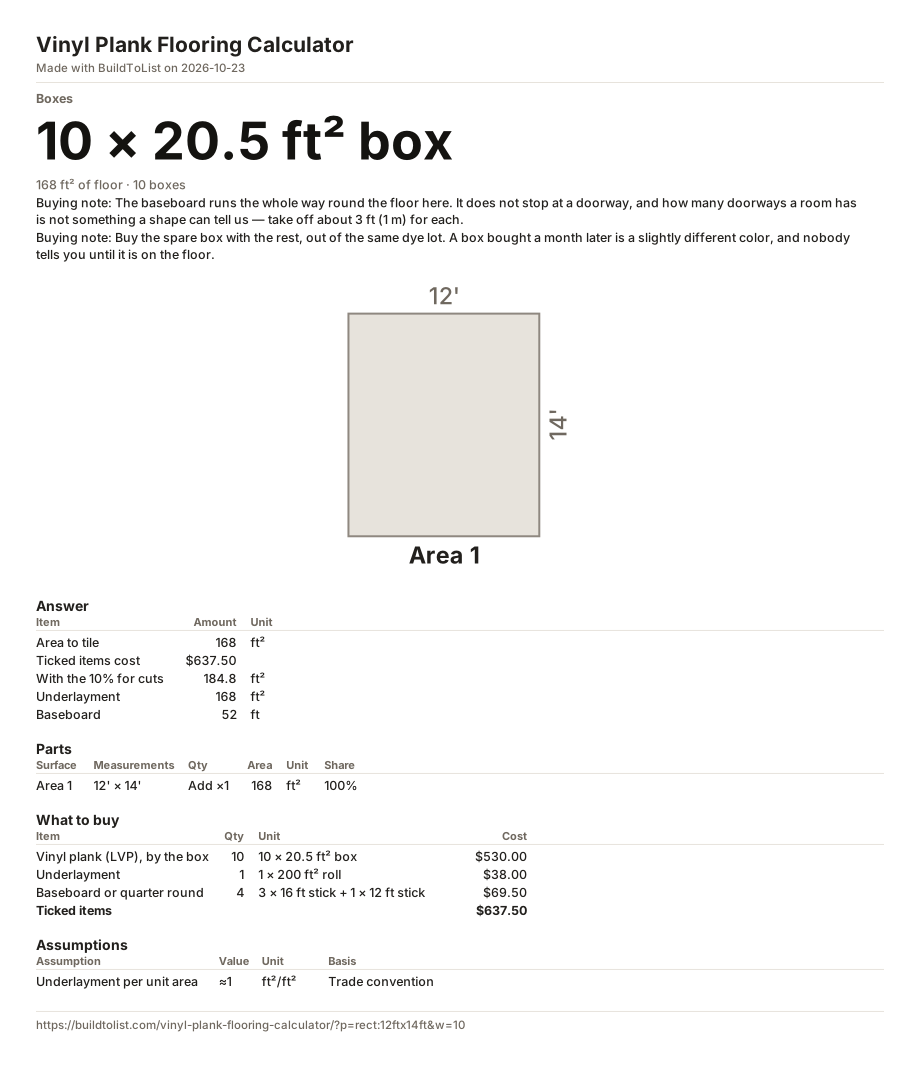
10 × 20.5 ft² box

168 ft² of floor · 10 boxes

Area to tile 168 ft²
Ticked items cost $637.50
More numbers
With the 10% for cuts 184.8 ft²
Underlayment 168 ft²
Baseboard 52 ft
DrawingThe project drawn to scale. Area 1: 12' × 14'.12'14'Area 1

Breakdown

Surface Measurements Qty Area Share
Area 1 12' × 14' Add ×1 168 ft²

What to buy

Buying noteThe baseboard runs the whole way round the floor here. It does not stop at a doorway, and how many doorways a room has is not something a shape can tell us — take off about 3 ft (1 m) for each.
Buying noteBuy the spare box with the rest, out of the same dye lot. A box bought a month later is a slightly different color, and nobody tells you until it is on the floor.

Shopping list

10 10 × 20.5 ft² box $530.00 Reference price $53.00. Type your store's. Reference price $48.00. Type your store's. Reference price $95.00. Type your store's.
1 1 × 200 ft² roll $38.00 Reference price $22.00. Type your store's. Reference price $38.00. Type your store's.
4 3 × 16 ft stick + 1 × 12 ft stick $69.50 Reference price $9.50. Type your store's. Reference price $14.00. Type your store's. Reference price $18.50. Type your store's.
Ticked items $637.50

Untick what you already have. Each row has its price beside it — type what your store charges.

Save imageExcel
How this was worked out

Every number below is yours. Each constant links to the row where you can change it.

Area 1 12' × 14' 168 ft²
With the waste for cuts 168 ft² × (1 + 10%) 184.8 ft²
Boxes to buy 184.8 ft² ÷ 20.5 ft² 10 × 20.5 ft² box · 20.2 ft² left over
Underlayment 168 ft² × 1 168 ft² → 1 × 200 ft² roll

Change:Underlayment per unit area

Baseboard round the floor 52 ft × (1 + 10%) 57.2 ft → 3 × 16 ft stick + 1 × 12 ft stick
What it comes to 10 × $53.00 + 1 × $38.00 + 3 × $18.50 + 1 × $14.00 $637.50

Assumptions

Every one of these is editable. Change one and the answer changes with it.

Assumption Value Confidence
Underlayment per unit areaUnderlayment covers the floor once. Rolls with a self-adhesive lap seam are butted rather than overlapped, so there is no second allowance here the way there is under a roof. A roll's printed area is its usable area. ≈ ft²/ft² Trade convention

How many boxes of vinyl plank

This page opens on Omni's own worked example, because it is the clearest illustration of the gap: a 16 by 13 foot room, 208 square feet, 5% waste, 218.4 square feet to buy. At 20.5 square feet a box that is 11 boxes.

Omni gets to 218.4 and stops. So does Inch Calculator. The last division is the one you cannot do at the counter without knowing the carton size, and the carton size is the thing you are standing in front of.

Why 5 per cent and not 10

Because plank is cut differently from tile. A plank run is cut once at each end of a row, and the offcut from the end of one row usually starts the next — so the waste is end cuts rather than edge tiles. Mullican advises 5%, with a 5 to 7% range, for a straight lay; tile's 10% is for a field cut on two edges.

Laid diagonally that advantage goes and Mullican's figure rises to 10–15%. Change the layout and this page names the figure rather than moving your number: the box is the only thing that sets the waste, and a box that changed itself when you touched a dropdown would be lying about what it is.

LVP, SPC, WPC and what it changes

Nothing, for this calculation. Luxury vinyl plank, stone-core and wood-core all come in cartons marked with a square footage, and the division is the same. What changes is the carton: a thicker rigid-core plank means fewer square feet per box, often nearer 16 than 20, because the box is sized by weight as much as by area.

So read the carton and type its figure into the assumptions. It is the one number on this page that decides the answer, and ours is a starting point.

Underlayment, or not

Many rigid-core planks have a pad attached, and putting another layer under them voids the warranty and makes the floor feel soft. Check the plank before buying underlayment: if it has a pad, untick that row.

If it does not, the page counts the underlayment off the same area as the planks, butted rather than overlapped — the roll's printed area is its usable area, unlike a roof underlayment where the lap eats into it.

Expansion gap and the trim

A floating floor needs a gap round the edge, usually 1/4 inch, and that gap is covered by the baseboard or the shoe rather than by the floor. It does not change the area you buy — a 1/4 inch all round a 16 by 13 room is under one square foot — but it does mean the trim is part of the job, which is why it is on the list.