How many tiles a floor takes
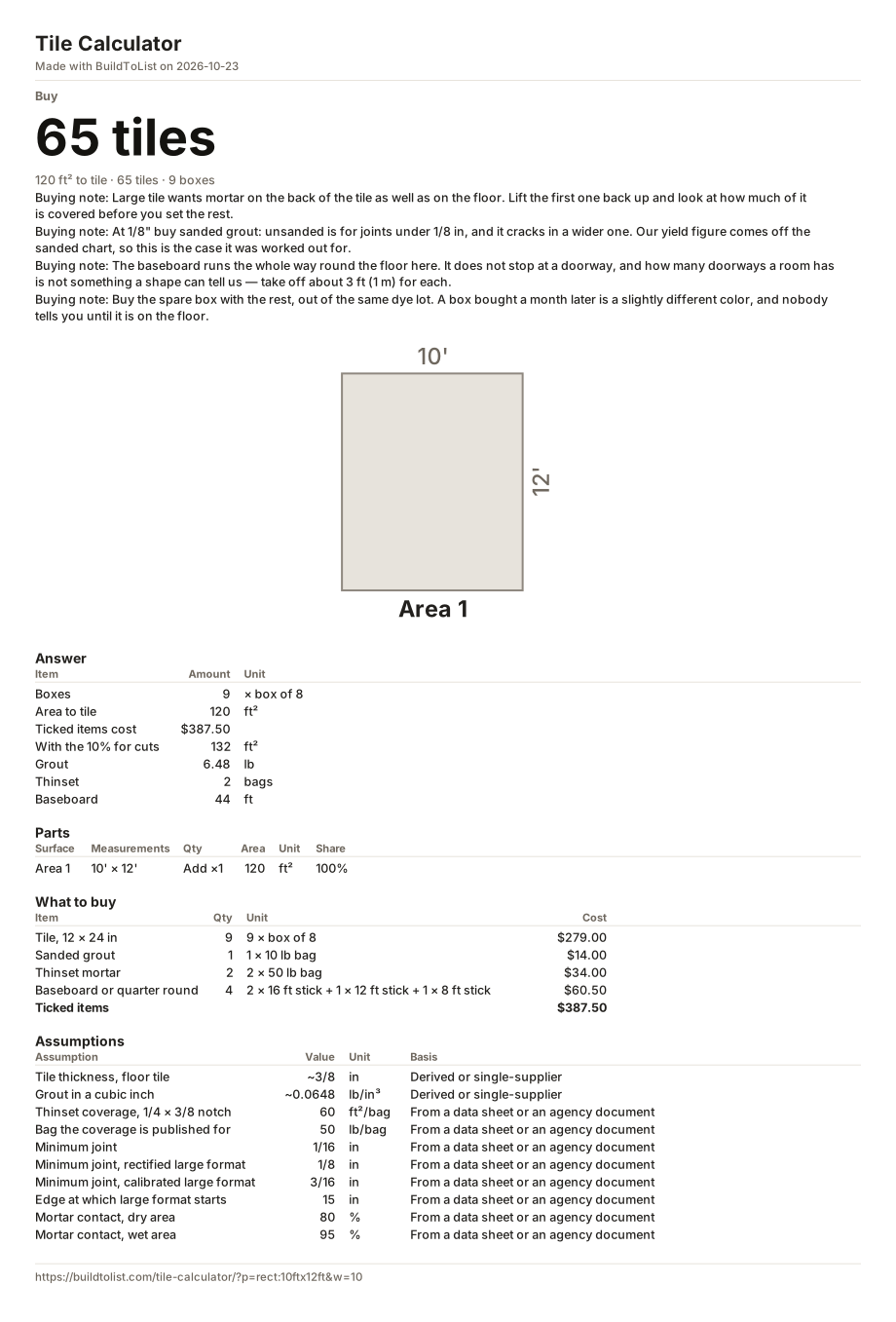
Measure the floor, add the waste, and divide by what one tile covers with its grout joint round it. The 10 by 12 foot floor this page opens with is 120 square feet. A 12 by 24 inch tile set at 1/8 inch joints occupies 12.125 by 24.125 inches, which is 2.031 square feet — so the field takes 60 tiles with nothing spare. Add 10% for cuts and that is 132 square feet, or 65 tiles, which is 9 boxes of 8.
The waste is the part every other tile calculator leaves out, and it is not optional. Dividing an area by a tile module is right for a continuous field, but a room has an edge, and every tile on that edge was bought whole and cut. Inch Calculator prints 98 tiles for a 10 by 10 foot floor in 12 by 12 tile — arithmetic that is exactly right and two tiles short of the hundred the floor actually needs, because its waste advice lives in the article and never reaches the calculator.
The same floor at each waste figure
| Waste | Tiles |
|---|---|
| None | 60 |
| 10% — straight | 65 |
| 15% — diagonal or herringbone | 68 |
| 20% — a complicated room | 71 |
120 square feet in 12 by 24 tile at 1/8 inch joints. The box starts at 10% because that is what Inch Calculator advises for a straight layout; change the layout and the page names the figure its source advises instead of quietly moving your number.
Grout and mortar, in pounds and bags
Nobody else works these out. The grout in a floor is the volume of its joints: a joint as deep as the tile is thick, running round every tile. For this floor that is 0.834 cubic inches of joint per square foot, or 100 cubic inches in all, which at 25 pounds a bag over 386 cubic inches is 6.5 pounds — one 10 pound bag, which is the smaller of the two sizes grout is racked in and still leaves a third of it over.
That formula was worked back out of thirty cells of Custom Building Products' own Polyblend Plus coverage chart, and it lands inside 1% of the chart at every tile 12 inches and over. At a 2 by 2 inch mosaic it runs about 20% over, and the page says so on the floor where it happens. Over, not under — the safe side for a shopping list.
The thinset depends on the trowel, not on the tile. A 50 pound bag of VersaBond covers 60 square feet with a 1/4 by 3/8 inch square notch, so this floor takes 2 bags; the same floor with a 1/2 by 1/2 inch notch takes 3. Matching a notch to a tile size is not something the maker publishes, so the page asks you which trowel you are holding rather than guessing.
What the standard asks of the joint
A grout joint has to be at least 1/16 inch, and at least three times how much the tiles vary in size — which you find by laying a few out dry. Above 15 inches of edge the minimum rises: 1/8 inch for rectified tile, ground to size after firing, and 3/16 inch for calibrated. A 12 by 24 is over that threshold on its long side, so the 1/8 inch this page opens with is the minimum and only if the tile is rectified.
The page will not tell you that passes. Which kind of tile is in the box is printed on the box, and no measurement here can see it, so the check says what each minimum is and asks you to look. These figures are ANSI A108.02's, read through the Ceramic Tile Education Foundation's article about the clause rather than in the standard itself — the standard costs money, and we say so rather than citing a text we have not opened.
Floors, walls and baseboard in one project
A bathroom is a floor and two or three shower walls, and they are one shopping trip. Add a part for each surface and mark it floor or wall: the tiles and the grout add up across all of them, the baseboard is counted round the floors only, and the mortar contact the standard asks for goes from 80% to 95% as soon as one part is a wall.
The baseboard runs the whole perimeter, and it does not stop at a doorway. How many doorways a room has is not something a rectangle knows, so the page counts the full perimeter and tells you to take off about 3 feet for each opening.
What this page does not do
It does not lay the tiles out. A real layout decides where the first course starts and which edge gets the cut row, and that changes the count by a tile or two either way — it is a cutting diagram, and this is a division. The waste box is what covers the difference, which is why it has a value in it from the moment the page opens.