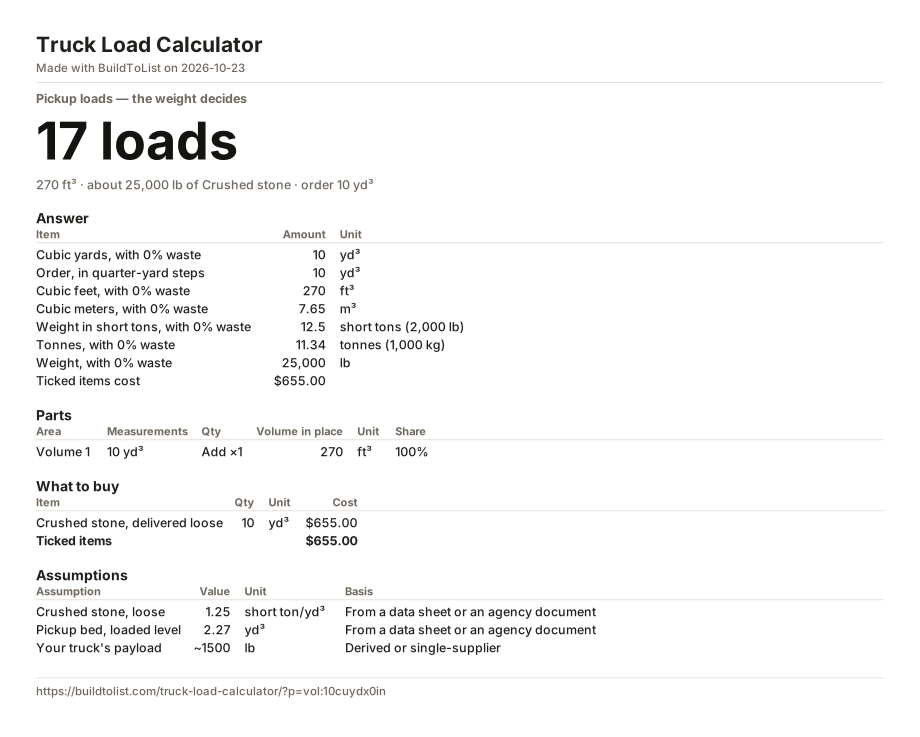
How many truck loads
A pickup is limited twice: by what its bed holds and by the weight it can carry. Work out both and take the larger. A pad 10 by 12 feet and 4 inches deep is 40 cubic feet, 1.48 cubic yards; in crushed stone at about 2,500 lb a yard it weighs 3,704 lb. That fits in one bed of about 2.27 cubic yards, but a pickup carrying about 1,500 lb has to make 3 loads. The weight decides, and the page says so beside the number.
Both limits are boxes under Assumptions. The payload is printed on the sticker in the driver's door jamb; type yours and the loads follow it, and the page warns beside the answer if a load is over it. The bed is measured inside, length × width × the depth of the sides, divided by 27 for cubic yards.
Which limit decides
Heavy material runs out of payload long before the bed is full; light material fills the bed first. A 1,500 lb load holds only this much of each, loose:
| Material | Cubic yards in 1,500 lb |
|---|---|
| Crushed stone | 0.6 |
| Sand | 0.54 |
| Topsoil | 0.64 |
| Wood mulch | 3.17 |
So with stone, sand and soil the weight decides, and a 2.27 cubic yard bed leaves most of its room empty. With wood mulch the bed fills at about 1,074 lb, and the bed decides. With no material picked the page has no weight to divide, and counts by the bed alone.
Where the figures come from
The 1,500 lb is the low end for a full-size pickup: the 1500-series trucks advertise 2,260 to 2,440 lb of payload, and ordinary trims carry 600 to 700 lb less. The bed is the makers' own measure of a box to the top of its sides: Ram gives 61.3 cubic feet for its 6 ft 4 in box and Ford 62.3 for the F-150's 6.5 ft box, and the page keeps the smaller, 2.27 cubic yards. A short box holds less, about 53 cubic feet, under 2 cubic yards; measure yours. The weights a yard are the loose figures the gravel, mulch and fill dirt pages use, and each is a box you can change. We are not connected with any truck maker, supplier or store.