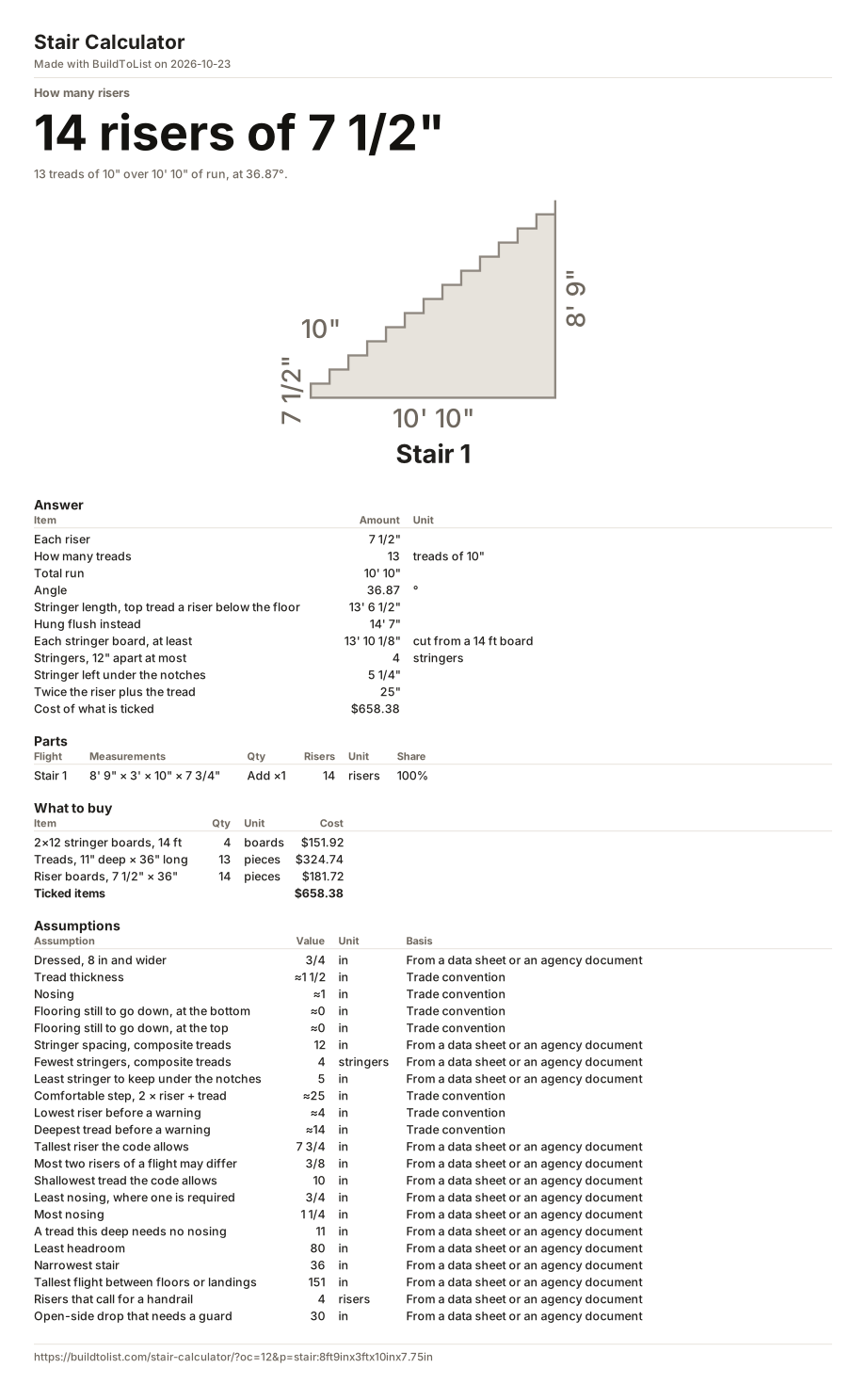
How many steps a stair takes
Divide the total rise by the tallest riser you will allow, and round up. A stair that climbs 8 ft 9 in, 105 in, with risers no taller than the 7¾ in the IRC allows takes 105 ÷ 7¾ = 13.55, so 14 risers of 7½ in. The top floor is the last step, so there is one tread fewer than risers: 13 treads, and at 10 in each, 130 in — 10 ft 10 in — of run, at an angle of 36.87°.
Never round to the nearest. One popular calculator does: 101 in over 7¾ in is 13.03, which it makes 13 risers of 7.77 in, taller than the code allows. Rounded up it is 14 risers of 7 3/16 in, which is what this page gives.
Measure the rise from the floor you stand on to the floor above. Where flooring is still to go down, put its thickness in the two flooring rows under Assumptions: the page adds the top one, takes the bottom one away, and cuts the stringer for it.
The stringer
The stringer is the notched board the treads sit on. Lay a framing square on its edge at the riser, 7½ in, and the tread, 10 in: each step is 12½ in along the edge, and 13 of them make the stringer 13 ft 6½ in long. Its bottom riser is cut 1½ in shorter, the thickness of a 2× tread, so that the first step comes out 7½ in like every other. Cut every riser the same and the first step is 9 in and the last 6 in — 3 in apart, where the code allows ⅜ in in a flight.
The board has to hold the cuts at both ends as well: 13 ft 10⅛ in, which a 14 ft 2×12 holds. A 2×12 leaves 5¼ in of wood under the notches; MyCarpentry and Blocklayer both ask for at least 5 in, and a 2×10 leaves only 3¼ in. A stair 36 in wide takes three stringers, no more than 18 in apart under wood treads (AWC's DCA 6).
What the IRC asks of a stair
| Rule | Limit | IRC 2021 / 2024 |
|---|---|---|
| Riser | 7¾ in at most | R311.7.5.1 / R318.7.5.1 |
| Tread | 10 in at least | R311.7.5.2 / R318.7.5.2 |
| Nosing, treads under 11 in | ¾ to 1¼ in | R311.7.5.3 / R318.7.5.3 |
| One flight | 12 ft 7 in at most | R311.7.3 / R318.7.3 |
| Width | 36 in at least | R311.7.1 / R318.7.1 |
| Headroom | 6 ft 8 in at least | R311.7.2 / R318.7.2 |
| Handrail | from 4 risers | R311.7.8 / R318.7.8 |
| Guard, open side | over 30 in | R312.1.1 / R321.1.1 |
Of the five state adoptions of IRC 2021 we read, four amend the riser and the tread: Connecticut, Pennsylvania and Virginia allow risers up to 8¼ in and treads from 9 in, Utah 8 in risers and 9 in treads. Montana adopted IRC 2024 with 8¼ in and 9 in. Type your town's figure over the code's under Assumptions and the check says it is your rule, not the book's.
Two calculators get the code wrong. One still holds a flight to 147 in, the IRC 2015 figure; it has been 12 ft 7 in, 151 in, since 2018. Another uses the commercial building code's 7 in risers and 11 in treads for a house, and so fails a 7½ in by 10 in stair the IRC allows.
A comfortable stair
One calculator rates a step by twice the riser plus the tread, and calls 60 to 65 cm — about 23½ to 25½ in — comfortable. This page ranks riser counts by how near they come to 25 in: the 14 risers above give 2 × 7½ + 10 = 25 in. The working also weighs 15 risers of 7 in (24 in) and 16 of 6 9/16 in (23⅛ in), each with the run it takes, nearest to 25 in first.