What a roof takes, and why the edges matter
A roof is bought in two ways at once. The field — the shingles, the underlayment, the nails — goes by area. Everything else goes by edge: starter strip along the eaves, ridge cap along the ridge and the hips, drip edge along the eaves and the rakes, ice barrier up from the eaves. Get the area and you can count bundles. Get the edges and you can count the other five things, which is most of the list.
So this page asks for a footprint and a pitch, and works the edges out of them. A 40 by 30 foot gable roof at 6:12 has 80 feet of eave, 40 feet of ridge, and four rakes of 16 feet 9 inches each — 67 feet of rake altogether, because a rake runs up the slope and the slope is longer than the plan.
From footprint to roof area
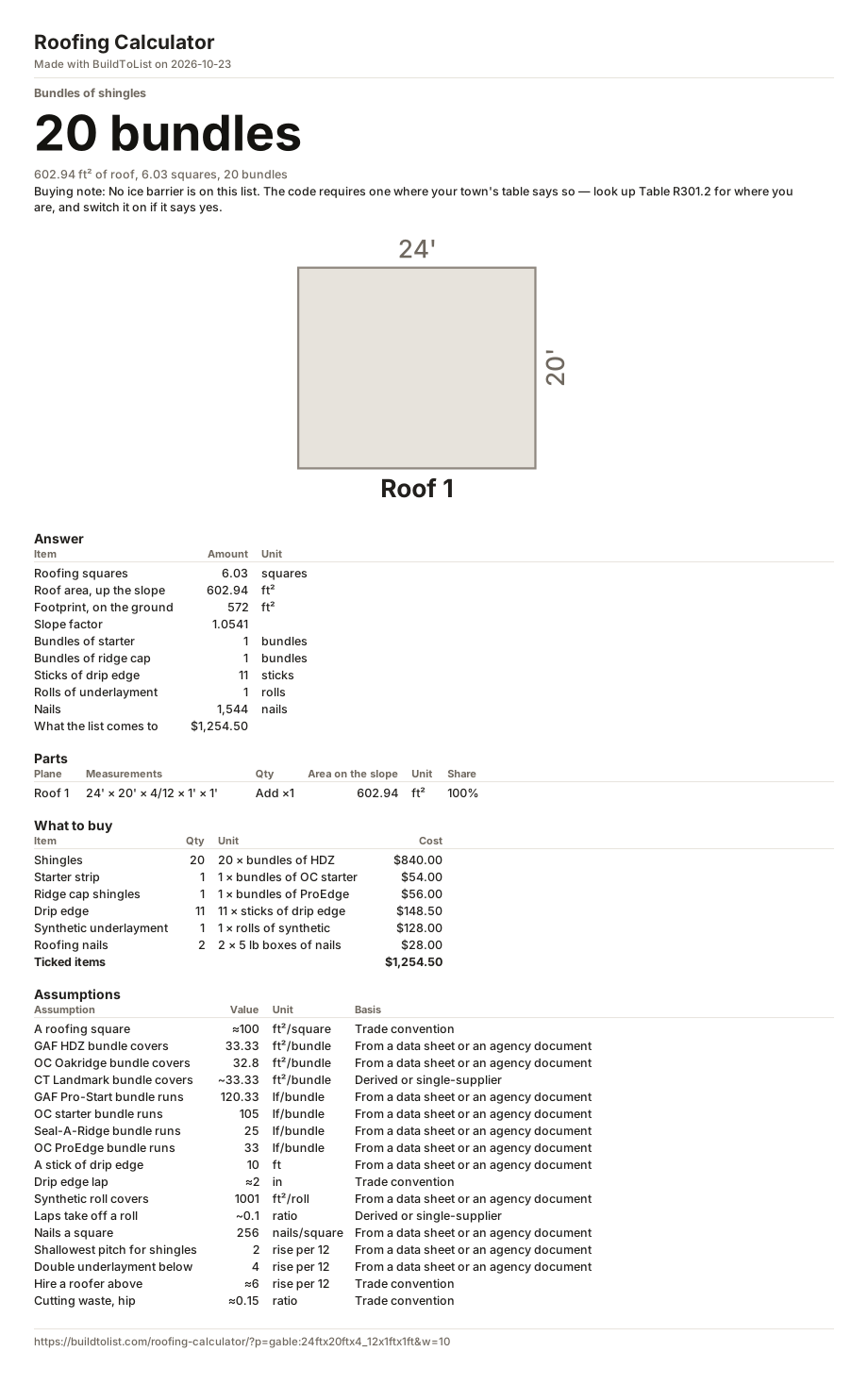
Roof area is the footprint times the slope factor, which is √(rise² + 144) ÷ 12. At 6:12 that is 1.118, so 1,200 square feet of footprint is 1,341.6 square feet of roof — 13.42 squares, a square being 100 square feet.
| Pitch | Slope factor | Degrees |
|---|---|---|
| 3:12 | 1.0308 | 14.0° |
| 4:12 | 1.0541 | 18.4° |
| 6:12 | 1.1180 | 26.6° |
| 8:12 | 1.2019 | 33.7° |
| 9:12 | 1.2500 | 36.9° |
| 12:12 | 1.4142 | 45.0° |
The footprint to use is the one measured to the drip edge, overhangs included — that is what the roof actually covers. If you measured the walls instead, put the overhang in the two boxes and the page adds it: the eave overhang widens the roof across the slope, the rake overhang lengthens it along the ridge.
Bundles, not three to the square
A bundle of shingles is roughly a third of a square, and the usual shorthand is three bundles to the square. It is wrong for some shingles: an Owens Corning Oakridge bundle covers 32.8 square feet, so three of them cover 98.4, not 100 — about two per cent short over a whole roof. This page divides by the coverage printed on the wrapper, and the table of ways to buy lets you pick the bundle you are actually buying.
Cutting waste is on top: the makers allow 10 per cent on a gable roof and 15 on a hip, where every plane meets another at an angle. That box is yours to change — on a big simple roof the manufacturers' own manuals say 10 per cent is generous.
Measuring the pitch
Hold a level against the slope, mark 12 inches along it, and measure down
from that mark to the roof. That drop is the rise. A drop of 6 inches over 12
is a 6:12 roof. You can type it any way you have it — 6,
6/12, 6:12, 26.6° or
50% — and the line under the box prints all three, so you can see at
once whether the slope it read is the slope you meant.
What this page does not do
It does not price labour or tearing off the old roof, and it does not count flashing around a chimney, a skylight or a wall. It also adds the edges of several planes up as if they were separate roofs: where two planes meet, the edge between them is neither eave nor rake, so a complicated roof entered as several pieces will read high on starter, cap and drip edge. For a single gable, hip or shed it counts every edge the roof has.