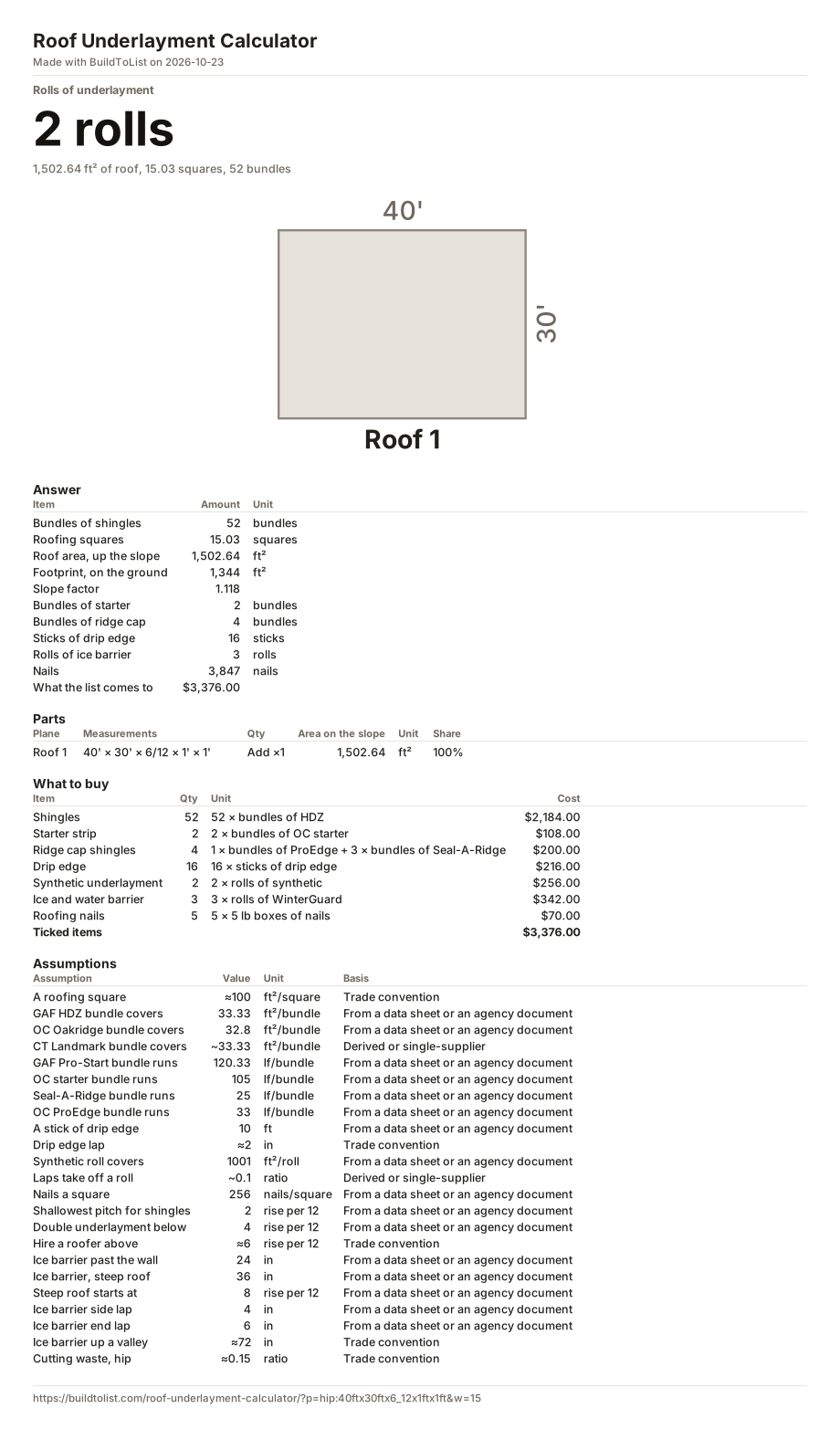
Underlayment covers the whole roof
Underlayment is the layer between the deck and the shingles. It goes over the whole roof, so it is counted by area — but a roll never covers the area printed on it, because every course laps the one below.
Synthetic underlayment comes in 10 square rolls, about 1,001 square feet, and the lap line printed on the sheet takes roughly a tenth of that. Felt comes in 4 square rolls (No. 15) and 2 square rolls (No. 30) and loses about the same. The box in the assumptions below is that loss, and it is yours to change if you know the exposure your roofer works to.
| Roof | Synthetic (1,001 ft²) | No. 15 felt (400 ft²) | No. 30 felt (200 ft²) |
|---|---|---|---|
| 1,000 ft² | 2 | 3 | 6 |
| 1,341.6 ft² | 2 | 4 | 8 |
| 2,000 ft² | 3 | 6 | 12 |
| 3,000 ft² | 4 | 9 | 17 |
When one layer is not enough
On a roof between 2:12 and 4:12, asphalt shingles need the underlayment doubled — two layers, lapped halfway, over the whole roof. Below 2:12, shingles are not the right covering at all. The code panel below says which of those applies to the pitch you typed, against the edition you pick.
Ice and water barrier at the eaves
An ice barrier is a self-adhering membrane stuck to the deck at the eaves, where meltwater backs up behind an ice dam and finds its way under the shingles. Where it is required, the code wants it from the eave to a line at least 24 inches inside the exterior wall, measured up the slope — and at least 36 inches up the slope on a roof of 8:12 or steeper.
So the strip is the overhang plus 24 inches, times the slope factor. On a 40 by 30 foot roof at 6:12 with a 12 inch overhang that is 3 feet 4 inches up from the eave, over 84 feet of eave: 282 square feet, which is two rolls.
Whether it is required where you are is not something this page can tell you. The code requires an ice barrier only where the local table of climatic criteria says so, town by town, and there is no national answer. Look up Table R301.2 for your jurisdiction — your building department will have it, and it is a single yes or no — and switch the box on if it says yes. Detached accessory structures without conditioned space are generally exempt even where it does say yes.
Rolls are 3 feet wide and are sold by the printed area — 150, 195, 200 or 225 square feet. The side and end laps take some of that, so this page divides by what a roll actually covers once lapped, and both lap figures are boxes you can change.