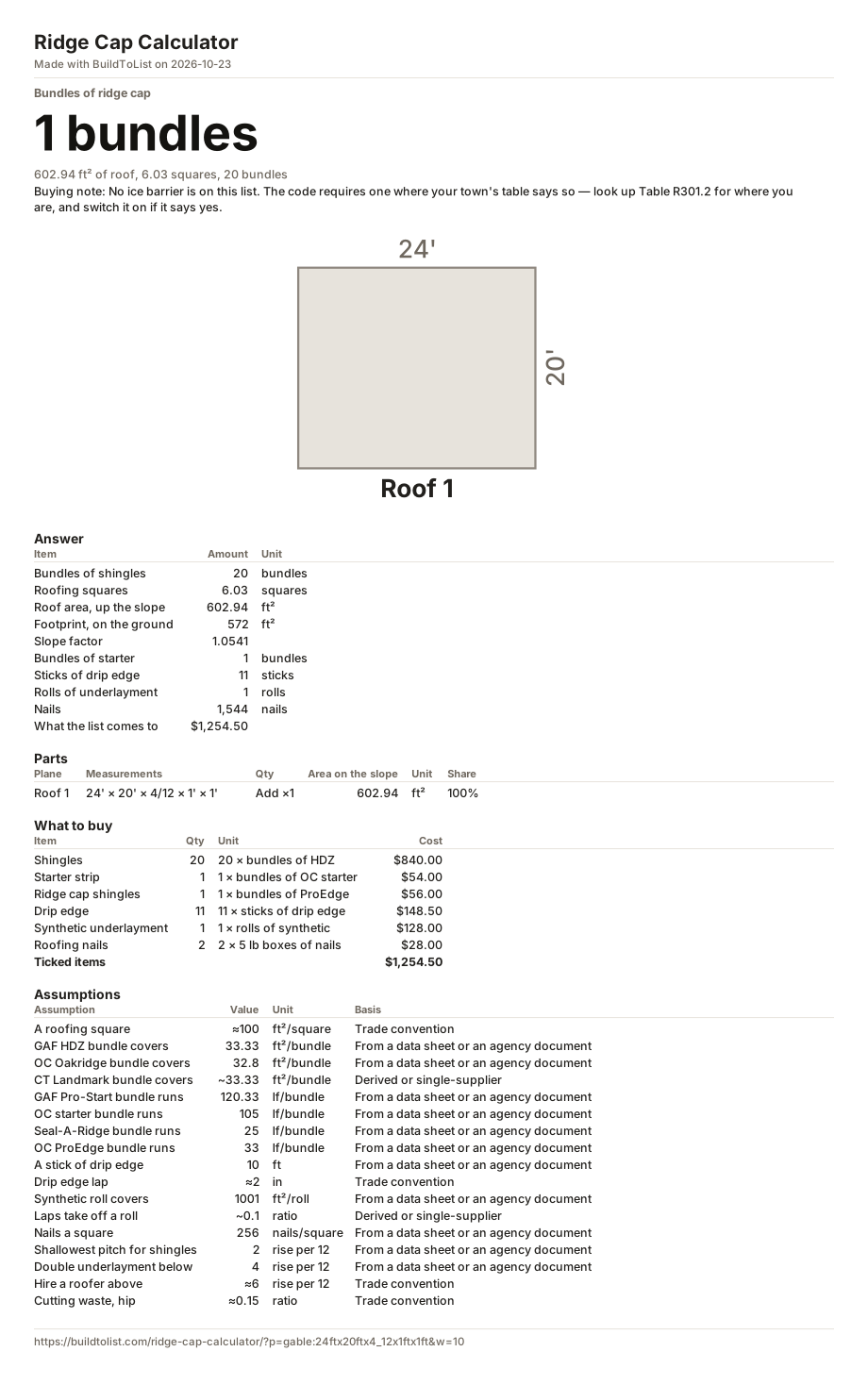
Ridge cap goes by the foot, not by the square
Ridge cap shingles are sold by the linear foot a bundle runs, and the bundles differ: GAF Seal-A-Ridge runs 25 feet, Owens Corning ProEdge runs 33. So the count is the ridge and hip length divided by whichever you are buying, rounded up.
That is why a roofing calculator has to know the roof's shape and not just its area. A 40 by 30 foot gable roof has 40 feet of ridge — two bundles of Seal-A-Ridge. The same footprint as a hip roof has 10 feet of ridge and 90 feet of hip, 100 feet in all, which is four.
| Ridge and hips | Seal-A-Ridge (25 lf) | ProEdge (33 lf) |
|---|---|---|
| 20 ft | 1 | 1 |
| 40 ft | 2 | 2 |
| 60 ft | 3 | 2 |
| 100 ft | 4 | 4 |
| 140 ft | 6 | 5 |
Hips take cap too
A hip is capped exactly as a ridge is, and on a hip roof the hips are much the longer run of the two. Forgetting them is the commonest way to come up short: the ridge of a hip roof looks small, so it is easy to buy for the ridge and find four corners uncovered.
A valley is the opposite case — two planes meeting the other way — and is not capped at all. It is lined, under the shingles, and these pages do not count the lining: the valley box, where a roof has two planes, runs ice barrier membrane up the valley and nothing else.
Cut cap and a ridge vent
Cutting your own cap from three-tab shingles is possible, and a bundle of three-tab yields roughly 35 linear feet that way. The manufacturers' wind warranties generally require their own cap with their own shingles, so it is worth checking before you save the bundles.
If you are fitting a ridge vent, it takes the place of cap along its own length — most vents are capped with shingle over the top, so you need cap for the vent run as well as for the bare ridge, but the vent length comes out of the plain ridge. Measure the vent, subtract it from the ridge, then add it back as capped vent: the arithmetic is the same length either way, which is why this page does not ask.