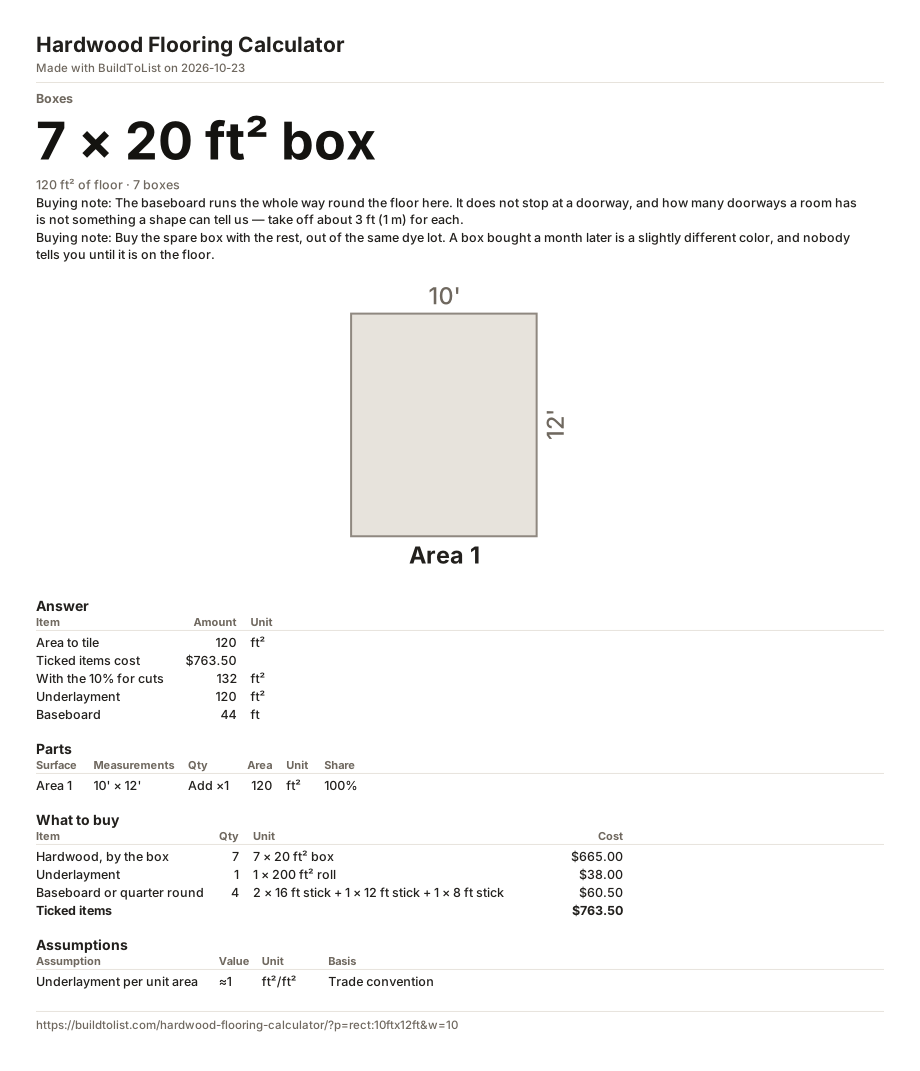
How many boxes of hardwood
This page opens on a 12 by 14 foot room: 168 square feet, 176.4 with the 5% Mullican advises for a straight lay, which is 9 boxes at 20 square feet each.
The 5% is the part worth noticing. Mullican publish it — 5%, in a 5 to 7% range, for a straight nail-down or glue-down lay — and this page applies it rather than mentioning it in a paragraph underneath. Lowe's own flooring tool advises buying 10% extra and then prints a number with none of it in.
Waste by how it is laid
| Layout | Mullican advises |
|---|---|
| Straight | 5% (5–7%) |
| Diagonal | 10–15% |
| Herringbone or parquet | 15–20% |
Plus one to two spare boxes on top, which Mullican also advise and which this page leaves to you — a spare box is a decision about how long you intend to live there, not a percentage.
Solid or engineered, and the one difference
For the area, none: both come in cartons marked with a square footage and the division is the same. Where they differ is what goes under them and whether the room is the right room. Solid hardwood is nailed to a wood subfloor and does not belong over a slab or below grade; engineered can be floated or glued and will go over concrete with the right barrier.
If yours is floating, it wants underlayment, and the page has a row for it. If it is nailed down, it wants rosin paper or a felt underlayment instead, and that is a different product with a different coverage — read the carton.
Acclimation is not waste
Hardwood has to sit in the room it is going into, in its boxes, for days before it is laid, so it reaches the moisture content the house is at. That is not a quantity question and it does not change the order — but it does change the schedule, and a floor laid the day it was delivered is a floor with gaps in it next winter.
Buy the whole order at once for the same reason you buy the spare box at once: boards from one run are milled to one thickness and sorted to one grade. A second order is a different tree.
Board feet, if that is how yours is sold
Unfinished hardwood from a mill is sold by the board foot rather than by the carton. That is a different sum — thickness times width times length — and this page cannot do it, because a board foot needs the thickness and the width of the board rather than the area of the floor. The board foot calculator on this site asks for those three measurements instead.