How far apart to set fence posts
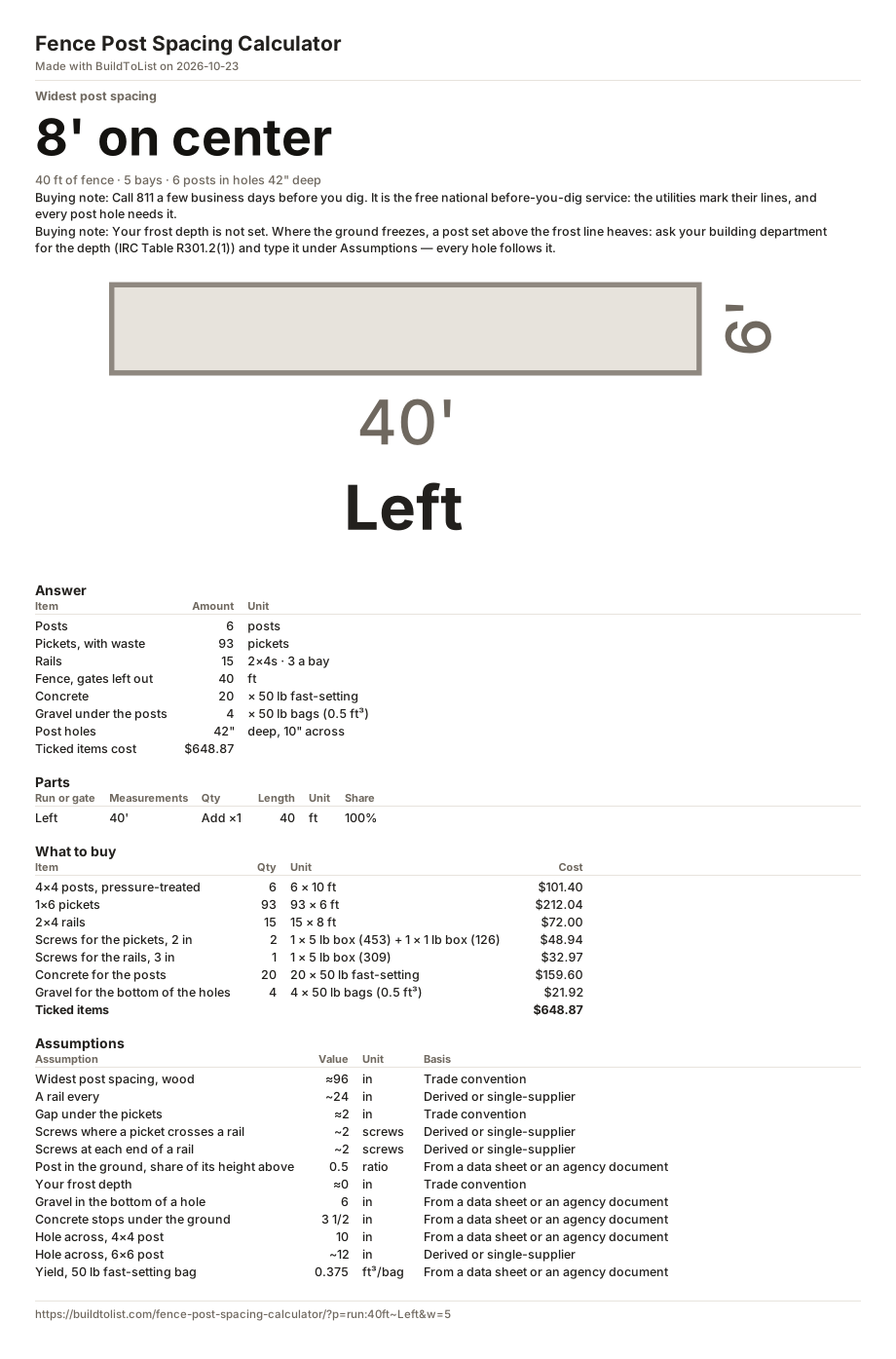
Divide each run into equal bays no wider than the spacing you allow, and the bays round up. 100 feet at no more than 8 feet is 12½ bays, so 13 bays of 7' 8 5/16" on center, and 14 posts. Thirteen bays of 8 feet would overshoot by 4 feet; twelve would leave one bay 4 feet wider than the rest. Even bays put every rail on the same cut and every post the same distance from the next.
| Run | Bays at 8 ft or less | On center | Posts |
|---|---|---|---|
| 50 ft | 7 | 7' 1 11/16" | 8 |
| 60 ft | 8 | 7' 6" | 9 |
| 75 ft | 10 | 7' 6" | 11 |
| 100 ft | 13 | 7' 8 5/16" | 14 |
| 150 ft | 19 | 7' 10 3/4" | 20 |
Which spacing
A wood fence on 2×4 rails is set no more than 8 feet apart, the length of the rail that spans a bay; wider than that a rail sags under the pickets, which is what builders say and what Inch Calculator and Omni both use — no standard gives the figure. Chain link line posts may be 10 feet apart. A panel fence has no choice: its posts stand a panel apart, 96 inches for an 8 foot vinyl or wood panel and 72½ for a 6 foot aluminum one. Split rail stands a rail apart, about 10 feet 3 inches for an 11 foot rail. Each is a figure under Assumptions you can change.
Several runs
Every run is divided on its own, from corner to corner or from end to gate, because a corner post is where both runs stop. A back yard of 50, 100 and 50 feet is 7, 13 and 7 bays — 27 — and 28 posts, the corners counted once.
Marking it out
Set the end and corner posts first and pull a string between them at post height. Measure the on-center spacing along the string from one end, mark each post, and dig. Measuring each bay from the last post adds up its errors; measure every mark from the same end. For the gaps between pickets — the even spacing a spacer block is cut to — use the picket fence calculator. We are not connected with any maker, store or supplier named here.