Drip edge is required, and nobody counts it
Drip edge is the metal angle at the edge of a roof that throws water clear of the fascia. The residential code has required it at eaves and rakes since the 2012 edition, with a lap of at least 2 inches where sticks meet.
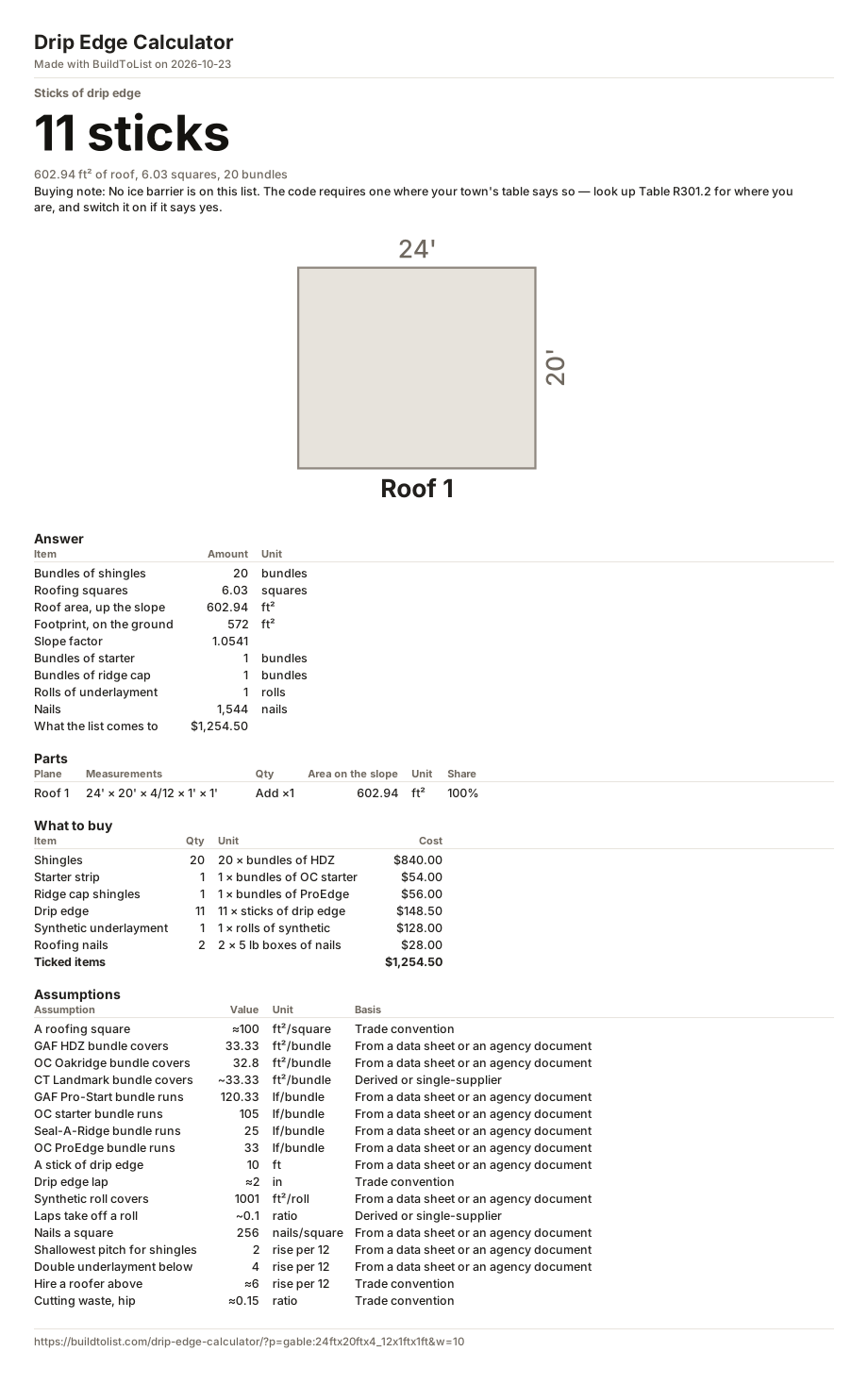
It is sold in 10 foot sticks, every profile. With a 2 inch lap, a stick covers 9 feet 10 inches, so the count is the eave and rake length divided by 9.83 — not by 10.
| Eave + rake | Sticks |
|---|---|
| 60 ft | 7 |
| 100 ft | 11 |
| 147 ft (40 × 30 gable at 6:12) | 15 |
| 140 ft (the same as a hip roof) | 15 |
| 200 ft | 21 |
Why the rake is longer than it looks
A rake runs up the slope. On a 40 by 30 foot gable roof at 6:12 each rake is 15 feet of plan times the 1.118 slope factor — 16 feet 9 inches — and there are four of them, two per gable end. That is 67 feet of rake against 80 feet of eave: nearly half the drip edge, and the part a calculator working from area alone cannot see.
A hip roof has no rake at all. Its eave runs the whole perimeter instead, so a 40 by 30 hip roof needs drip edge for 140 feet — slightly less than the gable, all of it at the eave.
Eave first or rake first
The order is not arbitrary. Drip edge at the eave goes under the underlayment, so water on top of the underlayment runs out over the metal. At the rake it goes over the underlayment, so wind-driven water running down the rake cannot get behind it. Getting it the other way round puts water under the felt at the eave, which is the one place it must not be.
Profiles
The common ones are the L-shaped type (sometimes called type C) and the one with a kick-out at the bottom (type D, or "D-style"), which throws water further from the fascia and is required in some jurisdictions. Both come in 10 foot sticks and both are counted the same way. This page counts one profile; if you are using a different one at the rake from the eave, count the two lengths separately.