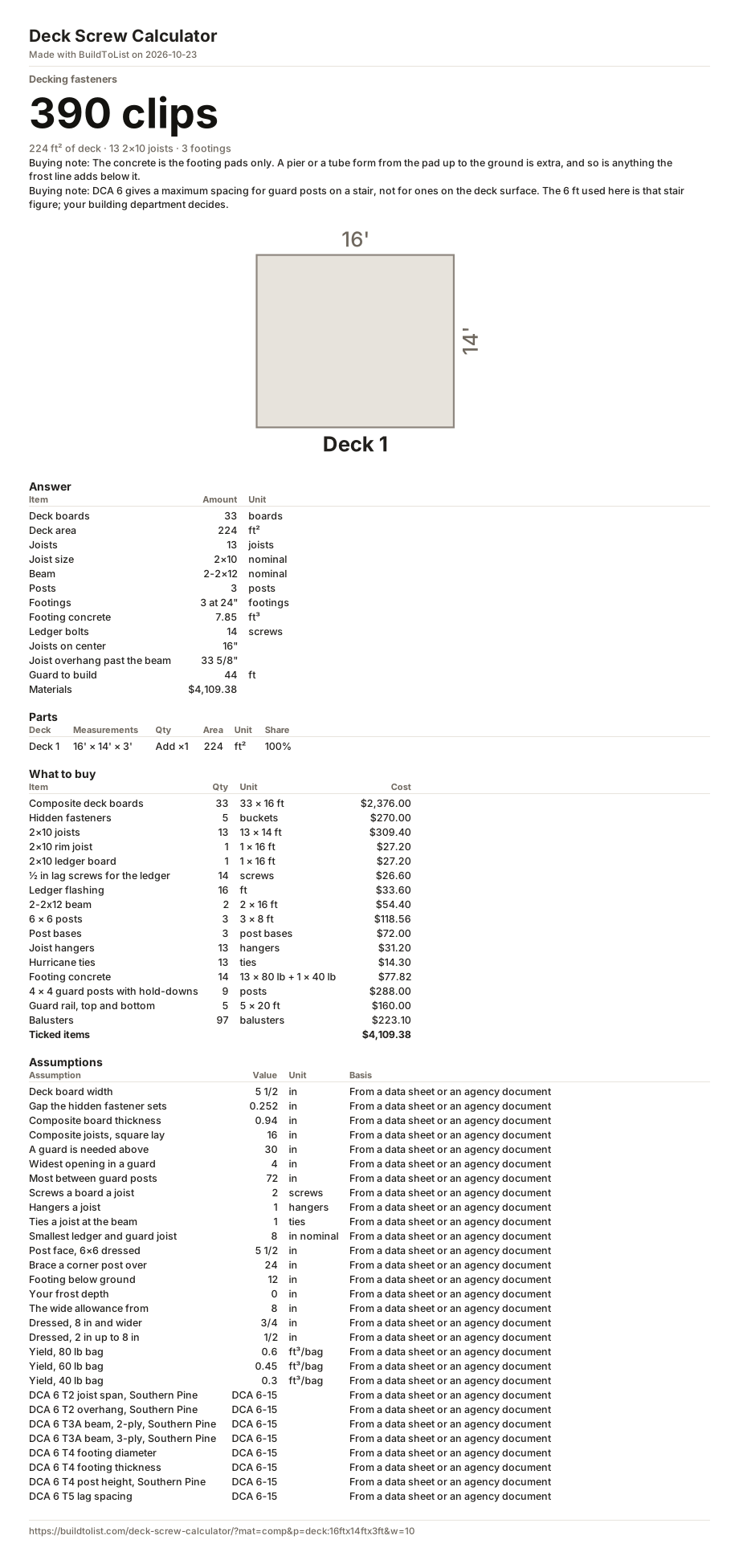
Deck screws: two a board at every joist
A 16 by 12 foot deck at 16 inches on center is 26 rows of decking over 13 joists. Each board gets two fasteners where it crosses each joist, so that is 26 × 13 × 2 = 676 screws — three 5 pound boxes of #9 × 3 inch at 309 a box. DCA 6-15 asks for 2-8d threaded nails or 2-#8 screws at every joist, and for the boards to sit about ⅛ inch apart.
Switch to hidden fasteners and it is one clip per crossing instead: 26 × 13 = 338 clips, four 90-clip buckets. A bucket covers about 50 square feet, so 192 square feet checks out at four either way.
Why a count per square foot is not enough
Omni uses a flat 3.5 screws a square foot. On this deck that gives 3.5 × 192 = 672, which looks right — but only because the joists happen to be 16 inches apart. Bring them to 12 inches, as a composite board laid at 45° requires, and the crossings go up by a third while the flat figure does not move: 676 becomes 884 and the fixed rate is 212 screws short. The count has to follow the spacing, and here it does.
Inch Calculator does vary its clip count with the spacing — 1.75 a square foot at 16 inches, 2 at 12, 1 at 24 — and takes screws as twice the clips, which lands close. Counting the crossings directly gets there without the rates.
The screws that are not decking screws
The list below keeps the structural fasteners apart from the decking ones, because they are not interchangeable. The ledger takes ½ inch lag screws or bolts with washers at the spacing DCA 6 Table 5 gives for the joist span — lead anchors are prohibited, and the tip of a lag has to pass right through the inside face of the house band joist. Joists hang on rated hangers at the ledger and take a hurricane tie at the beam, each good for at least 100 pounds in uplift and in lateral load. Hangers, ties, clips and their nails all have to be galvanised or stainless, and aluminum should not touch copper-bearing treated lumber.