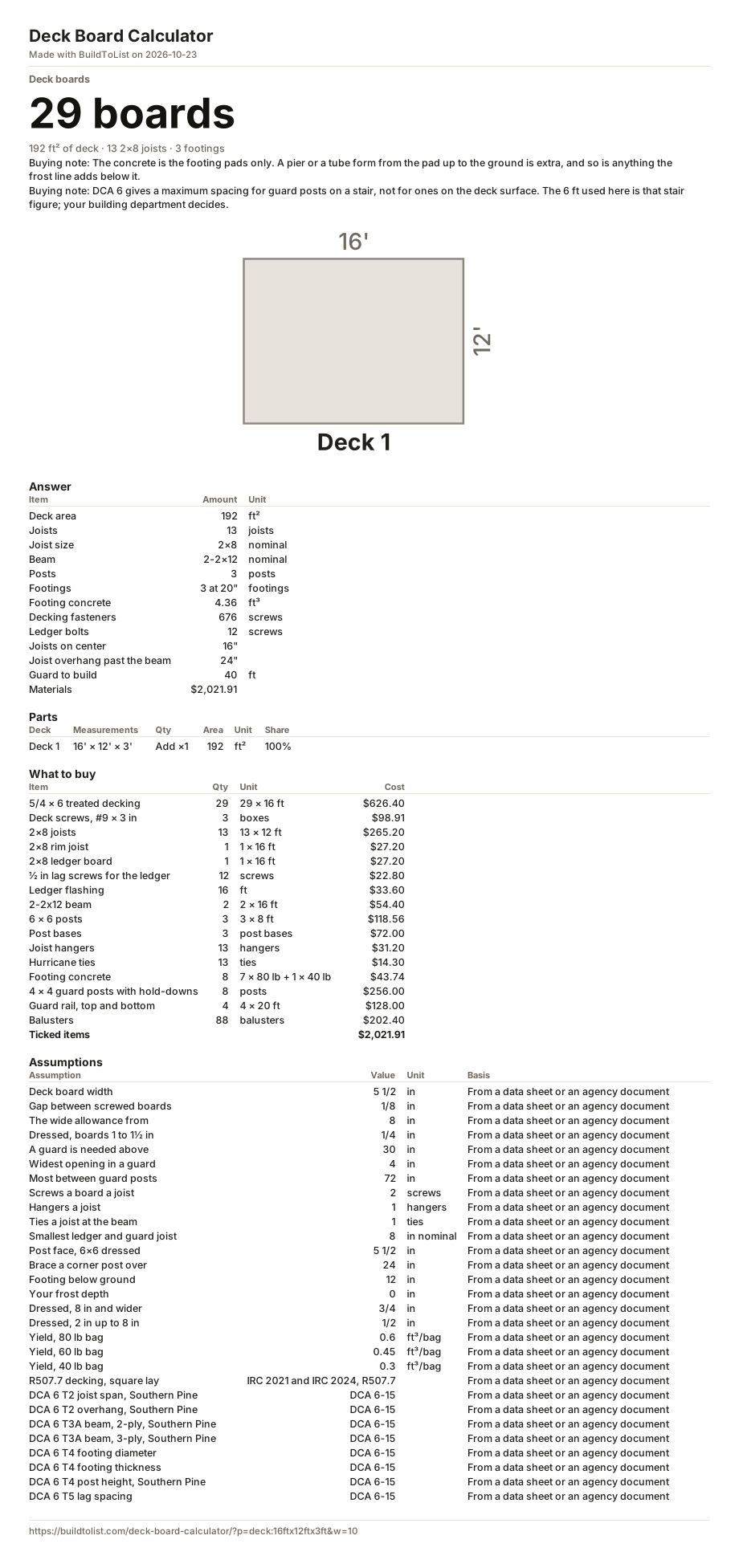
How many deck boards for a 20 by 12 foot deck
Count the rows, not the area. Twelve feet of depth is 144 inches; a 5/4 × 6 board is 5½ inches wide and sits about ⅛ inch off its neighbor, so a row covers 5⅝ inches. 144 ÷ 5.625 = 25.6, so the deck takes 26 rows, each one a 20 foot board. With 10% for cuts and culls that is 29 boards.
Change the run and the count of boards in a row changes with it. A 24 foot deck is two boards a row, and the page buys 12 foot boards for it rather than 20 foot ones, because two 12s meet at 24 feet with nothing left over and two 16s leave 8 feet on the floor. Sizing a deck to a board length is the oldest piece of advice in decking; this is it done as arithmetic.
Two ways the popular calculators get this wrong
Decks.com counts rows at the nominal 6 inches a board is called rather than the 5½ it measures. Over a 16 foot depth that is 192 ÷ 6 = 32 rows where 192 ÷ 5.5 = 34.9 means 35: three rows short, and the last foot and a half of the deck has no boards for it.
Inch Calculator's article divides the area by the area of one board: "200 sq ft ÷ 7.34 sq ft = 24.25 boards … 25 boards". The division is wrong — 200 ÷ 7.33 is 27.3, so 28 — and the method is wrong too, because it drops the gap between boards and it drops the butt joints where a row needs more than one board. Inch's own tool returns 28, so the article and the tool disagree with each other.
What else the boards decide
The joists under them cannot stand further apart than the decking spans: IRC R507.7 gives 16 inches for 5/4 laid square to the joists and 12 inches on the diagonal, and 24 inches for a full 2 inch board. Switch the decking or the angle at the top of the form and the frame below follows. Fasteners follow too — two screws a board at every joist it crosses.