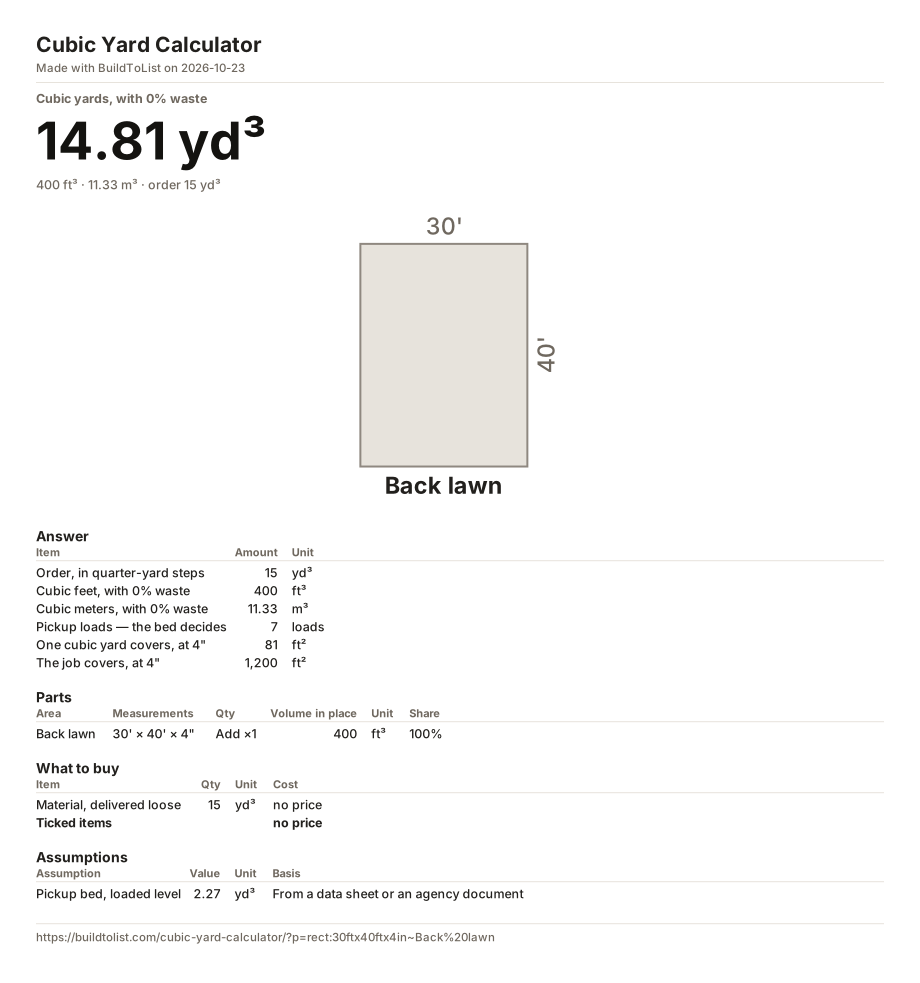
How many cubic yards you need
A cubic yard is a box 3 feet on every side: 27 cubic feet. To find how many a job takes, work out the area in square feet, multiply by the depth in feet, and divide by 27. A bed 10 feet by 12 feet and 3 inches deep is 10 × 12 × 3/12 = 30 cubic feet, which is 30 ÷ 27 = 1.11 cubic yards, or 0.85 cubic meters.
Nobody delivers 1.11 yards. The page rounds the order up to the next quarter yard, 1.25 yd³, and the step can be a half or a whole yard if that is how your supplier sells. It rounds once, after any waste you add, so the yards you order are never rounded twice.
Price what you order, not what you need
At $40 a yard, a popular calculator prices this bed at $44.44: 1.11 yards × $40. The truck brings 1.25 yards, though, and the bill is $50.00. Type your supplier's price per yard and its delivery fee beside the order, and the list adds up what you will actually pay.
Another calculator tells you to round up to whole yards. For this bed that is 2 yd³ — 0.75 yd³ more than the quarter-yard order, paid for and left in a pile. Pick whole yards here and the page says how much more it orders.
Waste is a box, and it starts at zero
The yards on this page are what the shape holds. Nothing is added unless you add it, because how much to add depends on what you are spreading: CalculatorSoup's table suggests 5–10% for mulch, 10–15% for a gravel path and 5% for concrete. Type 10% and the bed becomes 1.22 yd³ — still a 1.25 yd³ order.
Feet and inches, and several areas
Type a measurement the way a tape reads: 10 6 is 10 feet 6
inches, and 10 1/2 is ten and a half feet. One well-known
calculator reads 10 1/2 as 101. Add an area for each part of the job — a path,
a bed, a ring round a tree — and set one to subtract to take a patio or a
planter out of the middle. Round areas use π itself: a circle 10 feet across and
4 inches deep holds 26.18 cubic feet, where π rounded to 3.14 gives 26.17.
A worked example from another calculator, 12 by 14 feet and 9 inches deep, is 126 cubic feet: 4.67 cubic yards, or 3.57 cubic meters, ordered as 4.75.
What a yard weighs, and how many loads
A cubic yard says nothing about weight until you say what it is. Pick a material and the page weighs it at its loose figure: a cubic yard of crushed stone is about 1.25 short tons, or 2,500 lb; a yard of topsoil about 2,360 lb; a yard of wood mulch about 473 lb. Weights are printed in short tons of 2,000 lb and in tonnes of 1,000 kg, side by side.
If you haul it yourself, two things limit a pickup: what its bed holds and what it can carry. The page divides by both and the larger answer wins. The bed above in crushed stone weighs 2,778 lb. It fits in one bed of 2.27 yd³, but a pickup carrying about 1,500 lb needs 2 loads, so the weight decides. The bed is the makers' own measure of a full-size box and the payload is an estimate, and both are boxes under Assumptions: your truck's payload is on the sticker in the driver's door jamb.
What one yard covers
Turned round, the same sum says how far a yard goes: 324 square feet divided by the depth in inches. At 3 inches a cubic yard covers 108 square feet; at 4 inches, 81 — which is why a 9 by 9 foot bed 4 inches deep takes exactly one yard. When every area on the page is the same depth, the page prints that figure and what the whole job covers: 120 square feet for the bed above, its 10 × 12 feet back again.
For a weight in a single material — gravel by the short ton, mulch by the bag, a slab by the bag or the truck — the links under the answer carry this shape to the page that sells it. We are not connected with CalculatorSoup or with any calculator, supplier or store mentioned here.