Find a tool

Concrete Slab Calculator

One slab — how thick, how many yards, and what goes underneath.

Material only — it does not design a slab, and your building department has the last word.

Slab 1

1' 6" · 18 in · 1.5 ft · 0.4572 m

10' · 120 in · 10 ft · 3.048 m

4" · 4 in · 0.3333 ft · 0.1016 m

5 ft³

Check thisThe link gave a slab no thickness, so its box starts at the usual one. Check it.

10% covers spill, a soft base and forms that bow. It is added once, to the concrete and the base gravel.

This page recalculates as you type. There is no Calculate button.

Answer

Save imageExcel

With 10% waste

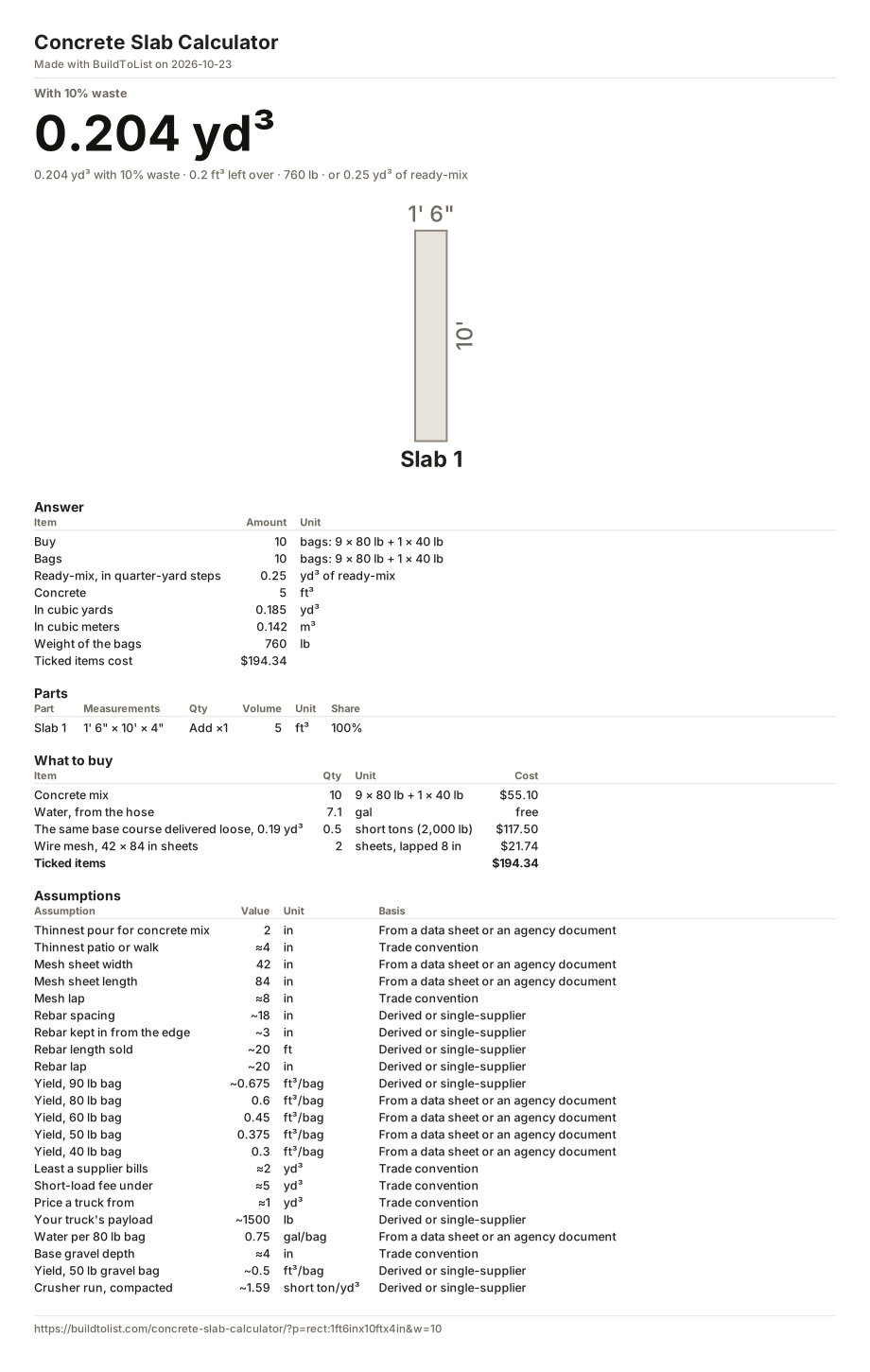
0.204 yd³

0.204 yd³ with 10% waste · 0.2 ft³ left over · 760 lb · or 0.25 yd³ of ready-mix

Buy 10 bags: 9 × 80 lb + 1 × 40 lb
Bags 10 bags: 9 × 80 lb + 1 × 40 lb
Ready-mix, in quarter-yard steps 0.25 yd³ of ready-mix
Concrete 5 ft³
In cubic yards 0.185 yd³
In cubic meters 0.142 m³
Weight of the bags 760 lb
Ticked items cost $194.34
DrawingThe project drawn to scale. Slab 1: 1' 6" × 10'.1' 6"10'Slab 1

Breakdown

Part Measurements Qty Volume Share
Slab 1 1' 6" × 10' × 4" Add ×1 5 ft³

What to buy

Ways to buy the bags

Every way is worked out; pick the one you will buy. The 50 and 90 lb bags are offered on their own only: we have not seen them on a shelf.

8 × 80 lb + 1 × 60 lb + 1 × 40 lb Bags 10 Left over 0.05 ft³ Weight 740 lb Cost $54.40
9 × 80 lb + 1 × 40 lb Bags 10 Left over 0.2 ft³ Weight 760 lb Cost $55.10
9 × 90 lb Bags 9 Left over 0.58 ft³ Weight 810 lb Cost $58.32 Reference price $6.48. Type your store's.
10 × 80 lb Bags 10 Left over 0.5 ft³ Weight 800 lb Cost $56.80 Reference price $5.68. Type your store's.
13 × 60 lb Bags 13 Left over 0.35 ft³ Weight 780 lb Cost $64.74 Reference price $4.98. Type your store's.
15 × 50 lb Bags 15 Left over 0.13 ft³ Weight 750 lb Cost $67.20 Reference price $4.48. Type your store's.
19 × 40 lb Bags 19 Left over 0.2 ft³ Weight 760 lb Cost $75.62 Reference price $3.98. Type your store's.

Shopping list

10 9 × 80 lb + 1 × 40 lb $55.10
7.1 gal free
11 50 lb bags (0.5 ft³) $60.28 Reference price $5.48. Type your store's.
0.5 short tons (2,000 lb) $117.50 Reference price $45.00. Type your store's. Reference price $95.00. Type your store's.
2 sheets, lapped 8 in $21.74 Reference price $10.87. Type your store's.
2 #4 bars, 20 ft $29.96 Reference price $14.98. Type your store's.
Ticked items $194.34

Untick what you already have.

Save imageExcel
How this was worked out

Every number below is yours. Each constant links to the row where you can change it.

Slab 1 1' 6" × 10' × 4" 5 ft³
All parts 5 ft³ ÷ 27 0.185 yd³ · 0.142 m³
Plus waste 5 ft³ × (1 + 10%) 5.5 ft³ = 0.204 yd³
Bags 5.5 ft³ ÷ 80 lb at 0.6 ft³, 40 lb at 0.3 ft³ 9 × 80 lb + 1 × 40 lb · 0.2 ft³ left over

Change:Yield, 80 lb bagYield, 40 lb bag

Ready-mix 0.204 yd³ → quarter-yard 0.25 yd³

Change:Least a supplier bills

Water 760 lb of bags ÷ 80 lb × 0.75 gal 7.1 gal

Change:Water per 80 lb bag

Base gravel (15 ft² × 4" + 0 ft³ in holes) × (1 + 10%) ÷ 0.5 ft³ a bag 11

Change:Base gravel depthYield, 50 lb gravel bag

Base gravel, delivered loose 0.204 yd³ × 1.59 short tons a yard, compacted, to 0.25 short ton steps 0.5 short tons (2,000 lb)

Change:Crusher run, compacted

Wire mesh 3' 6" × 7' sheets lapped 8", laid over each slab 2

Change:Mesh sheet widthMesh sheet lengthMesh lap

Rebar #4 every 1' 6" both ways, 3" in from the edge, 20' bars lapped 1' 8" 2

Change:Rebar spacingRebar kept in from the edgeRebar length soldRebar lap

Cost 9 × $5.68 + 1 × $3.98 + 0.5 short tons (2,000 lb) × $45.00 + $95.00 + 2 × $10.87 $194.34

Assumptions

Every one of these is editable. Change one and the answer changes with it.

Assumption Value Confidence
Thinnest pour for concrete mixSakrete High-Strength Concrete Mix (Oldcastle APG): pour at least 2 in thick. Thinner is a job for a resurfacer. in From a data sheet or an agency document
Thinnest patio or walkPatios and walks are poured 4 in; no building code sets a minimum for a slab nobody lives on or drives on, so this is a trade convention rather than a limit. ≈ in Trade convention
Mesh sheet widthThe sheet Home Depot sells as a 42 in. x 84 in. remesh sheet. in From a data sheet or an agency document
Mesh sheet lengthThe sheet Home Depot sells as a 42 in. x 84 in. remesh sheet. in From a data sheet or an agency document
Mesh lapOne mesh square plus 2 in at every joint: 8 in for 6×6 mesh of W1.4-W2.1 wire under ACI 318-19 §25.5.4.1 (Wire Reinforcement Institute, WWR.7 schedule). WRI's ACI 301 detail for a slab on ground that carries no design load laps 2 in (WWR.2); the longer lap is kept. ≈ in Trade convention
Rebar spacingA common grid for #4 bar in a house slab. No standard sets one for a patio. ~ in Derived or single-supplier
Rebar kept in from the edgeACI 318-19 Table 20.5.1.3.1: 3 in of cover where concrete is cast against and stays in contact with the ground, kept here at the slab's edges. ~ in Derived or single-supplier
Rebar length sold#4 bar is sold in 10 ft and 20 ft lengths; the longer one wastes less. ~ ft Derived or single-supplier
Rebar lap40 bar diameters for #4 (½ in): a rule of thumb for a lap, not a code figure. ~ in Derived or single-supplier
Yield, 90 lb bagExtrapolated at 0.0075 ft³ per lb from the 80 lb bag of the 1101 data sheet, which lists no 90 lb bag. ~ ft³/bag Derived or single-supplier
Yield, 80 lb bagQuikrete Concrete Mix 1101 data sheet. ft³/bag From a data sheet or an agency document
Yield, 60 lb bagQuikrete Concrete Mix 1101 data sheet. ft³/bag From a data sheet or an agency document
Yield, 50 lb bagQuikrete Concrete Mix 1101 data sheet. ft³/bag From a data sheet or an agency document
Yield, 40 lb bagQuikrete Concrete Mix 1101 data sheet. ft³/bag From a data sheet or an agency document
Least a supplier billsJefferson County, MO ready-mix bid tabulation (2020): an order is billed at least 2 yd³. Every supplier sets its own minimum. ≈ yd³ Trade convention
Short-load fee underSame tabulation: a short-load fee on orders under 5 yd³. Ask your supplier for theirs. ≈ yd³ Trade convention
Price a truck fromCommon advice: past about a cubic yard, mixing bags by hand is a long day and a truck is worth pricing. ≈ yd³ Trade convention
Your truck's payloadFull-size (1500-series) pickups advertise 2,260-2,440 lb of payload (2026), and ordinary trims carry 600-700 lb less; this is the low end. Your truck's figure is on the driver's door-jamb placard. ~ lb Derived or single-supplier
Water per 80 lb bagQuikrete 1101 data sheet: start with about 6 pints per 80 lb bag, 6 to 9 pints in the end. Smaller bags take their share by weight. gal/bag From a data sheet or an agency document
Base gravel depthIRC R506.2.2 (R506.3.2 in IRC 2024) asks for 4 in of base under a floor slab below grade. Outdoors it is common practice. ≈ in Trade convention
Yield, 50 lb gravel bag0.5 ft³ per 50 lb bag. Sand, which the sand page buys in the same bag: Sakrete Play Sand (data sheet REV 3-10) and Sakrete's commercial sands (Rev. 06/16) yield 0.5 ft³, Quikrete Premium Play Sand is labeled 'approx 1/2 cu. ft.'; mason sand runs larger, 0.6 ft³ (Sakrete, Rev. 04/16). Gravel: Quikrete All-Purpose Gravel as retailers list it. ~ ft³/bag Derived or single-supplier
Crusher run, compactedMoDOT's compacted crushed granite or limestone, used for crusher run and paver base: assumed to pack about this tight, as no figure for the graded product was found. ~ short ton/yd³ Derived or single-supplier

How much concrete a slab takes

A slab is its area times its thickness. The 12 by 16 ft slab this page opens with, poured 4 inches thick, is 12 × 16 × 4/12 = 64 cubic feet, which is 64 ÷ 27 = 2.37 cubic yards. Add the 10% waste in the box and it is 2.61, and because a yard comes off the truck in quarter-yard steps you order 2.75. In bags it is 118 of 80 lb — 9,440 lb, or seven trips in a half-ton pickup, which is the answer to whether this one is a bag job.

Thickness is a box, not a pair of radio buttons: type 4, 4 1/2, 5 or 4.5 and the yards follow. Every number above is also a box — the waste, the bag yield, the gravel depth — and the result says which figure it used and where it came from under Assumptions.

How thick, and for what

Thickness follows what the slab carries, and only one of the four figures below is a building code. Tell the page what the slab is for and it checks the thickness against that figure and says which document the figure is from.

What the slab is Thinnest Where that comes from
Patio, walk or shed floor4"Trade convention — no code sets a minimum
Driveway, cars and pickups4"ACI 330, as the ASCC quick reference states it (4 to 4 1/2")
Driveway, trucks, RVs, dumpsters5"Producer guidance and the heavier ASCC classes
Floor inside a building, on the ground3 1/2"IRC 2021 R506.1 — adopted code where the IRC is in force

Pick the floor and two code rows appear under the answer: R506.1 on the thickness, and R506.2.2 on the base course under it. They are the only rows on this page that quote a code, and they say "not checked" rather than "fine" wherever the clause turns on something the page cannot see — your soil, in the case of the base. For a patio or a drive there is no clause to quote, so the thickness advice stays beside the box as a note.

Thinner than 2 inches, concrete mix will not hold at all and the job wants a resurfacer or a topping mix instead. That one is about the material, not the use, so the page says it whatever the slab is for.

Yards, square feet and bags by thickness

Thickness Cubic feet per ft² ft² a cubic yard covers 80 lb bags per 100 ft²
3 1/2"0.2929349
4"0.3338156
5"0.4176570
6"0.5005484

The bag column is before waste, at the 0.60 cubic feet an 80 lb bag makes. Add your waste figure and round the whole job up once — not each slab, and never to the nearest bag.

What goes under it

Under a slab on the ground go a base course and, usually, steel. The base is compacted gravel, 4 inches of it, which for the opening project means 192 ft² × 4 in = 64 cubic feet — the same 2.37 cubic yards of gravel as the slab takes in concrete, because the area and the depth are the same. In 50 lb bags at about half a cubic foot each that is 141 bags, which is the page telling you to buy this one loose.

So the list offers it both ways and ticks the loose one. Compacted, those 2.6 cubic yards weigh about 4¼ short tons, which a yard sells by the short ton and delivers on one trip; the two price boxes beside the row are the stone and the trip, both from the figures under Assumptions, both yours to type over. The bagged row sits right above it for the small patio that really is a trolley of bags — tick that one instead and the total follows. For another stone, or to order by the cubic yard instead, the gravel calculator takes this slab's outline through the link under the answer.

Where the IRC is in force, that 4 inches is R506.2.2 for a floor slab below grade, and the clause lets a well-drained gravel or sand soil go without. Outdoors it is not a code requirement at all — it is what keeps a patio from settling into a puddle.

Mesh and rebar are one choice, not two things to buy, so the mesh row is ticked and the rebar row is not. Untick the mesh and tick the rebar and the list swaps: sheets become bars, laid both ways at the spacing under Assumptions, kept the cover distance in from every edge. Either way the count is for this slab's own measurements, not a rule of thumb per square foot — getting that wrong is how a 100 ft² slab ends up quoted 63 sheets of mesh.

Bags or a truck

Past about a cubic yard, bags stop being the cheap answer and start being a long day. This slab is 2.6 yards: 118 bags to carry, open, and mix in batches, against one delivery. The page prices both from the figures in the boxes and puts the comparison under the buy list, with the short-load fee a supplier adds below their minimum load. Under a yard it goes the other way, and the comparison still shows, so the choice is visible rather than made for you.

Common questions

How many yards is a 12 by 16 slab?

2.37 cubic yards at 4 inches thick, 2.61 with 10% waste, ordered as 2.75. At 5 inches it is 2.96 before waste, and at 6 inches 3.56. Change the thickness box and the three lines under the answer change with it.

Is 4 inches enough for a driveway?

For cars and pickups on a prepared base, yes — that is the ACI 330 figure. For anything that arrives on six wheels, a skip, an RV or a delivery truck, the figure goes to 5 inches or more, and the page will say so when you tell it what the drive carries. How much steel goes in it is a separate question, and not one this page answers.

Does this slab need rebar?

This page counts steel; it does not design it. A patio or a shed floor is commonly poured with mesh and nothing else, a drive that carries weight with bars. What a slab with a building on it needs is an engineer's question, and your building department's answer wins over any calculator.

Is the waste added twice?

No. Waste is multiplied in exactly one place in this site, and the result shows the volume before and after it so you can see it happened once. Set the box to 0 and the before and after lines agree.

Can I pour part of this now and part later?

Then it is two slabs, and the honest way to count it is two parts: Add part, type the second one, and the breakdown gives you each on its own line with its share of the total. The drawing shows both to scale, which is the fastest way to spot a measurement typed into the wrong box.