Composite decking: the joists move with the boards
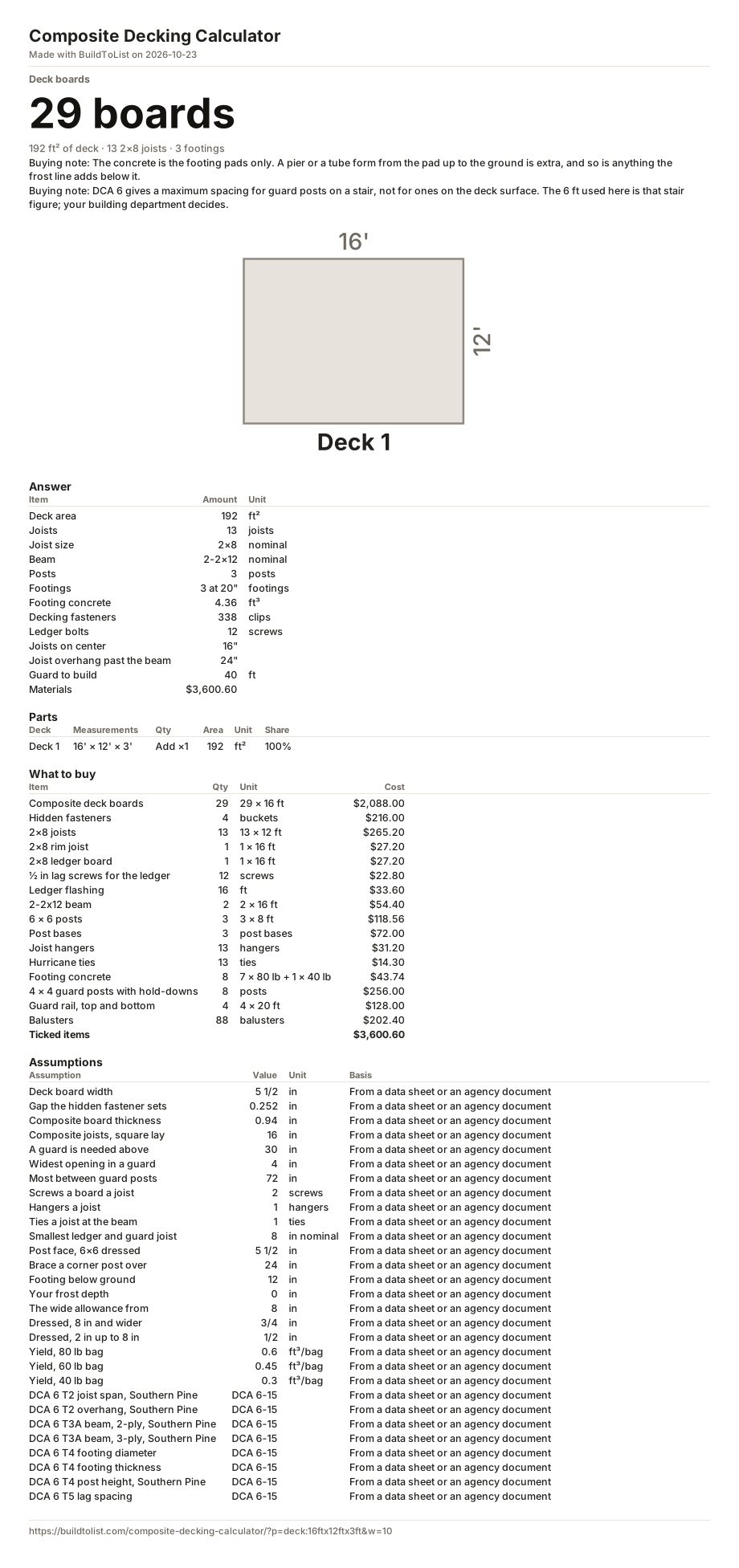
A composite board is the same 5½ inches wide as a wood one, but the hidden fastener sets a wider gap — Trex's clip holds 6.4 mm, about ¼ inch — so a row covers 5¾ inches instead of 5⅝. Twelve feet of depth is still 26 rows, and a 16 foot deck is 26 boards, 29 with 10%. The clips are one per board per joist: 26 × 13 = 338, which is four 90-clip buckets at the 50 square feet a bucket covers.
What changes more is the frame. Trex's installation guide puts joists at 16 inches on center for a residential deck, takes 2 inches off that for a board laid at 60° and 4 inches off at 45°. TimberTech prints 16, 14 and 12 inches for the same three cases. Pick an angle at the top of the form and the joist spacing here follows the tighter reading of the two.
The angle the two makers name differently
Trex measures the angle between the board and the joist: 90° is square, and 60° is its first diagonal case. TimberTech calls its middle case "30°" and does not draw it. Read literally that would be a sharper diagonal than 45°, which contradicts TimberTech's own rule that every diagonal lay is capped at 12 inches — and the 14 inches it prints is exactly Trex's 60° figure. So "30°" is almost certainly 30° off square, which is 60° to the joist. That is a reading, not a rule, so the page says it rather than hiding it, and if you are unsure the safe move is the 45° spacing.
Why the code check here never says pass
IRC 2021 and IRC 2024 both dropped the composite row from table R507.7. A composite board spans whatever its own label says, tested to ASTM D7032 (R507.2.2.1) and installed to the maker's instructions (R507.2.2.5). This page knows what Trex and TimberTech publish; it does not know what is printed on the box in front of you. A green tick over half a clause would hide exactly the half you have to go and read, so the decking span check stays open and names what to look for. We are not connected with Trex, TimberTech or any other maker.