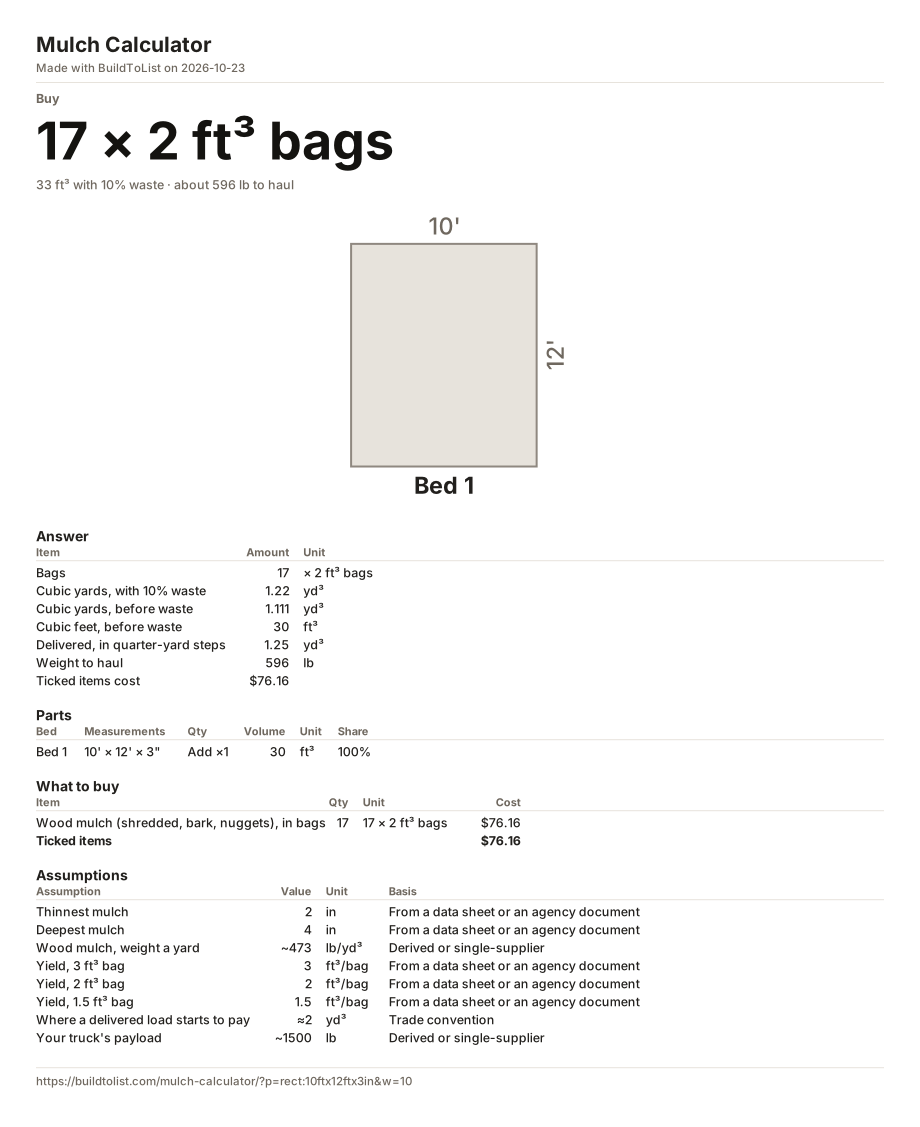
How much mulch you need
Area × depth gives the volume, 10% covers what spills and what settles, and the bag count is that volume over what one bag holds, rounded up. A bed 10 feet by 12 feet, 3 inches deep, is 10 × 12 × 3/12 = 30 cubic feet; with 10% that is 33 cubic feet, or 1.22 cubic yards. In the commonest bag, 2 cubic feet, that is 33 ÷ 2 = 16.5, so you buy 17 bags. In 3 cubic foot bags it is 11, in 1.5 cubic foot bags 22.
The two largest home stores' calculators both print 15 bags of 2 cubic feet for that bed, because they add nothing for waste — and 15 bags is the bed with no mulch spilled, none settled and none pushed past the edging. One of them prints the 3 cubic foot answer with a decimal, as if a store sold a third of a bag. This page always rounds up to whole bags and always says what is left over.
How deep to spread it
The University of Illinois Extension recommends 2 to 4 inches, with coarse mulch at 3 to 4 and fine material like compost at 2 to 3. Thinner than 2 inches does little against weeds, and more than 4 is past what Extension recommends. Type a depth outside that range for wood mulch and the bed says so beside its depth box.
- Keep mulch a few inches back from tree trunks and plant stems. A ring piled against the bark — the "mulch volcano" — holds moisture where it rots the trunk.
- Top up only when the old layer has broken down. Mulch on top of mulch that is still 3 inches deep is how a bed ends up 8 inches deep.
One yard, one bag: what each covers
| Depth | One cubic yard | One 2 ft³ bag |
|---|---|---|
| 2 in | 162 ft² | 12 ft² |
| 3 in | 108 ft² | 8 ft² |
| 4 in | 81 ft² | 6 ft² |
Those are before waste. The "a bag covers 6 square feet" you will see on store pages is only true at 4 inches; at 3 inches the same bag covers 8. A cubic yard is 27 cubic feet: 13½ bags of 2 cubic feet, so 14 to buy, or 9 bags of 3.
A ring around a tree
Choose the ring shape and give it two diameters: the outside of the mulched circle and the bare circle you leave around the trunk. A ring 6 feet across with a 1 foot gap at the trunk, 3 inches deep, is π/4 × (6² − 1²) × 3/12 = 6.9 cubic feet, or 4 bags of 2 cubic feet with waste. Add one area for each bed and each tree; subtract an area for a path or a patio inside a bed.
Topsoil and raised beds
Switch the material to topsoil and the bags change to the sizes soil is sold in — 0.75, 1 and 1.5 cubic feet. A raised bed 4 by 8 feet and 12 inches deep is 32 cubic feet: 43 bags of 0.75 or 22 bags of 1.5 before waste. Soil is heavy: NRCS puts healthy loam under 1.40 g/cm³, about 2,360 lb a cubic yard measured dry in the ground, so that bed is some 2,800 lb, two trips in a full-size pickup at the 1,500 lb payload we assume. Bagged soil is moist and weighs more. The Extension depths are for mulch, so the page does not apply them to soil.
Bags or a delivered load
Mulch is sold by volume, not weight, so the yards on this page are what a yard loads in its bucket. Home Depot's calculator suggests buying mulch in bulk from about 2 cubic yards and soil from 5; the page uses those as the point where it starts buying the load for you. Type your store's bag price, the yard's price per cubic yard and its delivery fee, and the comparison under the shopping list says which costs less and from what amount the load wins. The prices start at dated reference estimates, not quotes: type your store's and your yard's.
What it weighs
Only for hauling: the EPA's volume-to-weight factors put green wood chips at 473 lb a cubic yard and dry ones at 243, so a 2 cubic foot bag weighs 18 to 35 lb. Bagged mulch is usually moist, so the page uses the heavier figure, about 35 lb a bag. Both figures are boxes under Assumptions. We are not connected with any store or supplier named here.