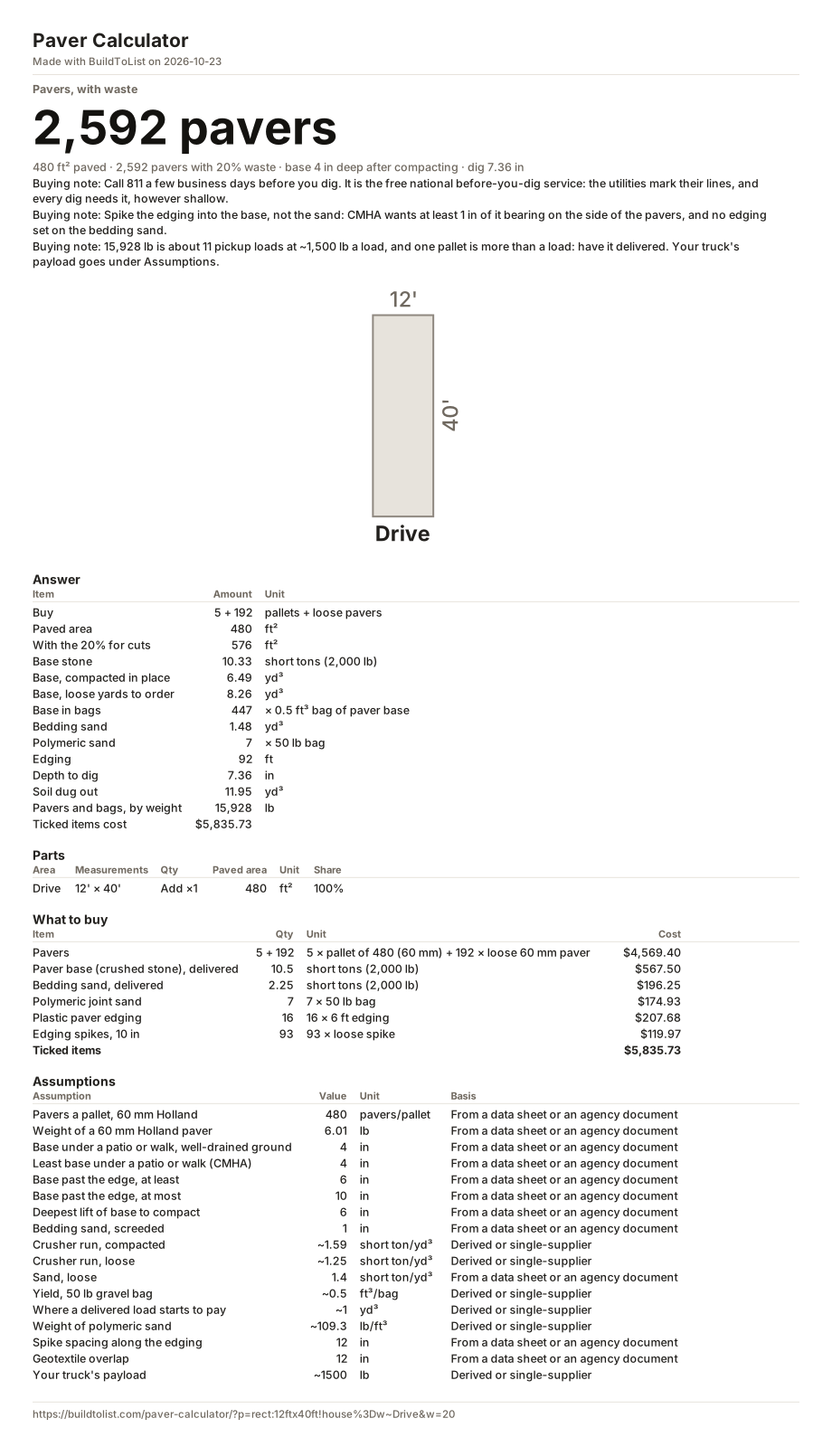
How many pavers you need
Measure the patio, add the waste for cuts, and divide by the space one paver takes when it is laid. The patio this page opens with is 12 by 20 feet, its 20 foot side against the house: 240 square feet. With 10% for the pavers cut at the edges that is 264 square feet, and a 4 by 8 inch Holland paver laid with its joint takes 32 square inches — 4.5 to the square foot — so the patio takes 1,188 pavers.
The 4 by 8 is the module, not the paver: a Holland stone is 100 by 200 mm, 3.94 by 7.87 inches, and the difference is the joint. A popular paver calculator divides by 0.23 square feet a paver and gets 2,609 pavers for 600 square feet with no waste; at 4.5 to the square foot it is 2,700. A store's calculator rounds the paver to 0.22 square feet and gets 1,200 for this patio instead of 1,188. Each error is small, and each one is a trip back.
Pallets or loose pavers
Pavestone ships its 60 mm Holland 480 to a pallet. The 1,188 pavers are 2.48 pallets, and the page prices three ways of buying them:
| Buy | Pavers | At the reference prices |
|---|---|---|
| 3 whole pallets | 1,440 | $2,517.00 |
| 2 pallets + 228 loose | 1,188 | $2,122.60 |
| 1,188 loose | 1,188 | $2,316.60 |
The third pallet would leave 252 pavers over, so the mix wins at these prices. The pallet price is a Home Depot listing for Pavestone's Holland; the loose price is our estimate. Type your supplier's.
What goes under them
Three layers, from the top: the pavers, an inch of bedding sand, and a base of crushed stone compacted to depth. CMHA, the industry's technical body, puts the base under a patio at no less than 4 inches after compaction on well-drained ground. The base has to reach past every free edge — 6 inches for a base this thin — so the edging stands on stone, not soil. That band is 44 feet of edge by 6 inches, 22 square feet, and the base comes to 3.23 cubic yards in place, 5.14 short tons (2,000 lb) of stone, ordered as 5.25. The bedding sand is 0.74 cubic yards, 40 bags. Dig 7.36 inches: the base, the sand and the paver added up.
On clay, or on ground dug and filled in the last few years, the base is thicker; pick the ground above and the page uses Unilock's figure for it.
The joints and the edge
The joints take 4 bags of polymeric sand, worked out from the joint itself, and the free edge — 64 feet round the patio less the 20 against the house — is 44 feet of edging, 8 pieces of 6 feet, held by 45 spikes. Mark which side of each part sits against the house on its card; a side against a wall, a step or another paved part needs no edging either.
Herringbone
Herringbone and 45° patterns cut a paver at almost every edge. A store's calculator adds 20% for them, which takes this patio to 1,296 pavers. The pattern select names that figure beside the waste box and leaves the box to you. Call 811 a few days before you dig. We are not connected with any maker, store or supplier named here.