Find a tool

Paver Base Calculator

The stone under your pavers — how deep for what it carries and the ground under it, and how much to order.

An estimate of material — your quarry's weight a yard and your soil decide the order.

Drive

12' · 144 in · 12 ft · 3.6576 m

40' · 480 in · 40 ft · 12.192 m

480 ft²

10% covers the pavers cut at the edges in a running bond, which is where this starts; herringbone and 45° patterns cut more. It is added once, to the pavers — the base, the sand and the joints are the size of the patio.

This page recalculates as you type. There is no Calculate button.

Answer

Save imageExcel

Base stone

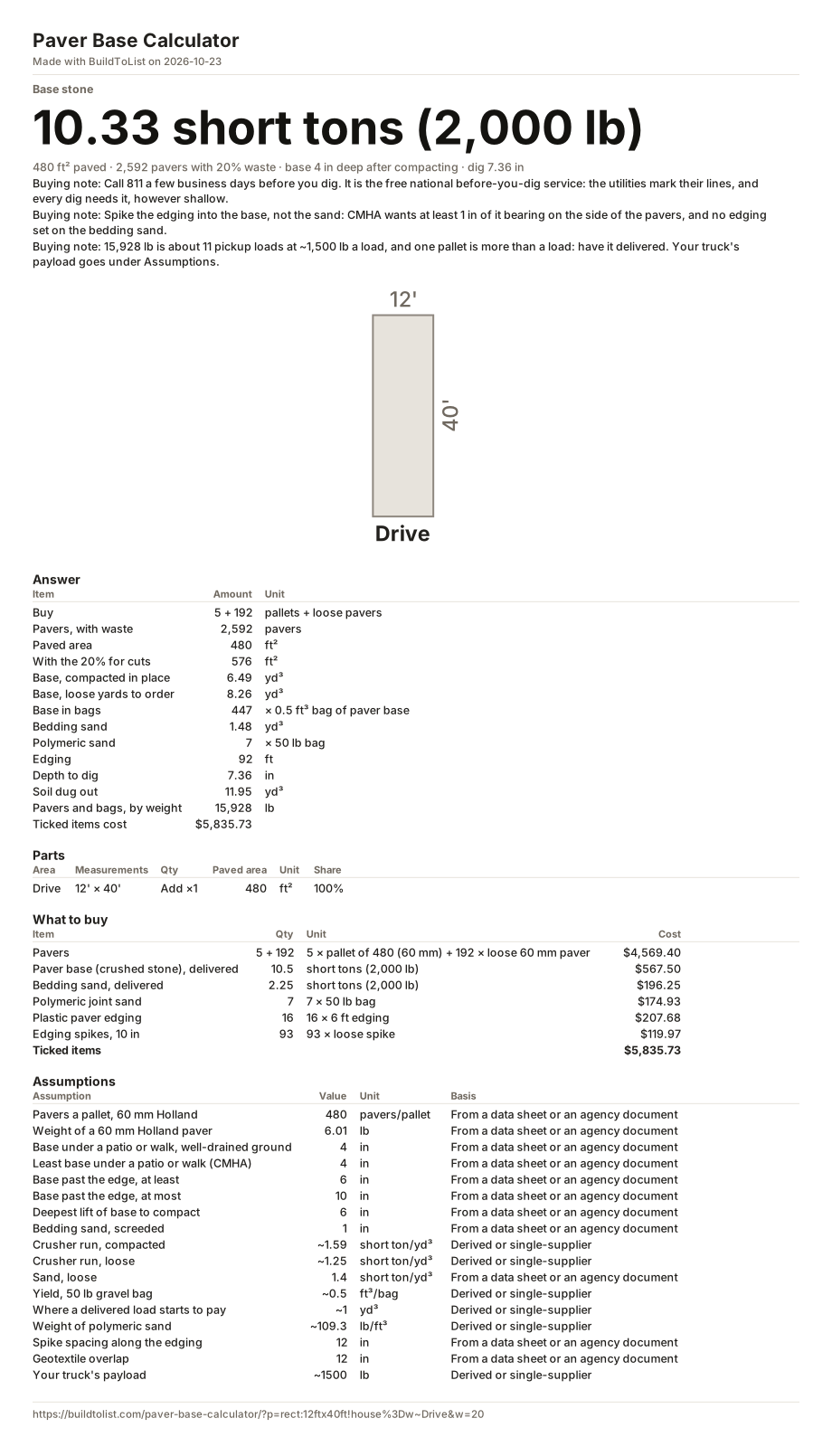
10.33 short tons (2,000 lb)

480 ft² paved · 2,592 pavers with 20% waste · base 4 in deep after compacting · dig 7.36 in

Buy 5 + 192 pallets + loose pavers
Pavers, with waste 2,592 pavers
Bedding sand 1.48 yd³
Polymeric sand 7 × 50 lb bag
Edging 92 ft
Depth to dig 7.36 in
Ticked items cost $5,835.73
More numbers
Paved area 480 ft²
With the 20% for cuts 576 ft²
Base, compacted in place 6.49 yd³
Base, loose yards to order 8.26 yd³
Base in bags 447 × 0.5 ft³ bag of paver base
Soil dug out 11.95 yd³
Pavers and bags, by weight 15,928 lb
DrawingThe project drawn to scale. Drive: 12' × 40'.12'40'Drive

Breakdown

Area Measurements Qty Paved area Share
Drive 12' × 40' Add ×1 480 ft²

What to buy

Buying noteCall 811 a few business days before you dig. It is the free national before-you-dig service: the utilities mark their lines, and every dig needs it, however shallow.
Buying noteSpike the edging into the base, not the sand: CMHA wants at least 1 in of it bearing on the side of the pavers, and no edging set on the bedding sand.
Buying note15,928 lb is about 11 pickup loads at ~1,500 lb a load, and one pallet is more than a load: have it delivered. Your truck's payload goes under Assumptions.

Pallets or loose pavers

A pallet is a count of pavers, set under Assumptions. Each way is priced; pick the one you will buy.

6 × pallet of 480 (60 mm) Pavers 2,880 Left over 288 pavers Weight 17,309 lb Cost $5,034.00 Reference price $839.00. Type your store's.
5 × pallet of 480 (60 mm) + 192 × loose 60 mm paver Pavers 2,592 Left over 0 pavers Weight 15,578 lb Cost $4,569.40
2,592 × loose 60 mm paver Pavers 2,592 Left over 0 pavers Weight 15,578 lb Cost $5,054.40 Reference price $1.95. Type your store's.

Shopping list

5 + 192 5 × pallet of 480 (60 mm) + 192 × loose 60 mm paver $4,569.40
10.5 short tons (2,000 lb) $567.50 Reference price $6.25. Type your store's. Reference price $45.00. Type your store's. Reference price $95.00. Type your store's.
2.25 short tons (2,000 lb) $196.25 Reference price $6.29. Type your store's.
7 7 × 50 lb bag $174.93 Reference price $24.99. Type your store's.
16 16 × 6 ft edging $207.68 Reference price $12.98. Type your store's.
93 93 × loose spike $119.97 Reference price $175.26. Type your store's. Reference price $1.29. Type your store's.
4 rolls $96.00 Reference price $0.12. Type your store's.
Ticked items $5,835.73

Untick what you already have. The pavers are priced in the table above; each bag, the stone by the short ton (2,000 lb) and the delivery beside their rows. The geotextile starts ticked on clay only.

Save imageExcel
How this was worked out

Every number below is yours. Each constant links to the row where you can change it.

The layers, in sectionThe layers from the top: Pavers 2.36 in, Bedding sand 1 in, Base, compacted 4 in. Dig to 7.36 in; the base reaches 6 in past the free edge, under the edging.Pavers 2.36 inBedding sand 1 inBase, compacted 4 inDig 7.36 in6 in past the edge
Drive 12' × 40' 480 ft²
With the waste for cuts 480 ft² × (1 + 20%) 576 ft²
One paver, joint included 4 in × 8 in ÷ 144 in²/ft² 0.22222 ft²
Pavers 576 ft² ÷ 0.22222 ft² 2,592 pavers
Whole pallets 2,592 pavers ÷ 480 a pallet 5.4 → 6 pallets

Change:Pavers a pallet, 60 mm Holland

Weight of the pavers 2,592 pavers × 6.01 lb 15,578 lb

Change:Weight of a 60 mm Holland paver

Edge to restrain 104 ft − 12 ft 92 ft
Base past the edge 92 ft × 6 in ÷ 12 in/ft 46 ft²

Change:Base past the edge, at leastBase past the edge, at most

Base footprint 480 ft² + 46 ft² 526 ft²
Base, compacted 526 ft² × 4 in ÷ 12 in/ft ÷ 27 ft³/yd³ 6.49 yd³

Change:Base under a patio or walk, well-drained ground

Base, weighed 6.49 yd³ × 1.59 short tons/yd³ 10.33 short tons (2,000 lb)

Change:Crusher run, compacted

Base, loose 10.33 short tons (2,000 lb) ÷ 1.25 short tons/yd³ 8.26 yd³

Change:Crusher run, loose

Base, bought 10.33 short tons (2,000 lb), ordered to the next 0.25 10.5 short tons (2,000 lb)

Change:Yield, 50 lb gravel bag

Bedding sand 480 ft² × 1 in ÷ 12 in/ft ÷ 27 ft³/yd³ 1.48 yd³

Change:Bedding sand, screededSand, loose

Bedding sand, bought 2.07 short tons (2,000 lb), ordered to the next 0.25 2.25 short tons (2,000 lb)

Change:Yield, 50 lb gravel bag

Joint, a share of the surface (4 in × 8 in − 3.937 in × 7.874 in) ÷ (4 in × 8 in) 3.12%
Polymeric sand 480 ft² × 0.03125 × 2.36 in ÷ 12 in/ft × 109.3 lb/ft³ 323 lb → 7 × 50 lb bag

Change:Weight of polymeric sand

Edging 92 ft 16 × 6 ft edging
Spikes 92 ft × 12 in/ft ÷ 12 in + 1 93 spikes → 93 × loose spike

Change:Spike spacing along the edging

Depth to dig 4 in + 1 in + 2.36 in 7.36 in
Soil dug out 526 ft² × 7.36 in ÷ 12 in/ft ÷ 27 ft³/yd³ 11.95 yd³
What it comes to 5 × $839.00 + 192 × $1.95 + 10.5 short tons (2,000 lb) × $45.00 + $95.00 + 2.25 short tons (2,000 lb) × $45.00 + $95.00 + 7 × $24.99 + 16 × $12.98 + 93 × $1.29 $5,835.73

Assumptions

Every one of these is editable. Change one and the answer changes with it.

Assumption Value Confidence
Pavers a pallet, 60 mm HollandPavestone Holland 60mm data sheet (Quikrete, 2025): 480 units a pallet, 2,884 lb. Its 103 ft² a pallet is the pavers' faces alone, 480 × 3.94 × 7.87 in; laid at the 4 by 8 in module a pallet covers 106.7 ft². pavers/pallet From a data sheet or an agency document
Weight of a 60 mm Holland paverPavestone Holland 60mm data sheet: a 2,884 lb pallet of 480 units, 6.01 lb each. Unilock gives 6 lb for its 60 mm Hollandstone. lb From a data sheet or an agency document
Base under a patio or walk, well-drained groundCMHA PAV-TEC-002-22 (Revised 2022): sidewalks, patios and pedestrian areas, a minimum base of 4 in after compaction over well-drained soils. in From a data sheet or an agency document
Least base under a patio or walk (CMHA)CMHA PAV-TEC-002-22: the least compacted base for a patio or walk on well-drained soil. The page warns under it. in From a data sheet or an agency document
Base past the edge, at leastICPI Construction Tolerances (Rev Feb 2020, now CMHA PAV-MAN-006-20), base extension table: a base up to 6 in thick extends 6 in; from 6 to 10 in, as far as it is thick. CMHA PAV-TEC-003-22: at least the base's own thickness. in From a data sheet or an agency document
Base past the edge, at mostICPI Construction Tolerances, same table: a base of 10 to 20 in extends 10 in. Between 6 and 10 in it extends as far as it is thick. in From a data sheet or an agency document
Deepest lift of base to compactCMHA PAV-TEC-002-22: spread and compact the base in 4 to 6 in lifts with a 7,000 lbf reversible plate compactor, to 98% of standard Proctor density. in From a data sheet or an agency document
Bedding sand, screededCMHA PAV-TEC-002-22: bedding sand spread and screeded to an uncompacted nominal 1 in, concrete sand to ASTM C33. Never masonry sand or stone dust. in From a data sheet or an agency document
Crusher run, compactedMoDOT's compacted crushed granite or limestone, used for crusher run and paver base: assumed to pack about this tight, as no figure for the graded product was found. ~ short ton/yd³ Derived or single-supplier
Crusher run, looseMoDOT's loose crushed granite or limestone, used for crusher run and paver base: the same rock with its fines left in. No figure found for the graded product itself. ~ short ton/yd³ Derived or single-supplier
Sand, looseMinnesota PCA stormwater material conversions: clean sand about 1.4 short tons per yd³. MoDOT's loose sand, 97-110 lb/ft³, agrees. short ton/yd³ From a data sheet or an agency document
Yield, 50 lb gravel bag0.5 ft³ per 50 lb bag. Sand, which the sand page buys in the same bag: Sakrete Play Sand (data sheet REV 3-10) and Sakrete's commercial sands (Rev. 06/16) yield 0.5 ft³, Quikrete Premium Play Sand is labeled 'approx 1/2 cu. ft.'; mason sand runs larger, 0.6 ft³ (Sakrete, Rev. 04/16). Gravel: Quikrete All-Purpose Gravel as retailers list it. ~ ft³/bag Derived or single-supplier
Where a delivered load starts to payAbout where bags stop making sense: 54 bags of 0.5 ft³, some 2,700 lb. Chosen, not sourced. ~ yd³ Derived or single-supplier
Weight of polymeric sandAlliance Gator's sand calculator (modified 10/3/2025) holds a 50 lb (22.7 kg) bag of Gator Supersand G2 as 0.01295 m³: 109.3 lb/ft³. Gator's chart gives a 50 lb bag 65-85 ft² of 2 3/8 in pavers with narrow joints; at a Holland stone's joint this is 75 ft². ~ lb/ft³ Derived or single-supplier
Spike spacing along the edgingSnap Edge specification: 10 in spikes 12 in apart is preferred to longer spikes 18 or 24 in apart. ProFlex: a spike at each end of a piece and at most 18 in apart. CMHA PAV-TEC-003-22 leaves spacing to the maker. in From a data sheet or an agency document
Geotextile overlapCMHA PAV-TEC-002-22: geotextile under the base, used over clay and moist silty soils, overlaps at least 12 in down the slope and turns up the sides of the excavation. in From a data sheet or an agency document
Your truck's payloadFull-size (1500-series) pickups advertise 2,260-2,440 lb of payload (2026), and ordinary trims carry 600-700 lb less; this is the low end. Your truck's figure is on the driver's door-jamb placard. ~ lb Derived or single-supplier

How much base goes under pavers

The base under the 12 by 20 foot patio this page opens with is 4 inches of crushed stone after compaction, reaching 6 inches past each free edge: 262 square feet of footprint, 5.14 short tons (2,000 lb) of stone, ordered as 5.25, to the next quarter of a short ton. In place that is 3.23 cubic yards; loose, as a loader scoops it, 4.11 cubic yards; in 0.5 cubic foot bags, 223 of them — which is why it is delivered.

How thick, and why the figures differ

The thickness turns on two things: what the pavement carries, and what it sits on. CMHA's figures are the least for well-drained soil; Unilock, a paver maker, gives deeper bases where the ground is clay or recently filled:

GroundPatio or walkDriveway
Well-drained (CMHA)4 in6 in
Clay or silt (Unilock)8 in12 in
Recently filled (Unilock)8 in12 in

Unilock goes deeper even on good ground — 6 to 8 inches for a patio and 10 for a drive in established neighborhoods. CMHA's 4 and 6 are minimums, and every depth is a box under Assumptions. Compact it in lifts of 4 to 6 inches, each to 98% of standard Proctor density, so an 8 inch base is two lifts.

Compacted once, not twice

The depth is the depth after compaction. The page weighs that volume at the compacted density, 1.59 short tons a cubic yard, and orders it loose at that weight over the loose density, 1.25. A popular base calculator adds 20% "for compaction" on top of a figure that is already compacted, and orders a fifth too much stone. The two densities are MoDOT's for crushed stone, the same figures the gravel pages use.

Past the edge

The base reaches past every edge that has edging, so the edging is spiked into stone. CMHA's rule of thumb is at least the base's own thickness; ICPI's tolerance guide puts it at 6 inches for a base up to 6 inches deep, as deep as the base from 6 to 10, and 10 inches beyond that. Against the house there is no band: mark that side on the part's card.

On clay CMHA lays geotextile under the base, overlapped 12 inches; the page ticks that row on clay. We are not connected with any maker or supplier named here.