Find a tool

Linear Feet to Board Feet

A run of lumber in; the board feet in it, and in every foot, out.

Counts board feet by PS 20's nominal sizes; your yard's prices win.

Board 1

2" · 8/4 · 2 in · 0.1667 ft · 0.0508 m

6" · 6 in · 0.5 ft · 0.1524 m

100' · 1200 in · 100 ft · 30.48 m

100 board feet

Knots, checks and saw cuts: 10–15% is usual for surfaced stock; rough hardwood for furniture runs 25–30% (McIlvain). Added once, to what you buy.

Your yard's price; the answer says it in the other three units.

This page recalculates as you type. There is no Calculate button.

Answer

Save imageExcel

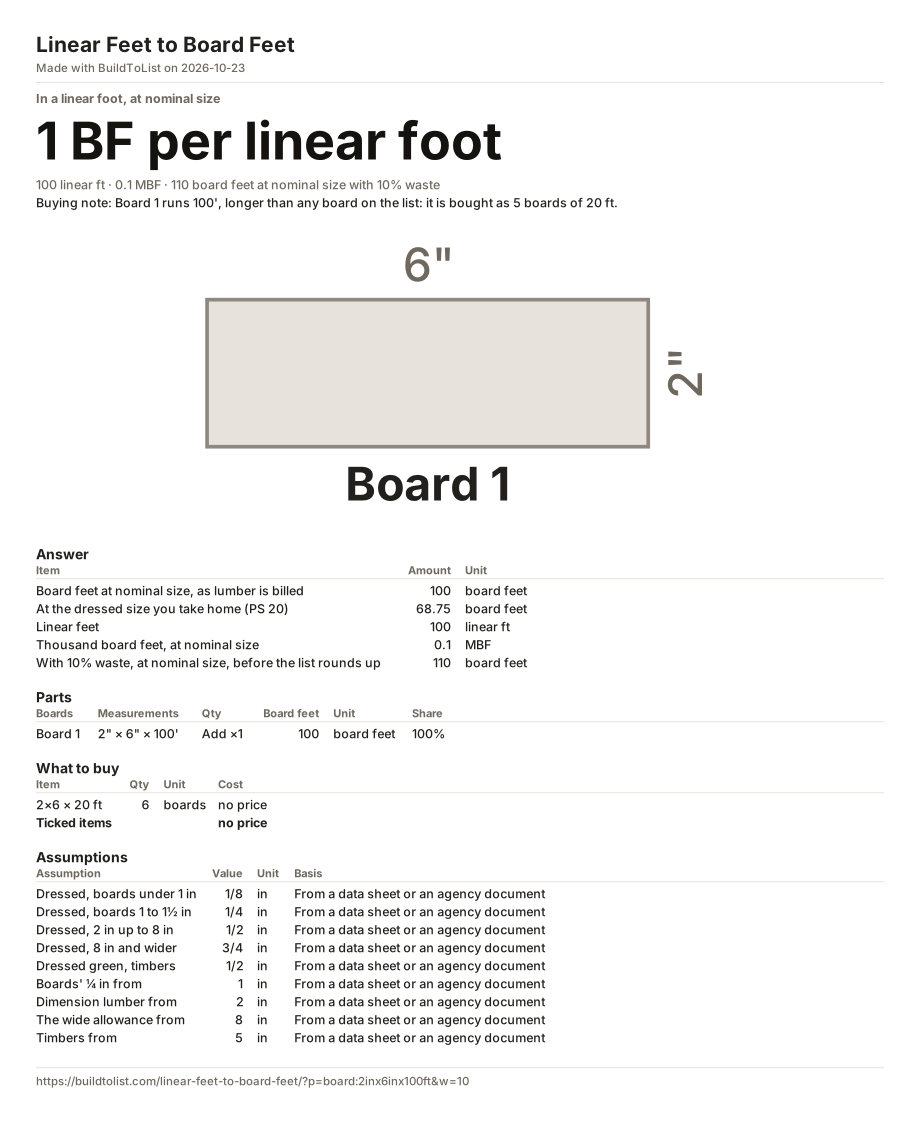
In a linear foot, at nominal size

1 BF per linear foot

100 linear ft · 0.1 MBF · 110 board feet at nominal size with 10% waste

Board feet at nominal size, as lumber is billed 100 board feet
At the dressed size you take home (PS 20) 68.75 board feet
Linear feet 100 linear ft
Thousand board feet, at nominal size 0.1 MBF
With 10% waste, at nominal size, before the list rounds up 110 board feet
DrawingThe project drawn to scale. Board 1: 6" × 2".6"2"Board 1

Breakdown

Boards Measurements Qty Board feet Share
Board 1 2" × 6" × 100' Add ×1 100 board feet

What to buy

Buying noteBoard 1 runs 100', longer than any board on the list: it is bought as 5 boards of 20 ft.

Shopping list

6 boards no price
Ticked items no price

Softwood is sold by the board, at the shortest length on the list that holds yours; hardwood by the board foot. Untick what you have.

Save imageExcel
How this was worked out

Every number below is yours. Each constant links to the row where you can change it.

Board 1: board feet 2" × 6" × 1200" ÷ 144 × 1 100 BF
Board 1: dressed size (PS 20) 2" − 1/2" = 1 1/2" · 6" − 1/2" = 5 1/2" 1 1/2" × 5 1/2"

Change:Dressed, 2 in up to 8 in

Board 1: board feet at that size 1 1/2" × 5 1/2" × 1200" ÷ 144 × 1 68.75 BF
Board 1: a linear foot 2" × 6" ÷ 12 1 BF/ft
Thousand board feet 100 ÷ 1,000 0.1 MBF
Waste 100 BF × (1 + 10%) 110 BF

Assumptions

Every one of these is editable. Change one and the answer changes with it.

Assumption Value Confidence
Dressed, boards under 1 inNIST PS 20-20, Table 3 (p. 16): a board ¾ in nominal is dressed dry to ⅝ in. This is the ¾ in board's figure, used for every board under 1 in; PS 20 dresses the ⅜, ½ and ⅝ in boards 1/16 in under, which this does not model. in From a data sheet or an agency document
Dressed, boards 1 to 1½ inNIST PS 20-20, Table 3 (p. 16): a board from 1 in and under 2 in nominal is dressed dry ¼ in under it - 1 to ¾, 1¼ to 1, 1½ to 1¼. in From a data sheet or an agency document
Dressed, 2 in up to 8 inNIST PS 20-20, Table 3: from 2 in nominal and under 8 in wide, lumber is dressed dry ½ in under it - 2 to 1½, 4 to 3½, 6 to 5½. in From a data sheet or an agency document
Dressed, 8 in and widerNIST PS 20-20, Table 3: 8 in nominal and wider is dressed dry ¾ in under it - 8 to 7¼, 10 to 9¼, 12 to 11¼. in From a data sheet or an agency document
Dressed green, timbersNIST PS 20-20, Table 3: timbers, 5 in nominal and thicker, are dressed green ½ in under nominal on both faces - 6×6 to 5½ × 5½, 8×8 to 7½ × 7½. Timbers are sold green; dried, 7 in and up loses more. in From a data sheet or an agency document
Boards' ¼ in fromNIST PS 20-20, Table 3: from 1 in nominal a board is dressed ¼ in under; thinner boards less. in From a data sheet or an agency document
Dimension lumber fromNIST PS 20-20: dimension lumber starts at 2 in nominal thickness; boards are thinner. in From a data sheet or an agency document
The wide allowance fromNIST PS 20-20, Table 3: the dressed allowance goes from ½ in to ¾ in at 8 in nominal width. in From a data sheet or an agency document
Timbers fromNIST PS 20-20: timbers are lumber 5 in nominal and thicker in the least dimension. in From a data sheet or an agency document

Linear feet to board feet

Multiply the linear feet by the thickness and the width in inches, and divide by 12. A 2×6 is 2 × 6 ÷ 12 = 1 board foot (BF) in every linear foot, so 100 linear feet of 2×6 is 100 board feet. A 1×6 is half a board foot a foot; a 2×12, two.

Lumber Board feet a linear foot
1×40.333
1×60.5
1×80.667
1×121
2×40.667
2×61
2×81.333
2×101.667
2×122
4×41.333
6×63

Type the whole run into the length box — 100 for 100 ft — or one board's length and the number of boards beside it. Both come to the same board feet.

These are nominal sizes, the ones a yard bills by. The 2×6 is really 1½ in by 5½ in, so the same 100 linear feet hold 68.75 board feet of wood. The answer prints both.

Buying a run

No yard sells a 100 ft board. The list buys the run in the longest boards it holds, 20 ft: five of them, and six once 10% for cuts and defects is on. Shorter pieces add joints; the list does not plan the cuts, it counts the boards.

A price per linear foot works the same way backwards: choose "per linear foot" under "The price is", and the answer says what that is per board foot and per board.