How many board feet are in a log
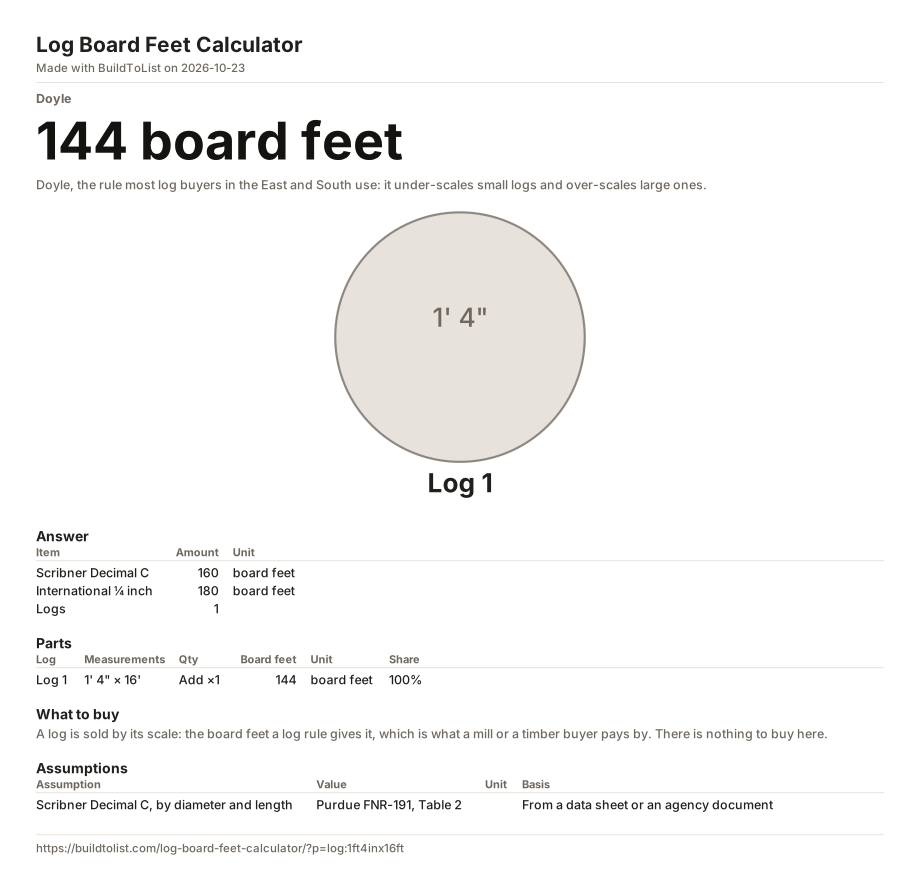
It depends on the log rule, and a mill or a timber buyer will tell you which one they pay by. Measure the small end inside the bark, across in two directions and averaged, and the length with a tape. A log 16 inches across the small end and 16 feet long scales 144 board feet by Doyle, 160 by Scribner Decimal C and 180 by International ¼ inch — the same log, three numbers, and the page prints all three, the rule you pick largest.
Doyle is (D − 4)² × L ÷ 16: take 4 inches off the diameter for slabs and edgings, square it, and scale by the 16 foot log — (16 − 4)² = 144. Purdue's FNR-191 calls it the most widely used rule, especially on private timber in the East and South, and says it seriously under-scales small logs and over-scales large ones. International ¼ inch is a formula too; the page uses Grosenbaugh's version of it for any length from 4 to 20 feet and rounds to the nearest 5 board feet, as the rule does. Scribner Decimal C is a diagram rule — its numbers were drawn, not computed — so the page reads it from FNR-191's table, in tens of board feet.
| 16 ft log | Doyle | Scribner | Int'l ¼ |
|---|---|---|---|
| 12 in | 64 | 80 | 95 |
| 16 in | 144 | 160 | 180 |
| 20 in | 256 | 280 | 290 |
| 24 in | 400 | 400 | 425 |
| 30 in | 676 | 660 | 675 |
Whole inches and whole feet
The page scales a log at the whole inch and the whole foot below what you measure: 15.9 inches is a 15 inch log, and a log just short of 17 feet is a 16 foot one, the way FNR-191 says lumber from it is tallied. The working under the answer shows the measure taken down before each rule.
Off the table
The Scribner table runs from 6 to 40 inches and from 6 to 18 feet and 20 feet; its 39 inch row is blank in the source. A log the table has no number for is left out of the Scribner total and named in its card — the page never reads the nearest cell. International covers 4 to 20 feet: a longer log is scaled as two logs or more, so type it as two. Several logs of one size are one card with a count.
A log rule estimates the lumber a log will saw out; the mill's overrun or underrun is theirs. We are not connected with any mill or timber buyer.