How much grout a tile job takes
Grout fills the joints, so the amount is the volume of the joints — and that is a shape, not a lookup. A joint runs round every tile, as wide as the spacer and as deep as the tile is thick. Work out the volume in one square foot and the whole floor is a multiplication.
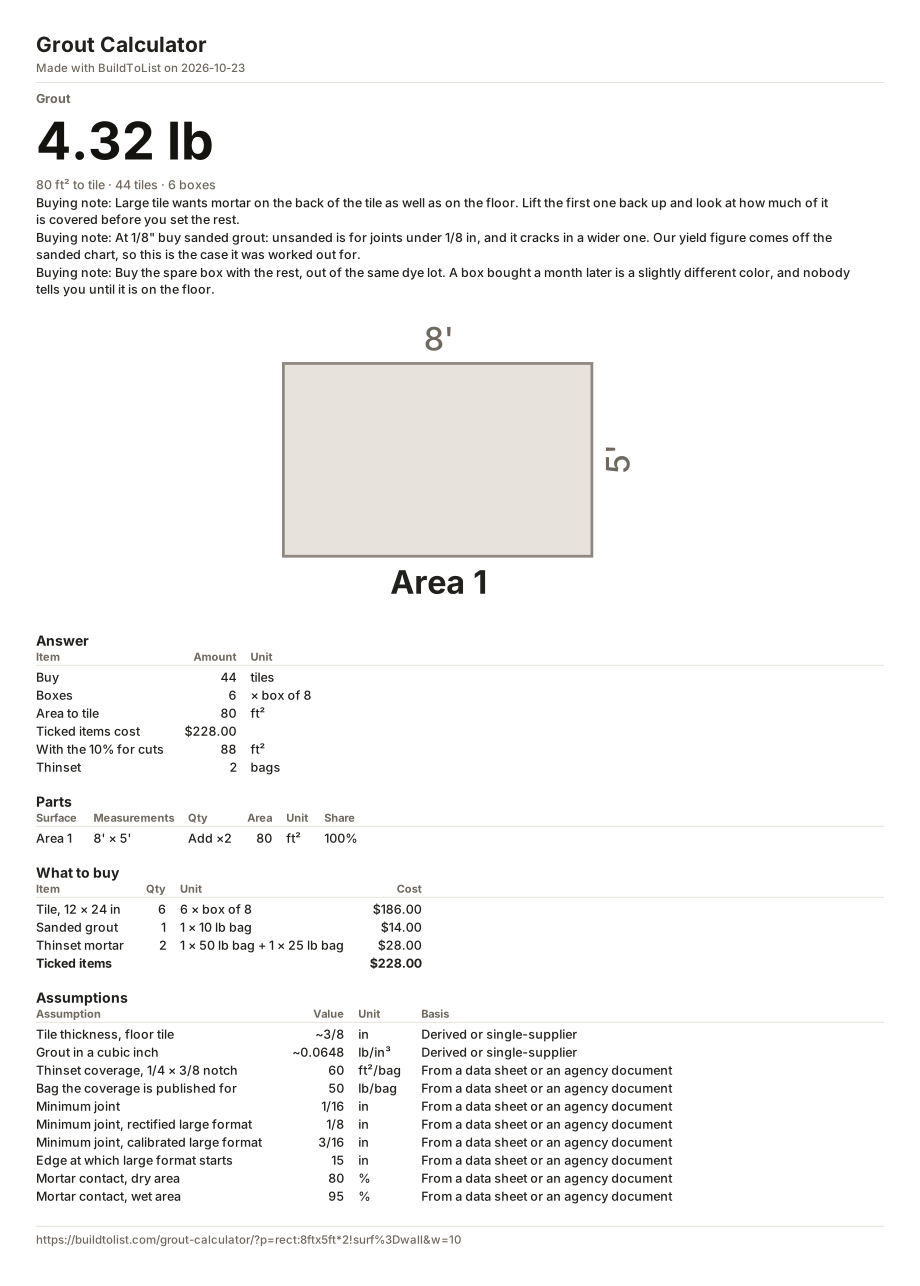
For the 10 by 12 foot floor this page opens with, in 12 by 24 inch tile at 1/8 inch joints and 3/8 inch thick: 0.834 cubic inches of joint per square foot, which is 100 cubic inches over 120 square feet, or 6.5 pounds of grout. That is one small bag with a third of it left.
Where the formula comes from
Custom Building Products publish a coverage chart for Polyblend Plus: tile size down the side, joint width across, square feet a bag in the cells. It is a good chart and it has the same problem every chart has — your tile is between two rows, or off the end of them.
So we worked backwards out of thirty of its cells. At every tile 12 inches and over, the chart implies between 384 and 390 cubic inches of joint per 25 pound bag. Taking 386 puts this floor at 6.5 pounds, which is exactly what the chart's own cell says: 0.26 of a bag. The formula lands inside 1% of the chart across its whole large-format range, and then keeps working at sizes the chart does not list.
It runs over at the small end. A 2 by 2 inch mosaic has a great deal of joint for its area, and there our figure is about 20% above the chart's. The page says so on the tile where it happens, and it errs upward on purpose: a bag too many is an afternoon saved.
Sanded or unsanded
| Joint | Which grout |
|---|---|
| Under 1/8 in | Unsanded |
| 1/8 to 1/2 in | Sanded |
Polyblend's own split. Unsanded grout in a wide joint shrinks and cracks; sanded grout in a narrow one will not pack in, and it can scratch a polished glaze. The page picks the one your joint calls for and names it on the shopping list. Our yield figure comes off the sanded chart, which is the nearest published number there is for either.
What changes the answer most
The joint, by a long way. Take the same floor from 1/8 inch joints to 1/4 inch and the grout roughly doubles, because the joint gets wider and the volume goes with it. Tile thickness is the other half: the same joint around a 1/4 inch mosaic holds two thirds of what it holds around a 3/8 inch porcelain. Both are boxes in the assumptions below, so if you have the box in front of you, type what it says.
Custom's own technical bulletin makes the point sharply: a change in joint width alone moves grout usage by about 25%. That is why this page asks for the joint rather than assuming one.