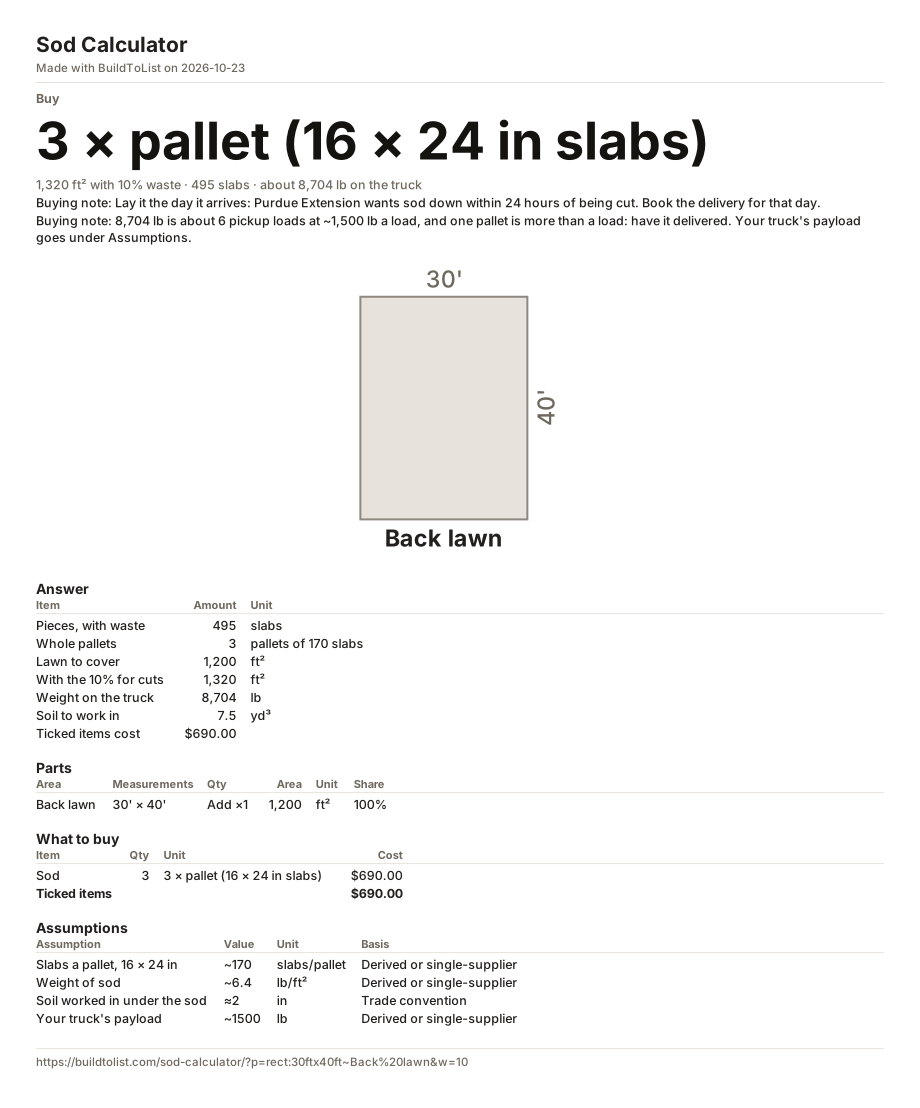
How much sod you need
Measure the lawn, take out what is not lawn, add 10% for the cuts, and divide by the piece your farm cuts. The yard this page opens with is two lawns, 30 by 40 feet and 50 by 35 feet, with a 12 by 16 foot patio taken out: 1,200 + 1,750 − 192 = 2,758 square feet. With 10% for the cuts that is 3,033.8 square feet, and a 16 by 24 inch slab covers 2.667 square feet, so the lawn takes 1,138 slabs: seven pallets.
Purdue Extension's guide to laying sod says to order about 10 percent more than the lawn measures, for the pieces cut at corners and edges and for errors in measuring. A popular sod calculator adds nothing: its own example, 0.13 acre in 10 square foot rolls, comes to 567 rolls, which is the lawn with no cut piece anywhere. The same lawn here is 623 rolls. The waste is one box, 10% to start, and it goes on the sod only — the soil under the lawn is the size of the ground, however the sod is cut.
Whole pallets, or pallets and loose pieces
A sod farm stacks a pallet by count, not by area: 170 slabs of 16 by 24 inches is 453 square feet, and Purdue and The Grass Outlet both put a pallet at about 450. The 1,138 slabs are 6.69 pallets, and there are two ways to buy the last 0.69:
| Buy | Slabs | Left over | At the reference prices |
|---|---|---|---|
| 7 whole pallets | 1,190 | 52 slabs | $1,610.00 |
| 6 pallets + 118 loose slabs | 1,138 | none | $1,731.64 |
| 1,138 loose slabs | 1,138 | none | $3,391.24 |
A loose slab costs more than a slab off a pallet, so the seventh pallet is $121.64 cheaper than the 118 loose slabs it replaces, and the 52 over are your spares. Buying the rest loose pays only when the last pallet would be mostly left over. The table on this page works all three ways at your prices and picks the cheapest — or whole pallets, when they cost within 2% of the mix, because one item at the counter is worth that much. The pallet price is The Grass Outlet's for St. Augustine; the loose price is our estimate. Type your farm's.
Slabs or rolls
Southern grasses — St. Augustine, Bermuda, Zoysia — mostly come as 16 by 24 inch slabs. Purdue describes slabs of 18 by 24 inches and rolls 18 inches by 6 feet or 2 by 5 feet, and The Grass Outlet sells hand rolls of about 18 by 40 inches. The cut select changes the piece and how many make a pallet; every count a pallet holds is under Assumptions, and the number on your farm's ticket beats ours.
What it weighs
More than any pickup carries. The Grass Outlet puts a 450 square foot pallet at 2,800 to 3,000 pounds; Purdue gives 35 to 40 pounds a square yard for thinner-cut sod, about 1,900 pounds a pallet. The page uses 6.4 pounds a square foot, the heavier figure, because it is the one that decides the truck: seven pallets are about 20,309 pounds, over ten short tons (2,000 lb). Have it delivered, be there when it comes, and say where the pallets can be set down.
Lay it the day it arrives. Purdue wants sod down within 24 hours of being cut, and Penn State Extension says it spoils in 24 to 48 hours in warm weather; anything you cannot lay that day goes grass side up in the shade, unrolled and watered.
The soil under it
Penn State works a 1 to 2 inch layer of compost or peat into the top 4 to 6 inches before sodding. At 2 inches this yard takes 17.02 cubic yards, ordered as 17.25. That row starts unticked: a soil test says whether your ground needs it, and the next link works the soil on its own.
Slopes
Mark a steep area on its card and the page adds sod staples: two a piece, pinned at both ends on the high side, as Purdue describes. Lay a slope from the bottom up with the strips running across it. We are not connected with any farm, store or supplier named here.