Find a tool

Backsplash Tile Calculator

An 18 inch band behind the counter, counted tile by tile.

An estimate of quantities — outlets and window reveals are yours to take off.

Area 1

4' · 48 in · 4 ft · 1.2192 m

12' · 144 in · 12 ft · 3.6576 m

48 ft²

Inch Calculator advises about 10% for tile laid straight, which is where this starts; 15% for diagonal, and Alpine 10-15% for herringbone. Mullican advises 5% for wood laid straight. It is added once, to whatever gets cut — the tiles or the planks, and the baseboard. A grout or mortar figure, where the page has one, is worked out on the surface as laid.

This page recalculates as you type. There is no Calculate button.

Answer

Save imageExcel

Buy

398 tiles

48 ft² to tile · 398 tiles · 4 boxes

Boxes 4 × box of 100
Area to tile 48 ft²
Ticked items cost $143.00
More numbers
With the 10% for cuts 52.8 ft²
Grout 8.34 lb
Thinset 1 bags
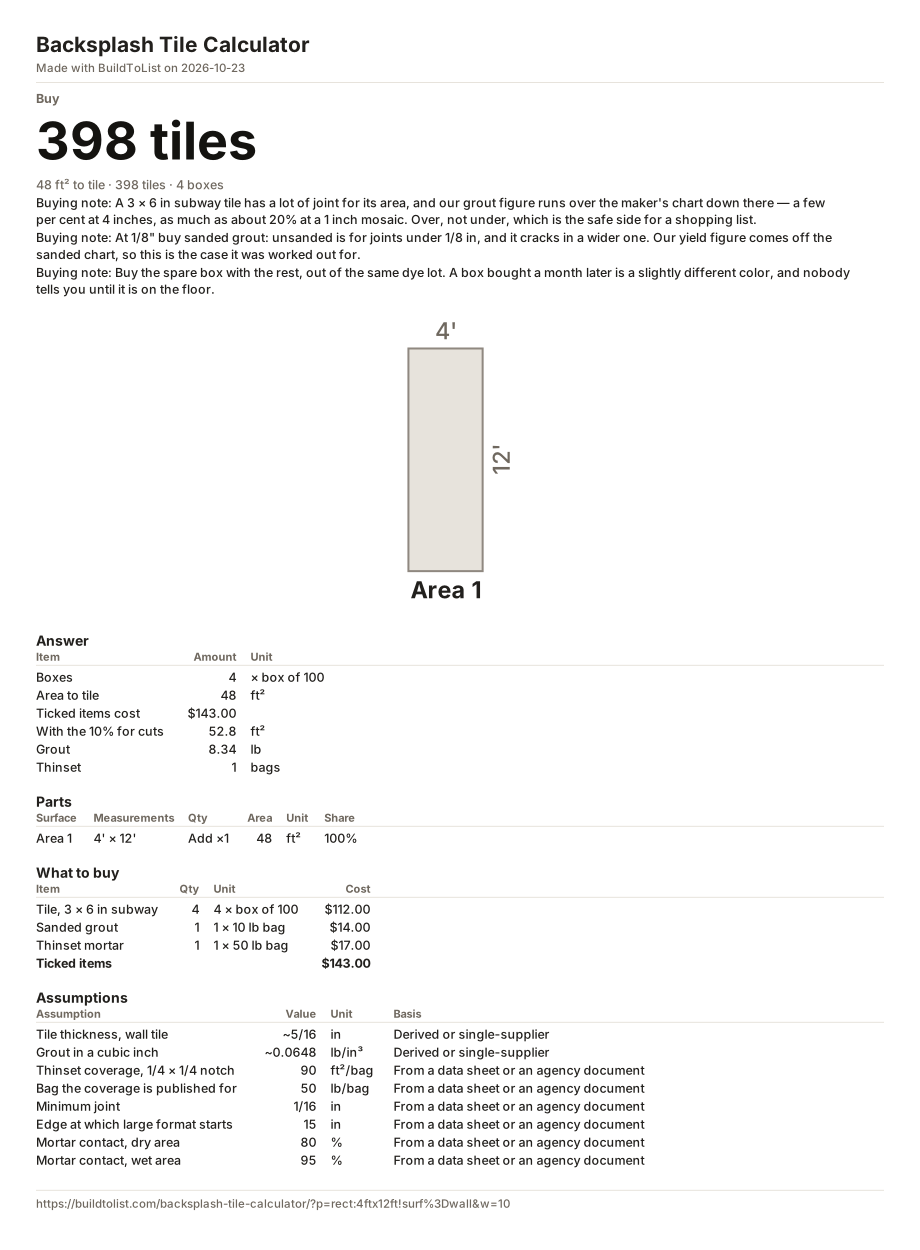
DrawingThe project drawn to scale. Area 1: 4' × 12'.4'12'Area 1

Breakdown

Surface Measurements Qty Area Share
Area 1 4' × 12' Add ×1 48 ft²

What to buy

Buying noteA 3 × 6 in subway tile has a lot of joint for its area, and our grout figure runs over the maker's chart down there — a few per cent at 4 inches, as much as about 20% at a 1 inch mosaic. Over, not under, which is the safe side for a shopping list.
Buying noteAt 1/8" buy sanded grout: unsanded is for joints under 1/8 in, and it cracks in a wider one. Our yield figure comes off the sanded chart, so this is the case it was worked out for.
Buying noteBuy the spare box with the rest, out of the same dye lot. A box bought a month later is a slightly different color, and nobody tells you until it is on the floor.

Shopping list

4 4 × box of 100 $112.00 Reference price $23.50. Type your store's. Reference price $31.00. Type your store's. Reference price $29.50. Type your store's. Reference price $30.00. Type your store's. Reference price $33.00. Type your store's. Reference price $28.00. Type your store's. Reference price $26.00. Type your store's. Reference price $42.00. Type your store's.
1 1 × 10 lb bag $14.00 Reference price $24.00. Type your store's. Reference price $14.00. Type your store's.
1 1 × 50 lb bag $17.00 Reference price $17.00. Type your store's. Reference price $11.00. Type your store's.
Ticked items $143.00

Untick what you already have. Each row has its price beside it — type what your store charges.

Save imageExcel

Standards

We hold the criteria and the clause, not the wording of the standard.

Not checked ANSI A108.02 · minimum joint width, as CTEF reads §4.3.8

A 1/8" joint clears the 1/16" minimum, which is as far as a measurement gets. The clause also asks for three times how much the tiles vary across their faces — lay a few out dry and look before you commit to the spacers.

Not checked ANSI A108.02 · mortar contact, as CTEF reads A108.02

This project tiles a wall, so the standard asks for 95% of the back of each tile in contact with mortar, against 80% in a dry area. It is measured by lifting a set tile back off — nothing on this page can judge it.

How this was worked out

Every number below is yours. Each constant links to the row where you can change it.

Area 1 4' × 12' 48 ft²
With the waste for cuts 48 ft² × (1 + 10%) 52.8 ft²
One tile and its joint (3 in + 1/8") × (6 in + 1/8") ÷ 144 in²/ft² 0.1329 ft²
Tiles to buy 52.8 ft² ÷ 0.1329 ft² 398 tiles
Boxes to buy 398 tiles ÷ 100 tiles 4 × box of 100 · 2 tiles left over
Grout 48 ft² × 2.6816 in³/ft² (1/8" joints, 5/16" deep) × 0.0648 lb/in³ 8.34 lb → 1 × 10 lb bag

Change:Tile thickness, wall tileGrout in a cubic inch

Thinset 48 ft² ÷ 90 ft²/bag 1 bags → 1 × 50 lb bag

Change:Thinset coverage, 1/4 × 1/4 notchBag the coverage is published for

What it comes to 4 × $28.00 + 1 × $14.00 + 1 × $17.00 $143.00

Assumptions

Every one of these is editable. Change one and the answer changes with it.

Assumption Value Confidence
Tile thickness, wall tile5/16 in, glazed ceramic wall tile - subway and 4 1/4 in field tile, which are thinner than porcelain floor tile. Interpolated between the 3/8 in floor figure and the 1/4 in mosaic one rather than read off a data sheet. ~ in Derived or single-supplier
Grout in a cubic inch25 lb of grout fills about 386 in³ of joint, worked back out of 30 cells of Custom Building Products' Polyblend Plus Sanded coverage chart. A bag holds one volume whatever tile it goes into, so this is a density rather than a per-size figure. ~ lb/in³ Derived or single-supplier
Thinset coverage, 1/4 × 1/4 notchA 50 lb bag of VersaBond covers 90 to 100 ft² with a 1/4 × 1/4 in square-notch trowel (TDS-119). The low end is the figure here: the high end buys short. ft²/bag From a data sheet or an agency document
Bag the coverage is published forThe bag the coverage figures below are published for. Custom Building Products' TDS-119 states VersaBond coverage per 50 lb bag, so a 25 lb bag covers half as much: coverage scales with weight, and the page solves the order in pounds rather than in bags for that reason. lb/bag From a data sheet or an agency document
Minimum joint1/16 in, the smallest grout joint ANSI A108.02 allows, and never less than three times the tile's facial dimension variation. Read in the Ceramic Tile Education Foundation's article on the clause, not in the standard itself - ANSI charges for the text. in From a data sheet or an agency document
Edge at which large format starts15 in: above this edge length the minimum joint stops being 1/16 in and becomes 1/8 or 3/16 in depending on how the tile was made. A 12 x 24 is over it on one side, a 12 x 12 is not. in From a data sheet or an agency document
Mortar contact, dry area80% of the back of the tile has to be in contact with mortar in a dry area. It is measured by lifting a set tile back up, not by any number on this page, so the page says the figure rather than judging it. Held as a percentage because that is how it is read and how the box shows it. % From a data sheet or an agency document
Mortar contact, wet area95% mortar contact in a wet area - a shower, a tub surround - and outdoors. The higher figure is why a shower wall project is told a different sentence from a kitchen floor. Held as a percentage because that is how it is read and how the box shows it. % From a data sheet or an agency document

Tile for a kitchen backsplash

A backsplash is a band, so it is two measurements: how far up the wall it goes, and how far along. The usual band is 18 inches — the gap between a counter and the underside of the upper cabinets. Behind a range it often runs to the hood instead.

This page opens on an 18 inch band behind a 10 foot counter: 15 square feet, in 3 by 6 inch subway tile at 1/8 inch joints, which is 125 tiles and 2 boxes of 100.

Common bands

Band Per foot of counter
4 in — a splash lip only0.33 ft²
18 in — counter to cabinets1.5 ft²
30 in — counter to a hood2.5 ft²
Full heightmeasure it

What to take off, and what not to

Take off nothing for outlets. A backsplash has four or five of them and each one is a cut tile, not a saved one — the piece you cut out of goes in the bin, so the outlets cost you tile rather than saving it. The waste box covers them.

Do take off a window reveal if the band runs into one, as a part with the minus sign on it. And do measure each wall separately if the band changes height, which it usually does behind a range: add a part for each run.

It is a wall, and the page knows

The part opens marked as a wall rather than a floor, and two things follow from that. There is no baseboard row, because a backsplash has no skirting. And the mortar contact figure the standards panel states is the wet-area one, 95% rather than 80% — a backsplash behind a sink gets wet, and a tile with voids behind it is where water sits.

The grout and the thinset are worked out the same way they are on a floor. At 3 by 6 inches a backsplash has a great deal of joint for its area, so the grout figure here runs a little conservative: over, not under.